Introduction
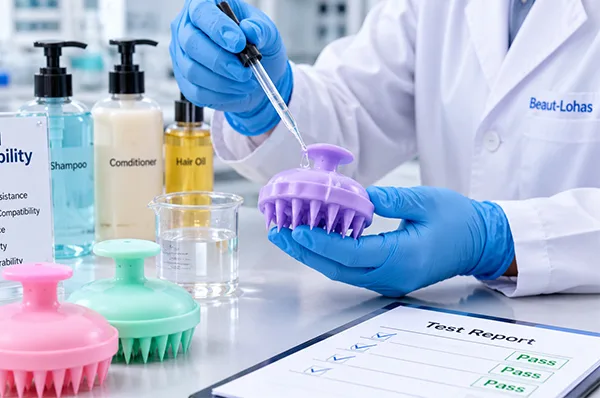
In personal care, silicone scalp brushes find application in shampooing, scalp cleansing, and massages. For cosmetic companies, professional product development is about more than just designing the scalp brush correctly. Silicone scalp brushes must pass chemical compatibility tests against common media including shampoos, conditioners, hair oils, hair styling products, water, and typical bathroom cleaners.
While a scalp brush might appear visually pleasing and soft to touch when coming out from production, constant exposure to cosmetic formulations might bring to light issues that would not be obvious at first glance. Silicone might get sticky, swollen, discolored, lose its initial hardness, or undergo surface alterations. Also, in some cases, there may be undesirable odors or lowered mechanical characteristics of the product.
It is why chemical compatibility testing is essential when talking about quality control of silicone scalp brushes.
What the manufacturer and product developer need to know is not just about silicone’s general resistance to chemicals. They should be aware whether silicone, pigment system, additives, and the product itself are chemically resistant under the required conditions of use.
This guide presents chemical compatibility tests that silicone scalp brushes must pass, how manufactures can conduct a practical testing program, and what buyers should look for in the silicone scalp brush supplier from other countries.
Short Answer: What Chemical Compatibility Tests Must Be Conducted on Silicone Scalp Brushes?
The scalp brush must be tested according to the actual conditions of its usage and the cosmetic products it will be exposed to.
Tests that may form a practical testing program:
- Resistant to shampoo and body washes.
- Resistance to conditioner and hair mask.
- Compatibility with hair oil and cosmetics oil.
- Resistance to surfactants and detergents.
- Testing for color stability and migration of pigments.
- Evaluation of surface tackiness and residues.
- Measurement of changes in hardness, dimensions, and weight.
- Mechanical properties testing after chemical exposure.
- Odor and visual evaluation.
- Accelerated aging tests and repeated usage tests.
These tests need to be chosen depending on the specific product formulation, design, target market, and application.
1. Importance of Chemical Compatibility for Silicone Scalp Brushes
Silicone is generally chosen for scalp brushes due to its flexibility, touch, and water resistance properties. But it is wrong to assume that all products made of silicone will exhibit similar chemical behavior regardless of the situation.
The different grades of silicone, curing process, pigments, fillers, and processing procedures may cause varying performance of the final material.
There can be a variety of substances used together with a scalp brush during its regular usage:
- Shampoos with surfactants and cleaning agents.
- Conditioners with oil, silicone, and conditioning ingredients.
- Hair masks with high concentrations of emollients.
- Essential oils and scalp treatment oils.
- Styling gels and creams.
- Bathroom cleansers and detergents for cleaning of the product itself.
The final product must be tested for compatibility with certain chemicals rather than simply referred to a chemical resistance chart for silicone.
1.1 Protection against Material Degradation
Contact with chemical products may influence the physical characteristics of an elastomer. According to the formulation and chemical conditions, possible changes may include swelling, softening, hardening, tackiness, or mechanical performance.
In the case of a scalp brush, these changes influence the bending and contacting capabilities of the bristles with the scalp.
For instance, the bristles may get noticeably softer after multiple contacts with a certain hair treatment oil; consequently, the massage effect may be reduced.
1.2 Product Appearance Preservation
Both color and surface characteristics matter when talking about beauty products.
Premium silicone scalp brush may come in such colors as pastel pink, lavender, beige, blue, or Pantone-matched colors. If the product gets stained, discolored, or acquires residue after coming into contact with shampoos and conditioners, the product quality may seem lower.
Chemical compatibility testing allows manufacturers to avoid these situations.
1.3 Product Longevity Tests
The scalp brush is usually meant to be reused several times rather than thrown away after single use.
The material can encounter warm water, cosmetic ingredients, abrasion, and drying process during a long time period. Testing can help understand whether the material can keep its properties during the actual use period.
It is especially important for B2B customers who create products for retail chains, professional salons, subscription boxes, and private label beauty lines.
2. Shampoo Resistance Test
Shampoo is one of the most crucial ingredients to be tested during a silicon scalp brush compatibility testing.
In contrast to sporadic exposure to a cosmetic product, shampoo usage is actually one of the key purposes of the brush.
2.1 What to Test?
Shampoo samples can be chosen in different varieties according to the target market and positioning:
- Regular shampoo for everyday use.
- Clarifying shampoo.
- Moisturizing shampoo.
- Anti-dandruff shampoo.
- Color protection shampoo.
- Sulfate-free shampoo.
These products will have various surfactants, fragrances, preservatives, pH regulators, and conditioning agents.
The test of only one type of standard shampoo will not reflect the diversity of the used products.
2.2 Test Suggestion
The internal screening test could be carried out according to the following scheme:
- Document the initial appearance, weight, dimension, and hardness of the silicone samples.
- Prepare shampoo solutions according to the test plan.
- Exposure of samples in the solution.
- Controlling the conditions of the exposure, which includes temperature and exposure time.
- Rinsing the samples if required.
- Drying the samples.
- Re-inspection of samples and their measurement.
- Comparison with the control samples without exposure.
The exposure time and concentration of the solution need to be documented and chosen properly to reflect realistic conditions of use or justified acceleration.
2.3 What Should Manufacturers Evaluate?
Following exposure, manufacturers should evaluate:
- If the silicone has gotten sticky.
- If the material has developed any visible residues.
- If there is a change in the color.
- If there is a change in the shape of the bristles.
- If the material has become too soft or too hard.
- If there is any peculiar odor in the material.
The success in this test implies that the formulation tested falls within the acceptance criteria of the product under the stipulated conditions. However, the success does not imply that the material is compatible with all shampoos.
3. Testing Conditioners and Hair-Masks Compatibility
Conditioners and hair masks need to be considered separately since the formulas for them can vary greatly from typical shampoos.
Conditioners typically contain oils, fatty alcohols, cationic conditioning agents, silicones, emulsifiers, and fragrances. Hair masks might have even more conditioning and emollients in their formulas.
The formula may result in some surface residues on the surface of a scalp brush, so it needs to be tested for material changes and cleanability.
3.1 Reasons to Test Conditioning Formulas
Scalp brushes are going to be used while applying conditioners and hair masks by the consumer.
In case if a surface residue becomes persistent, the brush will be harder to clean. Furthermore, some changes will be revealed only through extended exposure to the product.
3.2 Recommended Tests
After testing selected conditioners and hair masks, test:
- Stickiness of the surface.
- Ability to rinse out the residue.
- Any changes in color or gloss.
- Hardness and flexibility.
- Swelling or deformation of the surface.
- Odor persistence after cleaning.
It is recommended to evaluate gaps between bristles where cosmetic residues might accumulate.
For products with dense bristle arrangements, cleaning performance is an important part of the overall product evaluation.
4. Resistance to Hair Oil and Cosmetic Oils
Hair oils and scalp oils also comprise another category.
The consumer may use argan oil, coconut oil, jojoba oil, mineral oil derivatives, essential oil combinations, as well as commercial scalp treatments. The chemical formulas are different, and thus, producers cannot assume the results for any oil automatically apply to all other oils.
4.1 Reasons for Importance of Compatibility with Oil
Some silicones exhibit good resistance to a variety of substances; however, the compatibility is dependent on the exact formula and conditions of exposure.
The exposure to oil can affect the following characteristics:
- Weight of material.
- Dimensions of sample.
- Feel of surface.
- Hardness.
- Flexibility.
- Appearance and color.
In the case of scalp brushes, these parameters are important for the end user.
4.2 Oil Exposure Testing Recommendation
The test process may involve the selection of some representative oils, depending on the target customer base.
For example:
| Test medium | Reason for selection |
|---|---|
| Coconut oil | Common hair and scalp care ingredient |
| Jojoba oil | Frequently used in scalp and hair products |
| Argan oil | Common premium hair-care ingredient |
| Mineral oil | Representative cosmetic oil |
| Commercial scalp treatment oil | Relevant to the target product application |
It is necessary to document the type of oil, exposure temperature, time of exposure, method of sample preparation, and cleaning process.
Post-exposure, it is possible to compare the properties of the sample such as its weight, dimensions, hardness, color, and mechanical characteristics with those of the control sample.
4.3 Do Not Rely on General Chemical Resistance Charts Only
The chemical resistance charts can be used for initial selection of materials. But they do not provide sufficient basis for verification of chemical resistance of the actual silicone material and final product.
A chart will show the performance characteristics at normal temperatures, but a consumer may use the brush in warm water with concentrated hair care products.
In that case, actual tests will be more helpful if a brand uses its own specific formulation of shampoo, conditioner or hair oil for use with the product.
5. Testing Against Surfactant and Detergent Systems
Surfactants are extensively used in shampoos, body washes, and cleansing agents. They assist in removal of oils and dirt from hair and scalp.
Even though silicone is frequently chosen for products used in wet conditions, a manufacturer should test its products against particular surfactant systems.
5.1 Why Surfactant Testing is Important
Various cleansing products may have various surfactants and other ingredients.
Testing program may include representative cleansing liquids rather than only simple water contact.
This aspect becomes particularly important for the brushes designed for frequent hair washing or salon use.
5.2 What to Evaluate?
The major points to evaluate include:
- Visual appearance upon contact.
- Change in material hardness.
- Changes in sample size.
- Residue left upon rinsing.
- Flexibility and recovery of bristles.
- Possible change in odor.
Where necessary, manufacturers may compare results of different concentrations to determine the sensitivity of the product to concentrated cleansers.
The testing process should be performed under specific conditions of usage and not to be treated as universal industry requirement.
6. Color stability and color compatibility
Color is one of the ways how private label beauty products can be distinguished from other similar products.
The silicone scalp brush can be produced in various colors to fit the visual identity of the brand. However, the silicone material and its color combination must be assessed simultaneously.
6.1 What Can Lead to Problems with Color?
Among possible problems with color we can mention:
- Color fade under prolonged exposure.
- Inconsistency of coloring.
- Staining of the product surface.
- Color staining of the white cloth.
- Batch variations.
- Effects of the cleaning or cosmetic products on color.
Coloring can differ from the original one after exposure to oils, surfactants, or hair care products with color.
6.2 Recommended Color Stability Testing Protocol
Producers must make samples using real production silicone formula and pigment systems.
Samples will be exposed to selected cosmetic products and cleansing fluids.
Testing includes:
- Visual color difference.
- Staining effect on surface.
- Color migration while rubbing.
- Comparing exposed vs control samples.
- Reproducibility from several samples.
If exact color matching is required by the brand, instrumental color measurements are possible. Measurement protocol and acceptable tolerances must be established prior to the test.
This is especially relevant for OEM & ODM projects using custom Pantone colors.
7. Testing for Surface Tackiness and Residue
Tackiness is one of the practical problems that may occur with silicone scalp brushes.
Any product that becomes sticky when coming into contact with cosmetics will attract dust, hold onto hair treatment residues, and become uncomfortable to use.
7.1 Why Does Surface Tackiness Occur?
Possible reasons for this problem might include:
- Unsuitability of the formulation for an exposure medium.
- Processing residue.
- Inadequate or uneven curing.
- Contamination of the surface.
- Cosmetic product residue.
The reason should be established, and not always treated as being caused by chemical incompatibility.
7.2 Evaluating Tackiness
Manufacturers can develop their own testing protocol for evaluating surface tackiness.
For instance:
- Compare exposed and unexposed control samples.
- Find out if the surface became sticky.
- Check if there is greater adherence of dust or other fibers.
- Test whether the residue is removable by regular washing.
- Note whether the surface returned to its normal condition after cleaning and drying.
Development of a rating scale would help to ensure consistency of testing results.
8. Hardness, Weight, and Dimensional Change Testing
Visual examination alone does not provide enough information to assess chemical compatibility.
A silicone scalp brush might seem unaltered although some of its physical characteristics might have changed.
The manufacturer must hence test for changes in specific physical characteristics before and after exposure.
8.1 Hardness Testing
Hardness of the silicone influences the stiffness of the scalp brush bristles and the general brushing experience.
If hardness changes as a result of exposure, the brush will give different feelings.
Hardness of the silicone brush before and after exposure can be tested using a suitable durometer method.
8.2 Change in Sample Weight
Change in the weight of samples might be an indication of absorption of liquids, presence of residue, and interaction of materials.
Sample weights should be measured through a standard method including defined rinsing and drying conditions.
Interpretation of the data should be made considering dimensional and visual assessments.
8.3 Dimensional Stability
Any changes in length, width, thickness, and bristle size can influence the product functionality and performance.
For instance, swelling near the bristle base can impact the spacing and flexibility of bristles.
Dimensional assessment can help in identifying changes that cannot be identified through visual evaluation.
8.4 Mechanical Performance After Exposure
Mechanical performance of bristles is particularly important for scalp brushes.
Manufacturers can perform appropriate mechanical assessments of the brush after exposure to chemical agents as follows:
- Bending properties of bristles.
- Recovery from deformation.
- Resistance to bending.
- Structural stability of bristles’ bases.
- Appearance of cracking and tearing.
The goal is to ensure that chemical exposure does not negatively impact the function of the product.
9. Odor Retention and Cleaning Effectiveness
A scalp brush is used in close proximity to the user’s hair and scalp. Therefore, an unusual or persistent odor may lead to reduced consumer confidence.
Silicon-based materials tend to absorb traces of fragrance or other chemicals during their exposure period. The product needs to be evaluated for its ability to clean and dry under certain conditions.
9.1 Odor Evaluation Recommendation
Manufacturers can evaluate the exposed samples compared to control samples after a standard rinse and drying process.
The odor evaluation will document the following:
- An unusual odor of the material itself.
- Retention of fragrances.
- Changes in odor after multiple exposures.
- Difference in samples and batches.
In case odor is of significant concern, a controlled sensory evaluation or suitable analysis may be considered.
9.2 Cleaning Effectiveness
Scalp brushes need to be reasonably easy to clean after the usage.
Manufacturers can evaluate the amount of residue left from shampoo, conditioners, and oil between the bristles and handle.
It is especially important for densely packed bristle brushes, textured brushes, and multi-component brushes.
10. Accelerated Aging and Repeated Exposure Testing
One-time exposure testing does not cover the entire service life of a scalp brush.
The consumer is likely to use the item several times per week, putting it into constant contact with shampoo, hot water, and other cosmetic agents.
Tests for repeated exposure and aging can give more data on the long-term performance of the sample.
10.1 Repeated Chemical Exposure
It is possible to have a test series that will consist of several exposures of:
- Application or immersion of the test article in a chosen cosmetic product.
- Contact of the article with the product according to the required conditions.
- Rinsing of the article.
- Drying of the article.
- Inspection of the article.
- And repeat the cycle for a required number of times.
The cycle count should be based on the product’s expected use and the purpose of the evaluation.
10.2 Temperature Factors
Some users apply scalp brushes with warm or hot shower water.
Temperature may affect chemical reactions and physical properties. Thus, during the design of the test, manufacturers need to take into account the realistic temperature.
However, it is important not to equate the accelerated high-temperature exposure to the exact period of user activity in months. If such a correlation is established, it is necessary to justify the model.
10.3 Combined Chemical and Mechanical Testing
In order to carry out more thorough testing, chemical exposure can be followed by the test of mechanical properties.
Thus, the sample can be exposed to multiple applications of shampoos and then tested for the bristles’ ability to bend and return to the initial state.
This approach helps determine whether the material continues to perform as intended after simulated use.
11. What Testing Standards Can Help with Silicone Scalp Brush Testing?
Manufacturers and purchasers can consider test standards when preparing for testing of compatibility of substances with the silicone scalp brush.
The choice will depend on the type of material used, the purpose of testing, and product category.
11.1. ASTM D471: Rubber Property Evaluation in Liquids
ASTM D471 is one of the appropriate test standards that can be considered when evaluating the effect of liquids on the material.
The method can help to evaluate the change of certain parameters such as mass, volume, dimensions, and mechanical properties of rubber material after exposure to liquids.
In case of silicone scalp brushes, the appropriate laboratory can apply the suitable method according to this test standard to study the effect of selected shampoos, oils, or other liquids.
11.2. ASTM D543: Chemical Resistance of Plastics
ASTM D543 provides information about chemical resistance of plastics to chemical agents.
The test standard can be applied in case of a presence of plastic parts in a scalp brush, like a solid handle, connector, or other construction elements.
Nevertheless, this standard cannot be applied automatically as the main test standard in case of silicone elastomer components.
11.3 ISO 10993: Biological Evaluation for Medical Devices
ISO 10993 is a set of standards that govern biological evaluation of medical devices.
For instance, ISO 10993-5 is the in vitro cytotoxicity test for medical devices.
A typical consumer scalp brush is not considered a medical device, and therefore, ISO 10993 test cannot be considered a universal standard for cosmetic accessories.
If the product is designed for a medical purpose or belongs to one of the regulated categories of medical devices, then biological evaluation standards need to be evaluated based on its intended purpose and regulation.
11.4 REACH and Chemical Restrictions
In the case of products placed on the EU market, REACH becomes a major regulation governing chemical substances.
The manufacturers and importers need to make sure about substance restrictions and communication duties regarding particular products and materials.
The assessment of compliance depends on product formulation and market positioning, as well as particular substance restrictions. “REACH tested” does not imply detailed information about particular substance restrictions.
11.5 Standards of Tests are not Interchangeable
Chemical resistance test, biological assessment test and restricted substances test each have different functions.
For instance:
- A chemical resistance test is meant to assess the effects on the materials exposed to it.
- A cytotoxicity test assesses the biological reaction using the test system.
- A restricted substance test checks whether the specified chemicals are present according to the regulatory standards.
12. What Should the Manufacturer Include in a Chemical Compatibility Test?
A test regimen should always start with the real-world application of the product rather than selecting a number of tests that are not targeted.
This procedure is useful to manufacture of silicone scalp brushes.
Step 1: Determine the Application Area
Define whether the product is used for:
- Regular shampoos.
- Massaging of the scalp before or after hair washing.
- Combination with hair oils.
- Professional purposes.
- Dry and wet applications.
- Travelling and personal kits.
Application area will define the exposure conditions.
Step 2: Identification of Silicone Compounds Used
Material description includes:
- Identification of silicone compound.
- Hardness requirements.
- Color/pigment system.
- Required additives.
- Conditions of curing if needed.
- Production batch.
Test report is more valuable if tested material can be linked with actual production one.
Step 3: Choose Chemical Media Which Represent Target Market
Products which represent the target market should be chosen.
Premium hair oils could require a different test program than ordinary shampoo brush.
Whenever possible, it is better to receive commercial formulations of products from buyers for testing.
Step 4: Agree Test Conditions and Acceptance Criteria Before Test
The following you should agree before starting the testing:
- Concentration of exposure.
- Temperature.
- Duration of exposure.
- Number of cycles.
- Rinsing and drying procedure.
- Methods of measurement.
- Acceptable changes of hardness, mass, dimensions and appearance.
In this way, the disputing would not arise at the results’ review.
Step 5: Testing Production-Representative Sample
You should test by using production-representative samples.
If the formulation, color, molding procedure or curing procedure significantly change, then it is advisable to evaluate necessity of retesting.
Step 6: Documentation of Test Results
For effective reporting, the following should be included:
- Identification of product and sample.
- Information about silicone material if available.
- List of chemical media used for testing.
- Test method and test conditions.
- Results of observation before and after test.
- Results of measurements.
- Pictures if needed.
- Deviation and actions on deviations.
- Evaluation of results according to predefined criteria.
A clear report helps buyers make decisions and supports consistent quality management.
13. Typical Errors While Assessing Silicone Scalp Brush Suitability
Even seasoned customers tend to miss out on certain aspects when analyzing silicone product testing results.
Error No. 1: The Belief That Silicone Is Silicone
Various types of silicone can possess distinct properties related to resistance.
Therefore, you can not use one test conducted for one particular silicone compound for another compound or another supplier.
Error No. 2: Testing Using Only Water
Resistance to water does not imply resistance to shampoo, conditioner, hair oil, or any other cleaner.
You should choose test materials according to how the product you will use in reality.
Error No. 3: Not Taking Colorants and Other Additives into Account
The end product is not composed solely of the basic polymer.
Therefore, the colorants and other components of the formula might affect the performance of the final silicone compound.
Error No.4: Observing Appearance But Not Physical Properties
It is possible for an item to appear as usual when it undergoes variations in physical properties such as hardness, weight, size, and flexibility.
You should validate visual inspection with measurement data.
Error No.5: Assuming That One Test Proves Everything Is Safe
A chemical resistance test does not automatically prove skin safety, regulatory approval, or non-inclusion of any restricted materials.
They need to be treated separately based on the nature of the product and its market destination.
Error No.6: Not Conducting Re-tests When There Are Material Changes
A change in pigments, silicones, supplier or manufacturing process can alter the effectiveness of the product.
Change control will help to decide whether past test results are still relevant.
14. What Should B2B Buyers Ask a Silicone Scalp Brush Manufacturer?
Before placing a bulk order, international buyers should understand how the manufacturer manages material selection and product testing.
The following questions can help evaluate a potential supplier.
| Buyer question | Why it matters |
|---|---|
| What silicone material and hardness are used? | Helps confirm material specifications |
| Can you test the product with our shampoo or hair oil? | Evaluates application-specific compatibility |
| Do you measure hardness before and after exposure? | Checks whether material properties change |
| Can you provide color stability results? | Supports custom color quality |
| Do you inspect surface tackiness and residue? | Helps assess product usability |
| Are samples traceable to production batches? | Supports quality consistency |
| What happens if the material or pigment changes? | Confirms change-control practices |
| Can you arrange third-party laboratory testing? | Provides additional independent evidence |
A reliable supplier should be able to explain the test scope, sample details, and limitations of the results instead of simply claiming that the product is “100% chemical resistant.”
15. What Are the Reasons to Pick Beaut-Lohas for Custom Silicone Scalp Brushes?
When beauty brands, wholesalers, and personal care product developers pick suppliers, the cost per item isn’t the only consideration.
It’s important for the company to understand the basics of product design, silicone choice, manufacturing process, and the specifics of private labeling.
Beaut-Lohas is an OEM/ODM supplier of silicone products for international customers from the beauty and personal care industries.
15.1 Silicone Product Development
Having more than 15 years of experience in silicone ODM manufacturing, we help our customers to develop silicone beauty and personal care products.
Our customers can use the development process to assess product structure, material requirements, appearance, and manufacturing feasibility.
15.2 Custom Silicone Scalp Brushes Design
The needs of various customer types can lead to different designs of scalp brushes.
Beaut-Lohas can help customers to develop products based on:
- Design of bristles and their layout.
- Brush head sizes.
- Design of handle and handle grip.
- Silicone hardness.
- Custom colors and Pantone color matching.
- Logo printing and branding.
- Custom packaging.
These options allow brands to develop products that better match their positioning and target customers.
15.3 Material and Quality Testing
Material choices and quality testing are critical aspects of the production process of silicone products.
In appropriate cases, testing plans can be provided based on the usage of the product and customer requirements.
If the priority is chemical compatibility, customers can send us representative samples of shampoos, hair conditioners or hair oils to develop an appropriate testing plan.
Third-party lab tests can also be provided in case the customers require independent test reports.
15.4 OEM and ODM Solutions
The company provides OEM and ODM services for beauty brands, wholesalers, distributors and any other B2B customers.
Some of the services that can be provided include:
- Concept development of the product.
- Prototype and mold development.
- Silicone material and color customizing.
- Logos and packaging customizing.
- Production coordination.
- Quality inspection and shipment preparation.
If you are creating a new silicone scalp massager or adding more silicone hair care products into your product line, we are ready to discuss the product specifications with you.
15.5 Begin Your Custom Scalp Brush Design
Should you wish to collaborate with a silicone scalp brush supplier and maker, you could inform us about the design of your preference, the amount you expect to order, the hardness of the material, and the intended usage of your scalp brush.
In case your product requires use alongside a shampoo or hair oil, you can provide us with product details.
Contact Beaut-Lohas to discuss custom silicone scalp brushes, OEM/ODM development, and product testing requirements.
16. Frequently Asked Questions
Q1. Is silicone resistant to shampoo naturally?
Silicone is widely used in products that are meant to be used in water or cleansing products. Resistance may vary based on the type of silicone polymer, additives, and conditions of exposure and type of shampoo. Testing is recommended using relevant products.
Q2. Can shampoo affect a silicone scalp brush?
The silicone product formulation might be suitable for regular shampooing, but this should be evaluated. Repeated exposure to a certain shampoo formulation can cause changes in surface properties, color, hardness, or dimensions.
Q3. Are silicone scalp brushes to be tested with hair oils?
Yes, if the product will be used with hair oils or scalp treatment oils. Oil formulations may vary significantly; therefore, relevant products should be selected.
Q4. What is the most important chemical compatibility test for a silicone scalp brush?
There is no universal test applicable in all applications. Test for shampoo resistance is of great importance because of regular shampooing usage. Tests for conditioner, oil, cleaning agents, color stability, and repeated exposure may also be required.
Q5. If a scalp brush passes a chemical resistance test, does that mean that it is skin-compatible?
No. Chemical resistance and biological assessment are two separate aspects. While the chemical resistance test is an analysis of the effect on the material, biological assessment is concerned with any biological effects within certain conditions.
Q6. Must a silicone scalp brush undergo biological evaluation according to ISO 10993?
No, it must not. ISO 10993 standards apply to biological evaluation of medical devices. A consumer scalp brush cannot be considered a medical device. Requirements depend on the purpose and regulatory classification of the product.
Q7. For how long must a silicone scalp brush be tested?
It depends on the type of test and conditions of use. A short-term exposure test may be sufficient at the initial stage, but repeated exposures and aging tests will give more data.
Q8. Is it possible to test a customized silicone scalp brush using our own shampoo formula?
Yes, this issue can be discussed within a customized validation program. The customer can supply either the formula or a sample of the finished product; the manufacturer can collaborate with the appropriate laboratory to establish test conditions and criteria.
Q9. Is it necessary to test every color used in production?
When it comes to color stability, it might be worth testing the pigmentation of the actual production run. Changes in pigmentation or formula may require additional testing for highly color-sensitive products.
Q10. What documentation can be requested from the silicone scalp brush manufacturer?
Buyers can request material data sheets, reports on chemical compatibility testing, inspection reports, samples’ identification, and relevant information on regulatory substances.
Conclusion
Testing chemical compatibility is very essential when developing reliable silicone scalp brushes in the international cosmetics market.
Shampoo resistance, conditioner compatibility, oil resistance, surfactant resistance, color stability, surface tackiness, dimensional change, and reusability are just some of the possible tests that can be done.
The crucial thing for manufacturers is to test the actual product formulation and product using realistic usage conditions. As far as B2B purchasers are concerned, their main focus should be on asking for test methods, results and ensuring that the samples used for testing really represent the product that is being produced.
At Beaut-Lohas, we know that product development and OEM/ODM services include much more than product appearance.
If you are developing a custom silicone scalp brush for your beauty brand, contact Beaut-Lohas to discuss product design, silicone material options, OEM/ODM manufacturing, and application-specific testing requirements.