Introduction
The private label silicone body scrubber is an exciting business venture for beauty companies, personal care product firms, wholesalers, distributors, and online sellers who seek to increase the product range. Consumers continue to use reusable bath and body tools and silicone body scrubs provide an avenue for brands to come up with custom-designed products with unique colors, texture, and packaging.
But then, private labeling entails much more than choosing a product from a catalog and branding it. Buyers should pay attention to the product design, silicone choice, molds creation, manufacturing process, branding, packaging, and capability of the manufacturer.
Proper planning during the development process can help save money, avoid production errors, and ensure that the product meets the needs of the market the brand is targeting.
If you are interested in customizing an existing silicone shower scrubber or designing a unique body scrubber from scratch, knowing about the manufacturing process will be important.
This article outlines the procedure for producing the private label silicon body scrubber from start to finish, including product development through mass production and delivery. The article also talks about how Beaut-Lohas is helping OEM and ODM customization for foreign beauty care products.
1. Understanding the Private Label Silicone Body Scrubber Market
Brands need to know what kind of silicone body scrubber and what audience will be buying it before developing a product.
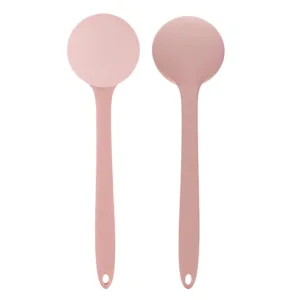
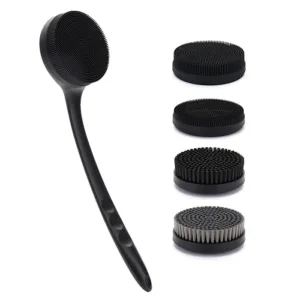
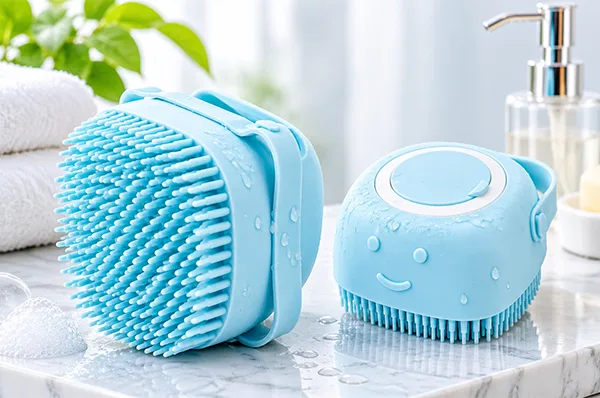
A silicone body scrubber is a reusable personal care item that is intended for use during bathing/showering. Depending on the product structure, it can be equipped with flexible silicone bristles, massage zones, ergonomic grip or long handle.
In contrast to classic bath sponges/loofahs, silicone-based products allow more product development and branding possibilities and offer unique opportunities for reusable products positioning.
For the B2B buyer audience, the following product opportunities exist:
- Handheld silicone body scrubbers: Small in size, convenient for daily showering routine.
- Long-handled silicone body scrubbers: Designed to reach hard-to-reach parts of the body (back, for example).
- Multi-textured body scrubbers: Products with various surface designs or zones with bristles.
- Silicone massage brushes: Bathing and massage at once.
- Multifunctional bath products: Products with several materials or structures combined.
- Private label bath kits: Scrub brushes in combination with hair brushes, face cleansing devices, or any other personal care accessories.
The most suitable product for you will depend on your target customers, pricing policy, sales channel, and brand strategy.
For instance, a well-known brand of skincare products would require high-end brushes with a long handle and special color design. An online retailer would require a test of a handheld brush as part of a private label brand line.
Before contacting a manufacturing company, clarify three basic issues:
- Who is your target customer?
- Which product attributes should be included in your scrubber to satisfy your target customer?
- Which sales channel and price range do you have in mind?
These decisions will help guide the entire development process.
2. Decide Between a Current Design and a New Product Idea
One of the earliest steps in creating a private label is choosing between customizing an existing design and creating a brand new product idea.
In both cases, it works fine but with different development prerequisites.
Option A: Customize an Existing Silicone Body Scrubber
This approach is always an easy way to start your new brand development or reduce your development efforts at the very beginning of the process.
The manufacturer may already have designs of silicone body scrubbers and relevant molds. The buyer can choose a suitable design and customize it accordingly.
It may include the following things:
- Product color
- Logo printing/debossing
- Surface/appearance customization
- Packaging design
- Product labels and instruction cards
- Product combination/gift set
Customizing the existing mold may help you avoid additional tooling costs and make the initial development easier.
Buyers have to check whether this design can be changed according to your requests and whether the product is exclusive.
Option B: Creating a Brand New Silicone Body Scrubber
Such a project is better suited for brands that need distinct designs for their products.
For instance, the brand may want to create a body scrubber with a longer handle and a special grip, custom bristles design, or unique design in general.
Such a product development project can include the following stages:
- Development of the product concept
- Creation of drawings and 3D-models
- Analysis of engineering feasibility
- Development of prototypes
- Creation of molds and manufacture of molds
- Production of samples
- Testing and acceptance of the product
- Manufacture of products in batches
This approach offers greater design flexibility but may require additional development time and tooling investment.
Which Option Should You Choose?
| Development Approach | Best For | Main Consideration |
|---|---|---|
| Existing product customization | Startups, wholesalers, and e-commerce sellers | Lower initial development complexity |
| Modified existing design | Brands seeking moderate differentiation | Modification feasibility |
| New product development | Established brands with original concepts | Tooling investment and development time |
An experienced OEM/ODM manufacturer will assist you in comparing the above methods prior to the selection of your development strategy.
3. Decide on the Product Shape, Structure and Size
Product design affects the following aspects directly:
- Product appearance;
- Product usability;
- Feasibility of its production;
- Market orientation.
Prior to mold development, buyers have to define the main structure and size of the product.
Select Product Shape
Silicone body scrubbers can be manufactured in various shapes such as:
- Round;
- Oval;
- Rectangular;
- Square;
- Special curved ergonomic shapes;
- Various custom shapes inspired by the customer’s brand.
The selected shape has to match the manner of usage and holding of the product.
The compact oval shape can be chosen for handheld product, while elongated shape will be preferable for a long-handle bath brush.
Design the Bristle Structure
Bristle design is the key aspect of product development.
The main aspects to consider are the following:
- Length of bristles;
- Diameter of bristles;
- Density of bristles;
- Distance between bristles;
- Shape of bristle tip;
- Arrangement of bristles;
- Thickness of bristle base.
Various combinations result in different tactile sensations.
For instance, short and dense bristles can provide a different sensation while brushing compared to longer and more flexible bristles. This can be checked by the manufacturer during design evaluation and physical testing.
Do not choose bristles based on their appearance. The final design should be analyzed for flexibility, usability in cleaning process, comfort and ease of manufacturing.
Think About the Design of Handle
The handle is crucial for long-handle silicone body scrubbers.
It is recommended to take into account:
- Length of handle
- Width and shape of grip
- Flexibility of handle
- Attachment between handle and brush head
- Presence of hanging holes or storage options
- Weight and balance
In case of detachable products, it is necessary to evaluate the attachment structure as well.
Think About Easy Clean and Storage
Since bathroom products are frequently in contact with water, soap and moisture,
design should pay attention to the issues of draining, rinsing, storage and drying.
The presence of hanging hole, proper surface structure and cleanable areas increases the practicality of product.
Manufacturer should check if the design involves narrow gaps, enclosed structures or complicated construction which will complicate cleaning and manufacturing.
4. Choose the Correct Silicone Material
Choosing the correct silicone material is another crucial factor in creating a private label body scrubber.
It depends on the type of material formulation and process employed. One should not assume that all silicone materials are alike regarding flexibility, hardness, surface finish, or even performance.
Some factors to consider in relation to materials include:
Silicone Hardness
Hardness is a factor that determines how the product will feel and deform while in use.
Depending on whether the product has flexible bristles or a structured grip or base, the hardness required is going to be different.
These include:
- Dimensions of bristles
- Thickness of the product
- Tactile feeling
- Structural needs
- Type of material used
- Process used in manufacture
Buyers should discuss with the manufacturer the desired feel of the product.
Grade of Material and Proposed Application
The choice of material is supposed to depend on the intended application and market requirements.
Customers may come across such terms as general purpose silicone, food contact grade silicone, and medical grade silicone. Such notions imply different requirements and should not be confused.
The supplier needs to specify the proposed material grade and present any documentation/test reports if necessary.
Color Uniformity
Colored silicone body scrubbers include:
- White
- Black
- Pink
- Blue
- Green
- Beige
- Purple
- Custom brand colors
When dealing with private label products, Pantone references can facilitate color communication.
But the actual appearance should be clarified using a sample since material recipe and manufacturing process may impact the final color.
Material Documentation and Test Reports
If your product is destined for the US, EU, or other markets, make sure that you mention your destination market and application before manufacturing starts.
Ask your supplier about material documentation and test reports available for your specific product.
Never assume that general material description guarantees compliance with all requirements in the destination market.
5. Select an Appropriate Method of Silicone Manufacturing
The method of manufacturing depends on product design, material, dimensions, manufacturing quantity, and surface finishing.
Compression molding is one of the most popular manufacturing processes for silicone rubber products. There are also other processes which may be employed depending on specific product design.
Compression Molding of Silicone
Compression molding is a popular process for solid silicone rubber products.
The process typically includes:
- Preparation of the silicone rubber material.
- Mixture of the material with appropriate additives and coloring agents.
- Cutting or weighing of the material in accordance with the product requirements.
- Preparation and installation of the mold.
- Loading of the material into the mold cavity.
- Application of heat and pressure.
- Curing of the silicone.
- Removal of the product.
- Trimming and finishing of the product.
- Inspection of the completed product.
Temperature, pressure, curing time, mold design, and preparation of the material affect the resulting product.
In case of silicone body scrubber, it is necessary to reproduce the design of the bristles and dimensions of the product during molding process.
Injection Molding Using Liquid Silicone Rubber
In injection molding using liquid silicone rubber (LSR), a two-component liquid silicone is used.
The components are mixed and then injected into a precise mold for curing.
There might be applications where LSR will be an option based on the specific properties of materials, dimensions required, or special structures.
Nevertheless, LSR will depend on what the designer needs and wants in his production process. The cost of tooling and manufacturing might differ compared to traditional solid silicone compression molding.
Multi-Color Silicone Molding
Some private-label products require multiple silicone colors.
Based on the product design, the manufacturer may choose special multi-color molding or dispensing process.
This will allow manufacturers to make:
- Products in two-color design
- Products with multiple colors
- Multiple color combinations
- Selection of 3D visual effects
Not all products require multi-color molding. The buyer should ask himself if the visual difference is worth the cost of developing and manufacturing process.
How to Choose the Right Process
| Manufacturing Method | Potential Application | Main Considerations |
|---|---|---|
| Compression molding | Many solid silicone body scrubbers | Mold design, material preparation, curing control |
| LSR injection molding | Specialized precision silicone components | Material system, injection tooling, processing cost |
| Multi-color molding or dispensing | Products requiring multiple silicone colors | Color separation, process complexity, tooling |
The manufacturer should recommend a suitable process after reviewing the product design and material requirements.
6. Creation of a Custom Mold
A mold is necessary for molding a silicone body scrubber with a specific form and structure.
In case of an existing item, the manufacturer can already have a mold suitable for its production.
If a new design is developed, a custom-made tooling can be necessary.
From Product Drawing to Mold Design
A development of a mold usually starts from the product drawing or 3D model.
The following aspects are taken into consideration by the manufacturer during this step:
- Product dimensions
- Wall thickness
- Design of the bristles
- Draft and demolding needs
- Cavity structure of the mold
- Location of the parting line
- Material shrinkage considerations
- Production process
The design should be changed in order to improve moldability and avoid production problems.
For instance, the complicated configuration of the bristles looks very attractive on the digital image but can be hardly molded.
Prototype Tooling and Samples Inspection
In some cases, depending on the project, it may be necessary to utilize prototype or preliminary tooling phase to inspect the item prior to the completion of the tooling for the mass production.
The buyer will have an opportunity to check the initial sample and make alterations in terms of measurements, construction, or aesthetics.
This is a critical moment when it comes to finding out any design flaws that could be avoided.
Ownership of the Mold and Its Exclusiveness
In case of custom projects, it would be wise to discuss the issue of tooling prior to going into production.
Some questions to ask are:
- Whose expense is the mold?
- Who owns the mold?
- Is it possible to use it for other customers?
- Is it an exclusive mold?
- Who is responsible for the mold maintenance?
- Can the mold be transferred to a new manufacturer?
A written agreement can help protect both parties and reduce future disputes.
7. Customize the Logo, Colors, and Brand Identity
A private label product needs to have its brand identity represented.
Logo positioning, colors, and product design are all necessary in order to make a common silicone body scrubber into a branded retail product.
Options for Logo Customization
Depending on the product’s structure and material, it is possible to employ one of the following ways of branding:
Debossed Logo
In this case, the logo is put into the mold and makes a recess in the silicone.
It gives a clean appearance.
Silk-Screen Printing
Silk-screen printing can be employed to put a logo or graphic image onto suitable product areas.
The manufacturing company needs to check the printability of an area and its resistance to wear under intended use.
Laser Marking
Laser marking may be possible for certain silicone products and logos. The final result will depend on the material, surface and technological parameters of processing.
Prior to manufacturing, please approve the logo artwork, size, location, and appearance.
Pantone Color Matching
Color plays a vital role in the process of brand recognition.
The buyer can submit a Pantone standard to indicate the required color. Then, the manufacturer will be able to prepare a color sample to be approved.
In case of multi-colored projects, it is advisable to indicate the color of individual components of products separately.
Product Design Consistency
When creating a product family, it is crucial to ensure that there is design consistency.
For instance, the use of the same color scheme and position of the logo on silicone body scrubbers, scalp massagers, and facial cleansing devices may be used by a brand.
This helps create a more recognizable product collection.
8. Create Private Label Packaging
Packaging is an integral part of the private label creation process.
It provides protection of the product when storing and transporting while introducing the brand to consumers.
The type of packaging will depend on the size of the product, channel of sales, retail requirements, and budget.
Some of the common packaging types are:
- Poly bags
- Paper card printing
- Hanging cards
- Color box
- PET box display
- Custom retail boxes
- Gift set packaging
- Cartons for shipping
What Should be on the Packaging?
Depending on the product and destination market, packaging might contain:
- Name of the brand and logo
- Name of the product
- Description of the product
- Dimensions/sizes of the product
- Instructions for use/care of the product
- Information about country of origin, if applicable
- Barcode/SKU
- Warning/Labeling, if any
Buyers should verify the labeling requirements for their destination market and not copy information from some other products.
Packaging for Different Sales Channels
Amazon and E-commerce Merchants
Think of size, protection, shipping efficiency, and product appearance.
Retail Brands
Think of visibility, clarity in product information, and branding.
Wholesalers and Distributors
Think of box counts, storage efficiency, barcode management, and packaging for bulk distribution.
A supplier who can manage product customization and packaging can help eliminate communication among different vendors.
9. Perform Quality Control Prior to Mass Production
Even a well-thought-out product can suffer commercial failure when there are problems in mass production.
Prior planning for quality control must take place before the order is produced, not afterwards.
Inspection of silicone body scrubbers might involve checking the following aspects.
Incoming Material Inspection
Materials specification, coloring agents, supplier’s documents, and others.
In-Process Inspection
Checking critical process parameters and product uniformity throughout the molding process.
Appearance Inspection
Inspecting the following aspects:
- Material contamination
- Incomplete molding
- Presence of bubbles and defects
- Too much flash
- Uneven bristles
Dimensional Inspection
Measure the dimensions of the product as per the drawing or specification sheet approved.
Usability and Functional Checks
Based on the design of the product check:
- Firmness of bristles
- Stability of handle
- Durability of connection
- Deformation of product
- Ease of rinsing and cleaning
Logo and Packaging Inspection
Ensure that the logo, color, positioning of logo, packaging design, labeling and packing quantity meet the requirements as approved.
Pre-Shipment Inspection
The finished goods must be inspected based on the quality standards agreed upon before shipment.
For large shipments, the buyer and seller may agree upon a sampling plan and acceptance standards.
An approved sample and the specification sheet serve as useful references for manufacturing control.
10. Understand the Cost to Develop Private Label Body Scrubbers
The overall cost of developing a private label silicone body scrubber will depend on several factors including product design, material specifications, tooling, volume, branding, and packaging.
Purchasers need to take into account the entire project cost rather than just the per-unit price.
The main cost elements include:
| Cost Component | What Influences the Cost |
|---|---|
| Product design | Design complexity and engineering work |
| Mold development | Mold size, structure, material, and tooling requirements |
| Silicone material | Formulation, grade, color, and material consumption |
| Manufacturing | Production method, cycle time, and order quantity |
| Logo customization | Printing method, logo size, and number of colors |
| Packaging | Packaging material, printing, and design |
| Testing | Required tests and laboratory arrangements |
| Shipping | Carton size, shipment volume, destination, and transport method |
Controlling Development Costs
Here are several techniques on how to control your investment at the start.
Use an Existing Mold
If your design permits that, you can save on the costs of making the mold.
Keep Designs Simple
Each new element can influence the design of your mold, manufacturing complexity and control process.
Finalize Requirements Earlier
Changing your specifications during mold creation or sample testing can raise your costs and slow down production.
Determine Packaging Requirements for the Right Sales Channel
If you sell through retail channel, you may need a nice package; otherwise, you probably don’t need one.
Estimate Order Size Wisely
Inquire about how order size influences unit cost, minimum order quantity, and manufacturing setup.
Your quote should clearly distinguish tooling, sampling, unit price, customization and packaging cost.
11. MOQ and Production Lead Time
production lead time and MOQ are critical issues both for new and old brands.
MOQ is contingent on the product model, material used, color specification, logo printing process, packaging, and whether the brand requires new molds or not.
For instance, the production process for personalizing an existing silicone body scrubber with the standard logo will be different from creating a brand new long-handle model with the custom mold.
In the request for a quote, you must obtain MOQ data for:
- Standard products
- Custom colors
- Logo personalization
- Custom packaging
- Modification of existing molds
- Development of new molds
It is also important to separate the lead time into distinct stages, including:
- Confirmation of the design
- Development or selection of the mold
- Sample production
- Approval of the sample
- Mass production
- Quality assurance
- Packaging
- Packing
Do not think that the quoted production period covers all development stages.
Realistic schedule must specify the start date, milestones, and possible issues affecting the delivery time.
12. Select a Reliable Silicone Body Scrubber Manufacturer
Choosing the right manufacturer is one of the key factors in private labeling.
The manufacturer must provide much more than just a catalog and good quotation.
Here are some competencies that buyers should look for:
Experience in Product Development
Does the supplier know the specifics of silicone bathing and personal care products?
Does it have competence to evaluate product concept, provide recommendations on design and development?
Ability to Work with Molds
Is the supplier able to work with existing molds, develop custom molds, maintain tooling?
Does it know the requirements of manufacturing process for various product structures?
Experience with Material and Process
Does the supplier know different material options, hardness, molding process and testing needs?
Quality Management
Is the inspection process for incoming materials, the inspection during manufacturing processes, and inspection of the final products properly documented?
Customization Capabilities
Is the supplier able to offer Pantone color matching, logo printing, debossing, and custom packaging?
Communication and Project Management
Does the supplier offer clear quotations, correct samples, and proper production updates?
International Orders
Does the supplier know about the necessary documentation, packaging, and communication needed for international business to business orders?
The supplier evaluation checklist is helpful when evaluating different suppliers.
13. How Beaut-Lohas Supports Private Label Silicone Body Scrubber Projects
Beaut-Lohas provides OEM/ODM manufacturing support for silicone personal care products, including silicone body scrubbers, bath brushes, scalp massagers, and facial cleansing tools.
With over 15 years of silicone ODM experience, Beaut-Lohas works with international brands, wholesalers, distributors, and e-commerce businesses on product development and private label customization.
Its manufacturing and development resources include:
- 50+ R&D staff supporting product development
- A 3,000 m² factory
- More than 1,000 existing molds
- 50+ QC staff
- 50+ sales staff supporting customer communication
- An annual production capacity of 50 million
Current Product Options and ODM Customizations
For those intending to create a private label silicone body scrubber without having to start from scratch with a totally new product design, Beaut-Lohas can provide options on current products.
Customization will include:
- Silicone color choice
- Color matching using Pantone
- Printing of logos
- Debossed logos
- Custom packaging
- Product set designs
Such an option would be ideal for companies interested in creating their own range of branded products.
OEM Product Design and Mold Customization
For companies that have their own design ideas, they can contact Beaut-Lohas for their customizing needs.
The development project will involve:
- Shape and size of the product
- Design of bristles
- Shape of handle
- Materials and hardness needed
- Custom mold designing
- Product colors and logo locations
- Product packaging
Buyers can submit images, drawings, product samples, and written specifications for their projects to begin with.
Logo Printing and Packaging Services
Beaut-Lohas provides logo printing and packaging services through techniques like silk screening, laser engraving, and debossing depending upon the product design and material compatibility.
Color matching with Pantone and customized packaging can also assist buyers in creating a brand-oriented product.
Quality Assurance and Testing Support
Beaut-Lohas owns ISO 9001, CE, BSCI, and RoHS certifications or supporting documents in the relevant fields.
Testing assistance with regards to CPSIA, REACH, California Proposition 65 regulations and any other relevant requirement is also possible.
It is suggested to verify which exact certificates and test reports are required for specific products.
If you are working on developing a new silicone body scrubber or personalizing your existing product range, Beaut-Lohas can work together on the product specifications, sample requirements, and manufacturing process with your team.
14. Step by Step: Guide to Creating a Private Label Silicone Body Scrubber
For companies developing their own private label body scrubbers for the first time, the process below can be a good place to start.
Step 1: Identify the Right Customers
Know who your customers will be and how the product will sell. Understand the expected positioning of the product at retail.
Step 2: Identify a Suitable Product Concept
Decide whether you prefer an existing handheld scrubber, a long-handled body scrubber, a multi-textured scrubber, or a completely new product concept.
Step 3: Find the Right Manufacturer
Contact a capable silicone personal care products manufacturer with your product specifications.
Step 4: Identify Material and Design Specifications
Talk about the product’s dimensions, bristle type, silicone hardness, colors, and any other functional aspects.
Step 5: Look Over the Quotation
Confirm the cost of the samples, tooling, MOQ, per-unit cost, customization fee, packaging, and lead time estimate.
Step 6: Sample Development and Approval
Examine the physical sample, and ask for any required modifications prior to giving final approval.
Step 7: Verify Branding and Packaging
Approve the logo design, colors, labels, packaging material, and other presentation details.
Step 8: Define Commercial and Quality Standards
Prepare documentation concerning the sample, product requirements, payment details, production plan, quality standards, and delivery.
Step 9: Begin Mass Production
Proceed to mass production of the goods based on the approved sample and plan.
Step 10: Test and Ship the Product
Organize testing, packaging, and shipment.
The use of the structured approach can help avoid any misunderstanding and give a clear idea about both sides’ responsibilities.
15. FAQs About Private Label Silicone Body Scrubbers
1. Is it possible to develop a silicone body scrubber under my own brand without inventing something new?
Yes. There are many companies that have silicone body scrubbers available that can be personalized according to your needs in terms of logo, colors, and packaging.
2. What personalization opportunities do I have with silicone body scrubbers?
It depends on the type of product. It might include such elements as shape, size, bristles’ construction, silicone hardness, color, printing of logos, embossing, and packing design. New mold might be developed for some special cases.
3. Do I need to pay for developing a new mold?
No. It will be enough if there is already a product that fits your needs and has an appropriate mold.
4. How much time will it take to manufacture a customized silicone body scrubber?
It will depend on whether you decide to go for any existing products or customize a new one. New mold design, prototypes evaluation, samples adjustment, and packaging approval may take additional time. Get your own manufacturing schedule and differentiate the process of these steps from mass production.
5. What kind of material should I use for a silicone body scrubber?
Material will depend on the use, flexibility, hardness, product structure, and market requirements. Consult the manufacturer regarding the appropriate material.
6. Is it possible to customize a long-handle silicone body scrubber?
Yes. The design and customization of such a product will depend on the capabilities of the manufacturer. Purchasers need to clarify the length of the handle, structure of the grip, way of connection, head structure, and storage options.
7. How can I make sure that the quality is consistent?
State the detailed specifications and approval of the physical sample prior to mass production. Inspection should be agreed upon for the dimensional, appearance, material, logo, and packaging aspects.
8. Does Beaut-Lohas offer any OEM/ODM silicone body scrubber service?
Yes. Beaut-Lohas has the capability to customize and develop silicone personal care products. You can talk to them about your product, color, logo, mold, samples, and packaging needs.
Conclusion: Develop Your Private Label Silicone Body Scrubber with the Right Partner
Developing a private label silicone body scrubber involves much more planning in terms of product design, choice of materials, tools, manufacturing processes, branding, packaging, and quality assurance.
The most efficient way to achieve success is to start by determining your target audience, choose the appropriate product design, and find a partner with experience in silicone manufacturing and cosmetics industry.
If you want to launch your product fast, then customization of an already existing product might suit you best. And if your brand calls for a specific structure of a product, then you should try a customized OEM project.
In any case, well-defined specs, sample approval, detailed quotes, and defined quality standards are crucial for project success.
Ready to develop your own silicone body scrubber brand?
Beaut-Lohas welcomes inquiries from beauty brands, wholesalers, distributors, and private-label businesses. Contact us to discuss existing product customization, custom mold development, silicone material selection, logo printing, Pantone color matching, and packaging solutions.
Visit Beaut-Lohas.com to explore our silicone personal care products and start your private label OEM/ODM project.