
For beauty brands, wholesalers, distributors, and retailers, selecting a supplier for silicone face scrubbers means more than just considering the cost of their products. A supplier might present you with very enticing quotations and interesting-looking products, but will it be able to maintain the international standards of quality, cater to varying market needs, handle custom orders, and deliver the products in time?
All these factors become even more critical when your company is planning to sell silicone face scrubbers in various countries around the world.
Every global market has its own customers, standards of safety, packaging needs, and logistics. A supplier who concentrates primarily on domestic production might not have all the mechanisms necessary for international clients.
The global-ready silicone face scrubber manufacturer should have the ability to produce high-quality products consistently with well-managed quality systems, material information, customizations, export facilitation, and stable production.
These qualities could help beauty brands and private labels minimize risks in sourcing, increase quality consistency, and even make international expansion easier.
This article reveals the major features of a global-ready silicone face scrubber manufacturer, the way buyers can assess potential suppliers, and the things buyers need to consider before placing orders internationally.
1. The Importance of Global Market Readiness in Selecting a Supplier
The international beauty and personal care market provides a potential opportunity for the use of silicone facial cleansing tools. But when entering the market, it is not enough to find a factory that is able to produce the final product.
The silicone face scrubber offered via a European beauty retailer will require different packaging documentation compared to the same product offered to a US distributor or Asian e-commerce platform.
It could be the same product, but the buyer’s needs in terms of business and compliance will differ.
A global market ready supplier should realize that his international clients will require assistance with the following:
- Product design and development.
- Selection of silicone materials.
- Documentation of product safety and quality.
- Personalized colors, logos, and packaging.
- Planning of production and orders.
- Export packaging and shipment organization.
- Consistency of repeated orders.
- Time zone differences communication.
Without all the above-mentioned abilities, buyers can encounter delays, extra costs, product specification inconsistency or problems with preparation of products for the target market.
A global-ready supplier is not simply a factory that can ship overseas. It is a manufacturing partner that can support the technical, commercial, and operational requirements of international business.
2. Capability and Experience in Direct Silicone Manufacturing
The next feature to consider is whether the supplier really manufactures products.
Companies may be trade companies or have their own factories. Both types can supply products to foreign customers, but the buyer should know who manufactures the goods and guarantees their quality.
For custom silicone face scrubbers, it can be beneficial if the company has direct manufacturing experience, since the effectiveness of such products is associated with specific materials, molds, and manufacturing process.
Which Manufacturing Capabilities Should Buyers Consider?
An experienced supplier should be ready to share its experience and describe its production process.
The following questions may arise:
- Is the company capable of manufacturing silicone cosmetic products directly?
- Does it have any experience in manufacturing facial cleansing brushes or other accessories of this kind?
- Is it possible to make custom molds?
- Is it possible to make a proper molding and finishing process?
- Is it able to make samples and bulk orders?
- Does it have quality inspection process?
Buyers may ask about factories, photos of production, samples of products and business documents.
Why Specific Product Manufacturing Experience Is Important
Silicone products manufacturing is not a one-size-fits-all process. It may vary depending on the structure of specific items.
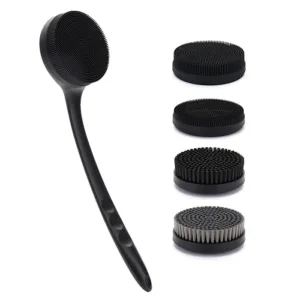
For instance, the manufacturing of a silicone face scrubber with fine brushes involves the issues connected with brushes manufacturing and uniformity. A flat cleansing brush may have other requirements regarding the thickness, flexibility, and surface finishing of the item.
An experienced manufacturer is more likely to be aware of possible manufacturing issues that may occur in mass production of such a product.
3. Adequate Manufacturing Capacity and Consistent Delivery Time
A supplier may provide high quality samples, but fail to deliver on their promises with larger and recurrent orders.
In the case of global customers, manufacturing capacity and timely deliveries are critical since late deliveries may impact product launches, promotions, stock levels, and buyer-supplier relationships.
The manufacturer of the silicone face scrubber must be able to share information about its manufacturing capacity and order management processes.
Key Production Factors to Evaluate
| Factor | What buyers should confirm |
|---|---|
| Production capacity | Available output for the required product |
| Equipment | Suitability of molding and finishing equipment |
| Workforce | Production and quality inspection resources |
| Production planning | How orders are scheduled and prioritized |
| Lead time | Estimated sampling and bulk production timelines |
| Peak-season management | Ability to manage higher demand |
| Repeat orders | Capacity to maintain consistent specifications |
Capacity Isn’t Just About the Size of the Factory
A huge factory doesn’t necessarily mean that there will be no problems with delivering the ordered items.
It is better to think about how much capacity the supplier has for producing the product, and not only the overall factory capacity or annual production amount.
For instance, a supplier can have great manufacturing capacity; however, he/she might lack it for certain molds or types of products.
Request a reasonable production timeline taking into account the order amount, required customization, and load.
A good supplier must warn you about any delays at once, instead of providing unachievable dates of delivery.
4. Good Quality and Traceability of Silicone Material
Silicone material is definitely one of the most important things when choosing silicone facial cleansing accessories.
In order to know something about the specifications of this material, it would be better to ask a supplier for necessary information and documentation.
Also, a supplier has to tell you about the material used, its characteristics, and checkup of the received materials.
Material Attributes for Review
Based on product design, there may be an assessment of:
- Type of silicone used and its specifications.
- Hardness and flexibility.
- Color uniformity.
- Surface finishing.
- Smell attributes.
- Dimensional stability.
- Resistivity to regular conditions of cleaning and usage.
- Chemical or material test results applicable.
The proper material selection depends on the application area and functional requirements of the product.
For instance, soft facial cleansing brushes have to be softer and more flexible than firm body scrubbers.
Material Traceability
A reliable manufacturer is supposed to keep appropriate material purchasing and inspection reports.
Buyers should inquire about the ability of the supplier to trace the origin of the material used, retain the batch information and provide appropriate documentation related to the product supplied.
Material traceability becomes especially important if a brand would like to examine a quality claim or material content of a certain batch of production.
It is necessary to avoid a simple description of material such as “premium silicone,” “food-grade silicone” or “medical-grade silicone.”
Such generalizations need proper support and should not be considered the proof of compliance with market requirements.
5. Quality control at all stages of manufacture
A supplier ready to operate internationally must have a properly organized quality control process and not depend solely on the visual inspection of the final product.
Quality issues can be related to material inconsistencies, molding issues, unevenness of bristles, surface defects, wrong dimensions, color discrepancies, or problems with logos for silicone face scrubbers.
It will cost buyers money in replacements, customer complaints, and their reputation will be damaged in case these issues are discovered after shipment.
Inspection Steps Required
Incoming materials inspection
Make sure that the incoming materials meet the required standards and accompanying documentation.
First-piece inspection
Inspect initial pieces of production according to the approved design, dimensions, color and appearance.
In-process inspection
Inspect production processes such as molding, trimming, surface treatment and others.
Final product inspection
Inspection of finished products for defects, dimensions, functionality, color consistency, logo quality and packaging.
Pre-shipment inspection
Inspection of the final order for compliance with the required standards before shipment.
Inspection Points for Products Specific
For silicone face scrubbers, the customer needs to inspect in detail the following aspects:
- Length and distribution of bristles.
- Flexibility and evenness of bristles.
- Thickness and weight of product.
- Smoothness of surface.
- Flash and overmolding.
- Presence of bubbles or incompletely molded parts.
- Consistency of color in batches.
- Clearness of logo.
- Accuracy of packaging.
Customers need to define quality standards prior to large-scale production. The sampling plan, such as acceptable AQL inspection level, can also be used to define acceptance criteria.
6. International Product Compliance Information and Documentation
The most crucial difference between a domestic supplier and an international supplier is the capability to fulfill international product compliance needs.
There may be variations in safety, chemical, labeling, traceability, and importer responsibilities in each market.
The manufacturer does not become the responsibility holder for all the importer’s or brand owner’s legal obligations. However, it is expected that the manufacturer is able to provide detailed product information and work with the buyer in cases where documentation and testing is needed.
Requirements for Products Placed on the European Market
For products sold in the European Union, buyers are supposed to assess the product safety requirements applicable to the product.
The General Product Safety Regulation (GPSR) applies since December 13, 2024 and sets out safety obligations for relevant consumer products and economic operators including manufacturers, importers and distributors.
According to the product and supply chain structure, some of the issues might be the following:
- Product risk assessment.
- Technical documentation.
- Product identification and traceability.
- Manufacturer and importer information.
- Required responsible person information.
- Safety information and warnings.
- Product listing information.
The GPSR will cover all relevant consumer products sold via both online and offline sales channels. The buyer needs to verify what obligations apply to the particular product and business model.
REACH restrictions may apply to the substances in articles. Buyers need to verify what chemical restrictions apply to the particular substance and to request the related material information or testing results if necessary.
United States Market Requirements
For silicone face scrubbers as physical beauty accessories, buyers should distinguish the difference between the accessory itself and the accompanying cosmetic formulation.
A single silicone cleaning device is not considered as a cosmetic formulation just by the mere fact that it is being used as a part of facial cleansing procedure.
But the claims made about the product, its usage, and the presence of certain substances may impact the regulatory classification.
Any health, disease, and therapeutic claims may add to regulatory requirements.
Brands also need to verify the related US product safety, labeling, and import requirements in accordance with the product characteristics.
Which Documentation Should Be Provided by the Supplier?
In regard to the product and destination market, the buyer might require:
- Specifications of the materials.
- Chemical test reports.
- Inspection reports of the products.
- Product identification and traceability details.
- Specifications for packaging and labeling.
- Declarations or certificates as applicable.
- Coordination of testing when necessary.
Important note: No certificate would mean that the silicone face scrubber is compliant with all international markets. The buyer needs to link each document and report to the specific product, material, application, and market.
7. OEM, ODM and Private-Label Manufacturing Customizations
Products of international beauty companies usually differ in their needs.
While some require a silicone face scrubber in its basic form, others might require the product in a unique design with certain specifics related to the shape, texture, color and packaging.
A global silicone face scrubber supplier should offer the possibility of OEM and ODM manufacturing.
OEM Manufacturing
OEM is used in case the company already has drawings, specifications or a finished design.
In this case, the manufacturer manufactures the product in accordance with buyer’s approved requirements.
Possible OEM customizations are the following:
- Custom product dimensions.
- Specifications of silicone hardness.
- Structure and surface texture of bristles.
- Custom colors.
- Logo location and printing.
- Retail packaging.
- Custom mold creation.
ODM Manufacturing
ODM is used by the buyer, which wants to create a product based on the manufacturer’s existing products or product development capacity.
This can include adaptation of the product structure, selection of colors, modification of certain features and creation of private-label packaging.
It will be helpful in minimizing initial development effort when the buyer does not demand absolute exclusivity for the design.
Customization Must Be Accompanied By Manufacturing Considerations
The supplier should not accept every design requirement without any regard for the feasibility of manufacture.
For instance, a complicated bristle configuration would complicate the mold process whereas excess thickness in the product could increase material use.
The supplier, being an experienced manufacturer, must be able to explain such compromises and suggest alternative designs.
It helps the buyer achieve a balance between product differentiation, cost of manufacture, and manufacturability.
8. Product Design and Mold Development Experience
Product design and mold development have their significance in deciding whether a silicone face scrubber is manufacturable.
A product may seem very beautiful in the computer-generated drawing but become difficult to manufacture.
The global supplier must have the knowledge of the link between product design, mold design, silicone movement, dimensioning, and finishing.
Existing Mold vs. Custom Mold
| Development option | Suitable situation | Main consideration |
|---|---|---|
| Existing mold | Buyers need faster customization or lower initial investment | Confirm available designs and mold usage rights |
| Modified existing mold | Buyers need selected structural changes | Check whether modifications are technically feasible |
| Custom mold | Brands require a distinctive product design | Confirm tooling costs, ownership, and development time |
Existing molds may be suitable for brands testing a new market or launching a private-label product with limited initial investment.
Custom molds are more appropriate when product differentiation and design ownership are important long-term priorities.
The existing molds can be used by brands that are trying out the new market or introducing their own private label products with a minimum investment.
The custom molds should be chosen in cases where differentiation and ownership of design matter a lot in the future.
Molds: Ownership and Intellectual Property
The following questions should be resolved prior to paying for the custom tooling:
- Who will own the mold?
- Will the supplier be able to use it for other buyers?
- Is there an option for exclusivity?
- Who is responsible for maintenance of the mold?
- What will happen once the manufacturing agreement expires?
- Are drawings and designs of the product protected?
Written agreements help protect both the buyer’s investment and the manufacturer’s production responsibilities.
9. Custom Packaging, Branding, and Retail Ready
Having the silicone component manufactured successfully does not mean that the product is ready for international shipping.
The product packaging, labeling, barcode information, and its presentation can influence the process of entering the retail or e-commerce supply chain.
A responsible supplier can assist in packaging development or work with professional packaging partners.
Private Label Packaging Options
- Custom printed retail boxes.
- Product display cards.
- Recyclable paper packaging, when appropriate.
- Transparent product bags.
- Branded pouches.
- Gift set packaging.
- Custom product inserts and instruction cards.
The packaging type should fit the brand positioning, sales channel, and shipping requirements.
Details About Product Packaging That Buyers Need to Check
Prior to manufacturing, check:
- Brand logo and design.
- Product name and description.
- Market-specific information to include.
- Location of the barcode and SKU number.
- Country of origin information, if necessary.
- Warning and care instructions, if necessary.
- Dimensions and materials of the packaging.
- Number of cartons and shipping labels.
A global-ready supplier should be aware that the packaging artwork needs approval prior to production and that different destinations have different requirements.
10. MOQ Flexibility and Scalable Manufacturing for Businesses of All Sizes
Purchasing behavior of international buyers varies.
While a startup beauty brand can be interested in small quantities to test their product, an experienced distributor will need bigger amounts and regular restocks.
A truly global supplier should be capable of explaining the structure of its MOQs and possibilities of its production to scale in the future.
MOQ: What Is Influencing?
The minimum order quantity of silicone face scrubs depends on:
- The availability of an existing or custom mold.
- Product design complexity.
- Requirements of silicone material and color.
- Setup process.
- Customization of logo.
- Packaging requirements.
- Manufacturing planning of the supplier.
Custom colors will usually need separate setup than standard colors. The customized packaging can also have its own minimum quantity requirements.
Sourcing Strategy for New Brands
In case of new brands, a step-by-step approach could reduce risks in terms of finances:
- Using an existing mold when it is possible.
- Customizing the color and logo.
- Approving samples.
- Testing product in the target market.
- Analyzing the feedback from customers and sales performance.
- Going for an exclusive design after proving the demand.
For mature brands, production planning and repeat order systems will be a better fit.
The buyer needs to talk about practical MOQ and price options without taking it for granted that every supplier will have the same minimum order quantity.
11. Exporting Knowledge, Shipping Coordination, and Document Preparation
A well-prepared supplier should have some understanding of the basics required in preparing for international shipments.
Despite the buyer selecting its own freight forwarder, the factory will have to provide correct production and shipping data.
Carton dimension, product details, packing quantity, and shipping documents being incorrectly provided can cause problems.
Export Coordination Capabilities
It is necessary to determine the ability of the supplier to assist with the following:
- Commercial invoices.
- Packing lists.
- Description of goods and HS code coordination.
- Dimensions of cartons and gross weights.
- Shipping marks.
- Origin of products as applicable.
- Shipping scheduling.
- Coordination with freight forwarders.
- Sample shipments.
It is necessary that the supplier provides accurate information and coordinates with the customs broker or logistics provider of the buyer when required.
Know Shipping Terms
Buyers also need to confirm the agreed Incoterm such as EXW, FOB, CIF, or DAP, etc.
Such Incoterm defines critical duties and responsibilities for both parties.
The quotation provided by the supplier needs to clearly outline what logistics services and associated expenses will be the responsibilities of the buyer.
When buying internationally, shipping arrangements are equally crucial as quality of production.
12. Communication, Responsiveness and Cooperation for the Long Run
Manufacturing projects abroad are usually preceded by several rounds of negotiations, sampling and production information exchange.
Thus, it makes sense to say that the ability of a supplier to communicate well may directly affect project efficiency.
A globalized supplier should be capable of giving clear answers to technical and business questions in a proper time and manner.
Good Supplier Communication
- Product features and prices are presented clearly in quotations.
- Technical questions are answered properly.
- Sample modifications are noted.
- Production schedule is adjusted if needed.
- Potential delays are reported timely.
- Quality issues are investigated.
- Changes are confirmed in writing.
- Repeat orders comply with previously agreed specifications.
Consider Other Factors Besides Timeliness
A fast response is valuable; however, it does not mean good project management.
The buyer should evaluate whether the supplier understands the product needs and gives reasonable proposals.
For instance, if some product design is impossible to produce, the right supplier should tell about it and propose a reasonable solution.
Long-term cooperation depends on transparency, problem-solving ability, and consistent delivery—not simply friendly communication.
13. How to Assess Silicone Face Scrubber Supplier Prior to Placing an Order
Buyers need to perform a proper supplier assessment before placing their orders.
A supplier assessment form will assist you in comparing manufacturers using similar criteria and will prevent choosing a supplier just because of their competitive pricing.
Global Supplier Evaluation Checklist
| Evaluation area | Questions to ask | Evidence to request |
|---|---|---|
| Manufacturing | Does the supplier manufacture silicone products directly? | Factory information and production evidence |
| Experience | Has it produced similar facial cleansing products? | Relevant samples and product portfolio |
| Materials | Can it identify material specifications? | Material documents and applicable test reports |
| Quality control | Are inspections performed throughout production? | Inspection procedures and sample records |
| Compliance support | Can it provide relevant product documentation? | Product-specific documentation |
| Customization | Can it support OEM, ODM, and private labeling? | Custom samples and process details |
| Mold development | Can it develop or modify molds? | Mold development process and ownership terms |
| Production capacity | Can it meet the required quantity and schedule? | Production planning information |
| Packaging | Can it support retail-ready packaging? | Packaging samples and artwork process |
| Export support | Can it coordinate international shipments? | Shipping documentation examples |
| Communication | Can it manage revisions and order updates? | Response quality and project records |
Request Product Samples Prior To Mass Manufacturing
Physical samples can be considered some of the best methods of assessing a potential supplier.
Purchasers should examine:
- Product shape and sizes.
- Flexibility of silicone material.
- Bristles design.
- Finishing.
- Uniformity of colors.
- Logo printing.
- Cleaning ability.
- Packaging quality.
The confirmed sample must be kept as a reference for large scale manufacturing.
In certain cases, buyers may opt for a factory inspection.
14. Why Beaut-Lohas Is the Supplier for Your Silicone Beauty Product Sourcing Needs
When it comes to sourcing silicones, it is essential that you find yourself a supplier with the right experience and ability to customize products.
Beaut-Lohas.com is your B2B silicone beauty and personal care product solution provider.
With 15+ years’ experience in silicone ODM, Beaut-Lohas helps its clients in product development, product customization, manufacturing coordination, and quality management.
This company’s capabilities include:
- OEM & ODM Manufacturing: Customization of silicone beauty and personal care products.
- Product Development: Design, prototype, custom molding development assistance.
- Customization of Material and Color: Specification and custom color of the product, Pantone matching.
- Logo Customization: Silk screen, laser mark, and deboss logo options.
- Private Labeling Packing: Product packaging and marketing design assistance.
- Quality Management: Inspection assistance at the right manufacturing stages.
- Testing Coordination: Assistance in conducting the appropriate CE, CPSIA, RoHS, REACH, and CA Proposition 65 tests, depending on product specifications and intended markets.
- Flexible Order Planning: Sample requests and discussion of MOQ based on product design and manufacturing requirements.
Beaut-Lohas produces various silicone beauty and personal care products, which include:
- Silicone face scrubbers.
- Silicone scalp massagers.
- Silicone body scrubbers.
- Reversible silicone under-eye patches.
- Various silicone beauty accessories customized for different needs.
It is beneficial for shoppers who deal with manufacturers that are knowledgeable in various silicone beauty products to be able to coordinate production of product lines as well as communication.
However, the review of specific product samples as well as agreement about quality of the products must be done prior to bulk ordering.
Looking for a silicone face scrubber supplier for your international business? Contact us to discuss product requirements, request samples, and explore OEM/ODM manufacturing solutions.
15. FAQs on Global Silicone Face Scrubber Manufacturers
1. What factors make a silicone face scrubber supplier global ready?
The supplier must have relevant manufacturing expertise, production capacity, material certification, quality control, OEM/ODM capability, experience in coordinating exports, and ability to meet specific market requirements.
2. What are the ways in which buyers can check if a supplier is indeed a silicone manufacturer?
Buyers can ask for the factory’s information, factory pictures, manufacturing process, related product samples, and business documents. Buyers can also consider having their own factory inspection or third party inspection in certain situations.
3. What kinds of certificates should be held by a silicone face scrubber supplier?
There is no one universal certificate to guarantee global readiness for all markets. Buyers need to evaluate the applicable product requirements and ask for corresponding factory certifications, material certification, and test reports of the products. For instance, ISO 9001 is about the quality management system but not the product safety test report.
4. Is CE certification required for the silicone face scrubber?
CE marking is only necessary if the product is covered by the relevant EU legislation which requires the CE marking. A simple non-electrical silicone face scrubber accessory doesn’t necessarily require the CE marking. The buyers have to check the classification and legislation of the product first.
5. Can one supplier serve buyers from different international markets?
If the supplier is qualified, he can serve buyers who want to go into different international markets. But the market-related responsibility is still dependent on the product and the manufacturer, importer, distributor and brand owner.
6. What is the MOQ for silicone face scrubbers in bulk?
The MOQ is dependent on the product design, mold availability, material, color, logo, packing and production preparation. Products which have existing molds may have better flexibility than those products which are fully customized.
7. Is it possible for the supplier to offer customized silicone face scrubbers with their own private labels?
Most manufacturers provide private-label services such as customization of product colors, logos, design and retail packaging. It would be advisable for potential buyers to know the printing process, mold options and packaging possibilities offered by the supplier.
8. Which factors need to be considered when testing silicone face scrubbers?
Buyers need to ensure that there is sufficient information on materials, product measurements, bristle composition, product flexibility, surface finish, color and logo positioning on the product, together with packaging details.
9. What needs to be done in order to ensure consistent quality in future purchase orders of silicone face scrubbers?
A sample product from the previous order should be retained, and there should be detailed specifications about materials, measurements, color standards and inspection criteria.
10. Why is export experience critical when it comes to choosing a silicone face scrubber manufacturer?
Export experience would enable the supplier to give accurate packing information, plan shipments, communicate with freight forwarding agents and provide relevant documentation.
Conclusion: Select a Supplier That Will Help You Succeed Globally
A supplier of silicone face scrubbers ready to work in the international market should provide a lot more besides beautiful designs and quotations.
Among the critical skills are the experience in direct manufacturing, solid production capabilities, consistent quality of silicone, organized quality control system, knowledge of international regulations, OEM/OEM services, retail packaging services, export services, and efficient communication.
These attributes will be beneficial for beauty companies operating internationally, and will help them minimize sourcing risks and lay solid foundations for the product expansion.
Before ordering bulk products, customers should ask for samples, check out manufacturing capabilities, receive necessary product documentation, and make sure that quality standards are met, along with establishing realistic shipping schedule.
A supplier that is able to manage all stages from the product development and sample approval to the mass production and shipping abroad may become an important manufacturing partner.
Explore silicone face scrubber manufacturing and private-label solutions at Beaut-Lohas.com to support your next beauty product project.