Introduction
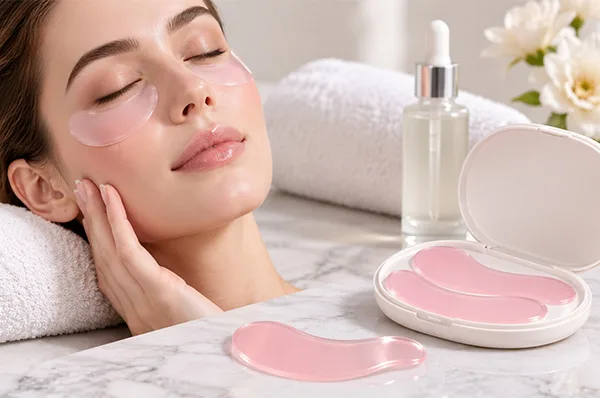
The beauty market has become highly competitive, and product differentiation is no longer limited to skincare ingredient formulas. Rather, consumers care more about skincare application accessories. Currently, these accessories cover facial rollers, gua sha tools, cleansing brushes, and reusable premium silicone eye patches for daily skincare routines.
For beauty brands, this opens up new chances to build distinctive products by prioritizing design over basic function. A quality silicone eye patch can serve as a luxury beauty tool instead of a budget skincare add-on. By selecting proper materials, design, visuals, branding and packaging, brands can set their products apart.
This is where reusable silicone eye patches shine, as they pair skincare use with flexible customization options.
Importantly, premium positioning does not come from high price tags or fancy packaging alone. On the contrary, it requires consistent quality, consistent brand communication, and well-regarded design.
Therefore, product developers, B2B buyers, private label partners and beauty retailers should keep these points in mind before developing a premium silicone eye patch line.
In the following sections, this article explains how to position silicone eye patches as premium beauty accessories, which manufacturing details influence perceived value, and how Beaut-Lohas helps brands develop and manufacture these items.
1. Why Silicone Eye Patches Have Premium Product Potential
Premium products in the beauty market are not always related to high costs only. They are often linked to the combination of product quality, consistency of design, customer experience, brand perception, and value.
There are many reasons why brands can use silicone eye patches to create such positioning.
Disposable Skincare Product to Reusable Beauty Tool
Generally speaking, typical disposable eye masks have been used for a one-off application of skincare products. Silicone eye patches can be promoted differently.
Brands can position them as an accessory that is used multiple times after being properly taken care of by the manufacturer’s recommendations.
Such positioning makes the product look different from customers’ viewpoint.
Reusable accessory can be positioned as an item to take care of, store, and apply again.
More Product Differentiation Opportunities
Some cosmetic brands have products that feature the same packaging, colors, and messages in advertising.
Another way to create a distinctive product identity is by having a unique silicone eye patch design.
Opportunities for product differentiation include:
- Unique shapes of patches
- Distinctive colors
- Special surfaces
- Exclusive packaging boxes
- Customized logos
- Product packaging
- Premium product lines
This will turn your regular product into a branded one.
Consistency With Modern Beauty Tool Collections
Modern beauty tool users have products like facial rollers, gua sha tools, cleansing brushes, and massaging tools.
Reusable silicone eye patches will perfectly fit the product collection of beauty lovers.
If you are a brand that already sells beauty tools, adding an eye care accessory will help you diversify your product range without creating a completely new line.
2. Determine Premium Product Positioning Prior to Development of the Product
Prior to mold selection, choice of materials and even packaging design, the company needs to decide on what is premium positioning for its target customers.
The premium skincare product for a minimalist brand will likely look differently than the product for luxury store or professional salon.
Target Customer Identification
Different customers appreciate different features of the product.
For example:
- Premium skincare customers would appreciate minimalist design and packaging.
- Beauty lovers would be attracted to exclusive color palette and complementary skincare tools.
- Professional salons would be looking at consistency, handling and durability.
- Gift purchasers would appreciate the full package design.
- Priviate lable retailers can concentrate on brand differentiation and margins.
An understanding of the target audience will help identify features worth investing in.
Selecting the Right Product Direction
There are different ways of positioning the line of silicone eye patches.
Minimalist premium beauty tool: emphasize simplicity, neutral designs, elegant packaging, and branding.
Luxury skincare accessory: pay attention to elegance, product collection, and premium packaging materials.
Modern reusable beauty essential: stress convenience, reusability, storage opportunities, and daily skincare needs.
Professional eye-care accessory: pay attention to the specification, instructions for use, and applicability for professionals.
It is better to choose one positioning direction instead of trying to present all the advantages.
Defining a Consistent Product Message
Consistency in product, packaging, website, and marketing messages is important when positioning products in a premium segment.
In case when the product is presented as an elegant beauty tool and has generic packaging and vague instructions, it creates confusion.
It is necessary that the physical product communicates the right brand message too.
3. Select a Unique Silicone Eye Patch Design
Product design is one of the most obvious aspects affecting perceived value.
A premium silicone eye patch must possess a unique look and a design that will represent the market in which the brand is targeting.
Design Shape & Contour
Shape affects the look and the fit of an eye patch.
Typical shapes include crescent-shaped patches that conform to the shape of the under-eye area. Nonetheless, there are possibilities of having variations on these shapes like variations in the width, length, curvature, and contour edges.
A uniquely designed product may help create an identifiable brand product.
Before settling on a particular design, one must consider the following:
- Overall shape
- Under-eye area covered by the product
- Curvature
- Ease of fitting
- Ease of use
- Comfortability
Simply because the shape of the product is unique does not mean that the product will be premium.
Thickness and Flexibility
Thickness and flexibility determine the texture of a patch and how easy it will be for customers to use the product.
A patch which is too rigid might be hard to place on one’s eye, while a very flexible product will be harder to hold and apply.
There is no standardized thickness for all high-quality silicone eye patches.
The brand should discuss this aspect with their producer and find out the appropriate specification after looking at samples together.
Edge and Surface Quality
Certain manufacturing details may affect the overall quality perception of a product made from silicone.
Rough edges, imperfections of the surface, uneven thickness, or unusual shape may make the accessory look unprofessional.
In case a brand aims to produce a high-quality positioning product, they should consider the following aspects:
- Smooth surfaces;
- Properly finished edges;
- Uniform look;
- Consistency of the dimensions;
- No obvious manufacturing flaws.
All these features have to be included in the approved product specification.
4. Choose the Correct Silicone Material & Product Finish
Product material selection is yet another key aspect of premium product manufacturing.
While consumers may lack technical knowledge about silicone material formulation, they can perceive differences in flexibility, texture, look and general quality of the material.
Material Consistency is Crucial
The manufacturer needs to be able to describe the particular material specification used for product manufacturing and provide necessary documentation.
Key aspects that need to be addressed in the case of B2B purchasers include:
- Agreed upon silicone material specification
- Consistent material from batch to batch
- Color consistency
- Flexibility
- Surface condition
- Use appropriateness
- Test documentation
It is highly recommended that brands do not use such vague terms as “premium silicone” without knowing the exact material specifications needed.
Select a Refined Surface Finish
The surface finish is part of what gives the product its look and feel.
Depending on the design, brands may choose a smooth, clean finish that is consistent with the minimalist or luxury beauty look.
Surface flaws, unwanted residue, unevenness, and defects should be checked for in the sample evaluation.
Think About Long-Term Product Appearance
A quality reusable product must have acceptable appearance for its expected period of use.
Brands need to consider how well the material reacts to the recommended cleaning and storage instructions.
Testing can be done to check the changes in the color, surface finish, flexibility, and form after use and cleaning.
Durability must be tested and not assumed based on the name of the material.
5. Utilize Color Customization to Enhance Brand Identity
Among the easiest methods to make silicone beauty accessories differentiable is using color.
Despite the popularity of transparent and pink silicone eye patches, high-end brands have plenty of options for color customization.
Choose a Unique Color Scheme
Here are some examples of how the brand color scheme can go:
- Transparency or translucency for simplicity
- Nudes and skin tones for subtle appearance
- Soft pink for a feminine approach
- Lavender for the skincare line
- Light blue for a fresh look
- Neutral beige for luxury minimalism
- Brand-specific colors for increased brand recognition
It all comes down to visual identity and target audience of the brand.
Using Pantone Matching for Uniformity
Pantone matching can be considered useful when the brand already has certain color guidelines, in order to match the silicone patches with other packaging materials or marketing assets.
Nevertheless, in any case, the final color should be confirmed with a sample.
The silicone material itself, as well as its surface and the conditions of production can influence the final result. The digital color guide might not be enough to get the identical result.
Creating a Color-Uniform Tool Set
The use of one color scheme by a brand can assist in developing a bigger product collection.
In particular, a brand can utilize the same color scheme for silicone eye patches, facial cleansing tools, and storage cases.
This makes individual products easier to recognize as part of the same collection.
6. Adding Premium Branding via Logo and Personalization
Branding is used to change a regular silicon product to one with a connection to an individual company.
For private label businesses, this is especially important since the product will resemble its competitors otherwise.
Logo Customization
There are several options for the process of adding the logo based on the product structure and manufacturing requirements, which can be:
- Screen printing
- Laser engraving
- Debossed logos
- Others
The most appropriate solution will depend on the logo size, its material, design, and the cleaning conditions.
A logo needs to be clear but not clutter the product.
Keep Your Branding Simple and Coherent
High-end beauty products typically incorporate simple branding.
Instead of putting a big logo all over the item, a small logo that is positioned well can look more elegant.
The same principles of aesthetics have to be used in the storage box and packaging.
Create Custom Design Features for the Product
Other design details may include:
- Unique edge contours
- Custom-sized patches
- Storage boxes that fit well
- Brand-branded protective trays
- Color combinations
- Retail packaging
All of these details have to serve a purpose visually or functionally.
7. Develop Premium Packaging that Complements the Value of the Product
Package design is vital for how customers perceive a beauty tool initially.
When designing packages for premium silicone eye patches, it is important to consider the protection, brand identity, and storage convenience of the product.
Pick the Proper Packaging Format
Available formats of packaging could be:
Gift boxes: Appropriate packaging for premium collection, gift sets, and special editions.
Folding cartons: Useful packaging format for retail products that requires consistency of the branding.
Storage case: Could be helpful for storing reusable patches in proper order.
Protective tray: Useful for holding the patches in place.
The selected format should match the product dimensions and provide adequate protection.
Provide Consistency in the Unboxing Process
It is not necessary to have expensive packaging to make an unboxing process high-quality. However, it is essential to provide a certain structure and details of it.
For instance, the item can be packaged in a snug-fitting tray together with a branded instruction card and then placed in an outer box which matches the design.
Everything should look like a part of the product collection.
Add Care Instructions
As silicone eye patches are reusable, it is important to provide instructions about how to clean, dry, and store them.
Such instructions should be consistent with what the manufacturer has validated.
It is also important to provide some limitations and replacement recommendations in connection with the eye region.
Clear instructions improve usability and help establish trust.
8. Promoting Product Features without Exaggerating Capabilities
Premium positioning relies on consistent, credible product communication.
In other words, brands should focus on verified product features instead of making exaggerated skincare claims.
Emphasizing Reusable Concept
For starters, reusability can serve as a strong selling point.
Brands may tell customers that these patches are engineered for repeated use when users follow the supplied instructions.
Crucially, brands should never advertise a fixed reuse count unless valid product testing supports that claim.
Explaining Design and Convenience of Usage
Beyond the reusable benefit, highlight design and usability features that help customers confidently make purchase decisions.
Such features may include:
- Flexible silicone-based material
- Design that fits under the eye
- Easily stored product
- Personalized colors
- Concept of product reusability
- Compatibility with specified skin care routines, where applicable
These features do not require any performance promises from the brand.
Beware of Any Medical or Uncorroborated Claims for Cosmetics
First and foremost, you must exercise great caution when making claims regarding wrinkles, dark circles, puffiness, and skin rejuvenation.
Specifically, silicone eye patches should never be marketed to treat any medical condition, nor should brands advertise unproven skincare benefits.
Instead, all claims should align strictly with the product’s actual function and intended use.
9. Provide Premium Experience Through Easy Usability
A premium beauty tool needs to be convenient to use, clean, and store. While customers may be drawn in by eye-catching packaging, the product still has to perform reliably as promised.
Make the Application Easy
First of all, the tool should be simple to lift, apply and remove.
Furthermore, brands should include clear instructions for product preparation and use.
Moreover, if the patches are designed to pair with other skincare items, brands must verify compatibility before outlining recommended usage steps.
Proper Storage Solution
On top of ease of use, a custom storage case greatly improves the user experience.
Not only that, it gives customers a dedicated spot to keep the patches after each use.
For best results, the container should be well-sized, simple to open and close, and suitable for the recommended storage requirements.
Provide Consistent Quality
A premium product should provide the customer with a consistent experience while using different units and batches of the product.
The brands should create the product specifications regarding size, thickness, coloring, appearance, and packaging.
The consistent quality standards are essential when increasing order volume.
10. Construct a Premium Price Strategy for Silicone Eye Patches
A premium product needs to have a pricing strategy that aligns with its total value proposition.
Simply setting a higher price point without enhancing the product experience or branding will hardly lead to any sustainable differentiation.
Know the Cost of Total Product Production
Costs involved in producing a customized silicone eye patch could be:
- Silicone material production
- Developing mold
- Custom color matching
- Applying the logo
- Producing storage case
- Packaging design
- Production and packaging
- Product quality control
- Logistics and shipping
In a word, sample cost, artwork cost and many other developmental costs are also needed when developing new products.
Determine the Retail Product Position
Brands can develop different levels of products according to the targeted market segment.
| Product positioning | Design direction | Potential sales channels |
|---|---|---|
| Everyday reusable tool | Simple design and practical packaging | E-commerce and beauty retailers |
| Premium beauty accessory | Custom colors and refined presentation | Skincare brand stores |
| Luxury eye-care tool | Distinctive design and gift-ready packaging | Premium retail and gifting |
| Professional beauty accessory | Consistent specifications and practical storage | Salons and distributors |
These are positioning examples, not price categories.
Perceived Value Evaluation
An effective pricing decision must take into account the quality of the product, its packaging, brand identity, customer expectations, competitive offerings, and channel margins.
With all these factors considered, companies should gauge customer reactions where possible before investing heavily in production.
Ultimately, this practice helps set a sustainable price that aligns with the actual product value.
11. Possibilities of Private Label and OEM/ODM in Beauty Products
For beauty businesses that want to build their own product identity, private label and OEM/ODM manufacturing can provide a practical development path.
Instead of selling an identical standard accessory, brands can work with a manufacturer to create a product that reflects their design and positioning requirements.
OEM: Manufacturing According to Brand Requirements
OEM projects generally begin with specifications provided by the buyer.
The brand may define the patch shape, dimensions, color, logo, packaging, and quality requirements.
The manufacturer then produces the product according to the approved specifications.
This model is suitable for brands that already have a clear product concept and design direction.
ODM: Product Development Assistance
ODM projects may involve more extensive support with product design and development.
For example, a brand may have a general concept for a premium eye-care tool but need help selecting a suitable existing mold, adjusting the product shape, or developing a custom design.
The manufacturer’s development experience can help turn the concept into a production-ready product.
Development of Custom Mold
For brands wishing to have a more unique design, developing a custom mold can become an option for consideration.
However, the buyers should consider the following factors:
- Costs of mold development
- Feasibility of the design
- Revisions and sampling
- Quantity of orders expected
- Ownership of the mold
- Future reordering needs
- Lead time in production
Custom Mold should serve a business purpose.
12. Quality Control: What Makes a Silicone Eye Patch Feel Premium?
Quality is one of the foundations of premium positioning.
B2B buyers should define quality expectations before mass production.
Inspect Appearance and Surface Finish
Inspection should cover:
- Surface marks and imperfections
- Uneven edges
- Visible contamination
- Color inconsistency
- Deformation
- Logo quality
- Packaging condition
The acceptance criteria should be agreed with the manufacturer and documented.
Verify Dimensions and Thickness
Dimensions and thickness influence product consistency and handling.
For this reason, buyers should confirm the approved measurements and define appropriate tolerances based on the product design and manufacturing capability.
In turn, the final approved sample can serve as the reference standard for production inspection.
Evaluate Durability and Cleaning Compatibility
Evaluation may include changes in shape, surface appearance, flexibility, color, and other relevant physical characteristics after repeated use and cleaning.
Brands should establish replacement guidance based on actual product performance and manufacturer recommendations.
Approve Samples Before Bulk Production
Sample approval is an important step in reducing manufacturing risks.
Therefore, before mass production, buyers should confirm:
- Final shape and dimensions
- Material specification
- Thickness and flexibility
- Color
- Surface finish
- Logo position and method
- Storage case
- Packaging artwork
Any changes after approval should be documented and reviewed.
13. How Beaut-Lohas Can Assist in the Development of Premium Silicone Eye Patches
Silicone beauty and personal care product development and manufacturing services for B2B are offered by Beaut-Lohas. This includes skincare brands, wholesalers, distributors, and private label companies.
For brands planning to position silicone eye patches as premium beauty tools, Beaut-Lohas can support the silicone product development and customization process.
Customization of Design and Product Development
Various options can be discussed by the brands for different shapes, sizes, thicknesses, colorings, and other surface needs of the product based on their own concept. Sometimes custom mold development can also be considered.
This enables the purchasers to manufacture products that match with their brand image and target markets.
Brand Image Options and Color
Options are available in Beaut-Lohas which could help customers to develop a unique brand image for their product line.
According to the need of the project, it can be:
- Silk printing
- Laser engraving
- Debossed logo option
- Custom colors
- Color match Pantone
- Packaging development
Physical samples must be approved for final specification.
Experience in OEM/ODM Manufacturing
With over 15 years’ experience in silicone ODM, Beaut-Lohas provides B2B customers with manufacturing and product development solutions.
The manufacturing capabilities include:
- Over 50 researchers & developers
- Over 50 sales team members
- Over 50 quality control members
- Factory space 3,000 m²
- Over 1,000 molds
- Annual manufacturing volume 50 million pcs
These manufacturing capabilities will support in product development and production coordination of silicone product projects.
Quality Management and Production Support
Beaut-Lohas operates with established quality management processes and holds certifications including ISO 9001, CE, BSCI, and RoHS.
That said, the relevance of certifications and test reports must be verified based on the product type, raw material, and target market.
For custom silicone eye patches, clients can confirm sample approval, product specifications, appearance standards, logo requirements, packaging solutions, and in-production quality inspections.
Private Label Brand Support
The company deals with B2B clients interested in customized silicone beauty accessories for their collections.
Whether a brand needs a standard design with a custom logo or a more distinctive product concept, beaut-lohas can discuss available development options and manufacturing requirements.
To explore customization possibilities, visit the Beaut-Lohas Customization Service or contact the team to discuss your project.
14. Frequently Asked Questions
How can silicone eye patches be marketed as premium beauty accessories?
A brand can enhance the premium positioning by offering unique product design, quality materials, custom colors, logos, convenient storage, beautiful packaging, and detailed instructions on how to use the product.
How can the look of a silicone eye patch be made more luxurious?
The eye patch can have an elegant design, smooth surface, uniform color, neat borders, discreet logo, and stylish packaging. The eye patch must be comfortable to wear.
Can silicone eye patches be personalized for private labels?
Yes, depending on the capabilities of the eye patch manufacturer, the eye patch can be customized in terms of shape, size, colors, logos, cases for storage, and packaging.
Are reusable silicone eye patches suitable for premium skincare lines?
They can be appropriate for premium skincare lines. The brand must offer clear instructions on how to take care of the eye patches.
Is there a need for a customized mold for a premium silicone eye patch?
Not always. Existing molds with customized colors, logos, and packaging may be sufficient for many brands. A custom mold is more appropriate when a distinctive shape or product structure supports a clear commercial objective.
Can Beaut-Lohas manufacture OEM/ODM silicone eye patches?
Beaut-Lohas offers B2B silicone products development and manufacture. This includes customization of colors, logo, mold development, and packaging.
Conclusion: Transform Silicone Eye Patches into a Known Luxury Beauty Product
Making silicone eye patches recognized as luxury beauty products goes beyond having good packaging and a premium price. Instead, design, material, usability, branding, and manufacturing quality are some of the elements you need to consider to deliver a consistent product experience.
For beauty brands specifically, the key is to start with identifying the target consumer and product positioning. Once this step is done, they can make appropriate choices concerning shape, thickness, color, texture, packaging form, and printing details.
Furthermore, quality control is equally important. Approving samples, defining clear specifications, and monitoring production quality help preserve a consistent product experience as order volumes grow. For this reason, it benefits B2B buyers to collaborate with a reliable silicone manufacturing partner.
To support this goal, Beaut-Lohas supports silicone beauty product projects with OEM and ODM manufacturing, mold customization, color and logo customization, and full quality control services.
So feel free to contact Beaut-Lohas to discuss your product development, sampling, wholesaling, and manufacturing needs.