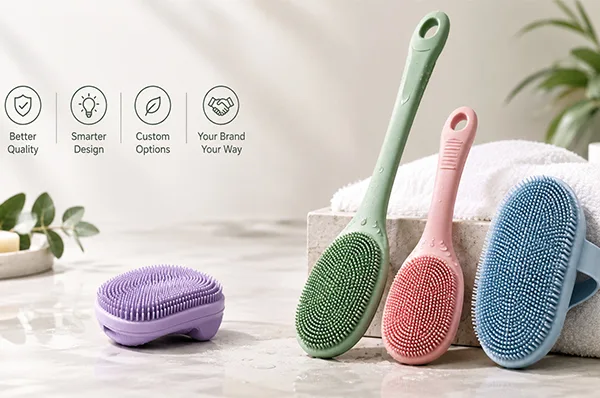
Introduction: The Need for Preium Body Scrubbers
The international personal care sector provides plenty of chances for brands to produce their bath and body care items. However, there is tough competition on the market. Premium Body scrubbers and low-end items are abundant in terms of various shapes, types of materials, colors, and prices. When there are several competing suppliers who offer items that are visually alike and serve the same purpose, brands may have troubles standing out, achieving reasonable profit margins, and gaining loyalty among their customers.
The answer for beauty brands, wholesalers, distributors, and ecommerce businesses is not to invent a totally new product. What should be done instead is to make a commodity body scrubber into a differentiated product.
A premium body scrubber refers to a product with a clear blend of usability, value, quality, and differentiation. Simply being more expensive will not necessarily mean a product is premium. The buyer needs to be able to see the differences that justify the price of the product.
When it comes to designing private label bath products, having an experienced body scrubber silicone manufacturer to collaborate with makes these concepts a reality. Beaut-Lohas provides both OEM and ODM customization services for products, colors, logos, molds, and packaging.
The following guide outlines how brands can design premium body scrubs without simply being cheaper than competitors.
1. Know the Differences between Premium and Commodity Products
Commodity body scrubber is commonly bought mostly based on its primary function and cost. The design, material, and packaging of the body scrubber may be similar to products of most competitors.
Premium body scrubber gives customers clear reasons to buy it over other options available.
| Product dimension | Commodity approach | Premium approach |
|---|---|---|
| Design | Standard shape and appearance | Distinctive, user-focused design |
| Materials | Selected mainly by unit price | Selected for performance, durability, and intended use |
| Function | Basic cleansing or exfoliation | Carefully differentiated functions and textures |
| Branding | Generic or minimal presentation | Consistent logo, color, and packaging |
| Quality | Basic acceptance requirements | Defined specifications and repeatable quality standards |
| Market positioning | Price-led competition | Value-led positioning |
| Product range | Similar products across suppliers | Coordinated designs for defined customer segments |
Being positioned as a premium product does not mean that all the products should be multifunctional or made of costly materials. Even a simple body scrubber made of silicone can be positioned strongly due to its functionality, unique design, and good quality of production.
It is necessary to define the differences of your product. In case a potential customer cannot give an explanation of why this product is better than others in one or two sentences, your strategy may need improvement.
2. Define Target Market of Customers Prior to Development
Another pitfall to avoid is trying to develop a body scrubber that would please every potential customer. It may be noted that a body scrubber created in a generic fashion is usually devoid of specific features since it was designed for no specific purpose.
Manufacturers have to decide on who their target customers are prior to establishing product specifications.
Premium brands of skincare and beauty products
This group of customers might value such attributes as color coordination, minimalistic design, luxury packaging, quality of materials and consistency of product range. A silicone body scrubber will go well with body washes, exfoliants and other bathroom accessories.
Beauty salons and spas
The priorities of professional buyers could include ease of handling, washing and durability of the product.
Wholesalers and Distributors
Distributors require easy-to-understand products, differentiated from other catalog offerings, easy-to-stock and versatile enough to sell through multiple retail outlets. Sometimes a good selection of sizes, colors and prices may be better than many different designs.
Ecommerce and Private Labels
The internet brands require products that convey the message through pictures, videos, packaging and descriptions. Unique shapes, distinctive colors, practical design features and product demonstration will help the customers understand the value.
In case of Beaut-Lohas’ products, the definition of the target market at an early stage will help define the design, level of customization, packaging and manufacturing quantity.
3. Create a Unique Product Design
One of the key methods that can help in distinguishing the high-end product from a low-quality one is product design. But, obviously, any differentiation must be justified by something other than just appearance.
There are several aspects that brands could take into account.
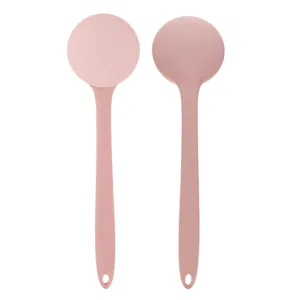
Shape and proportions: A well-thought-out shape will not only be easy to hold, to store and recognize but also will look more thought out.
Surface texture: The different textures will provide various feeling of the contact. And, of course, the design must suit the application field.
Handle design: A well-shaped handle with finger grooves or a non-slippery surface can be helpful.
Two-sided products: For example, one side can have soft, fine bristles and the other one will be of different texture. Of course, if both sides have their purpose.
Consistency: The shapes, colors and surfaces should fit the general visual brand identity.
The best design choices link aesthetics to functional advantages. For instance, the unique curved shape will also help position the hands. The hanging hole could facilitate easy drying and storage while providing an identifiable shape.
Before designing a customized mold, the brand needs to analyze its competitors, get customer insights, and see whether the design addresses any existing issues.
4. Selecting the Proper Silicone Materials and Surface Finishes
Material selection plays a direct role in the performance characteristics, feel, flexibility, appearance, and cost of manufacturing.
Silicone is a very common material for personal care accessories since it is able to form into various forms and finishes. Nevertheless, not all silicones behave similarly in terms of performance. Material specifications must be chosen depending on the intended application and the required marketplace specifications.
The following points should be taken into consideration when developing a premium silicone body scrubber.
- Softness and flexibility: The final product should have proper flexibility for the given intended purpose.
- Bristle geometry: Bristle length, diameter, spacing, and tip shape influence contact and cleaning sensations.
- Surface finish: Proper molding and finishing contribute to a professional look of the product.
- Color consistency: The desired color should be consistent throughout production batches.
- Odor and cleanliness: The choice of materials and manufacturing processes will prevent any unwanted odor, contamination, or residual matter.
- Durability: Product evaluation for deformation, tearing, and other possible issues during the intended use.
Brands should not make the assumption that all products containing silicon are necessarily equal and appropriate for any skin contact use. Prior to product release, the product documentation, material specifications, and appropriate testing should be carried out.
When the product is a private label, then the decision should be recorded on the product specification sheet.
5. Incorporate Functional Attributes that Customers Can Grasp
Many times premium products derive their value by doing better at solving one particular customer problem. Additional attributes are helpful, but adding extra complexity is likely to drive up prices and make the purchase decision more confusing.
Companies should emphasize on attributes that are functional, observable and business-relevant.
Differentiation attributes may include the following:
- Dual-side construction to cater to cleansing or exfoliation preferences.
- Different texture zones to meet particular applications.
- Ergonomic design for enhanced handling.
- Provision of hanging loops or built-in storage.
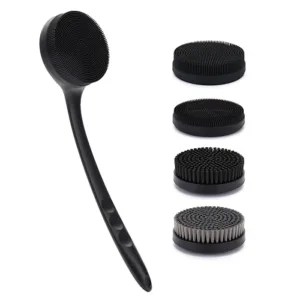
- Removable heads if there is real usability gain from interchangeable functions.
- Long handle for cleaning hard-to-reach places.
- Complete bath care accessory sets.
For instance, the dual-textured silicone body scrubber will seem much more beneficial than single-textured if both sides perform different functions. Long-handled version may be relevant for people who dislike bending or stretching while washing backs.
Not all features need to be included in all products. A facial cleansing device and a body scrubber have distinct requirements and should be designed separately.
An evaluation technique is to use three tests on each of the proposed features.
- Is it addressing an existing user problem?
- Can the feature be clearly communicated using product photography or demonstration?
- Is it manufacturable reliably at the targeted cost level?
Features which pass the three tests are better suited for a premium product approach.
6. Customize for a Recognizable Brand Identity
Private Labeling provides the option to develop a brand identity without having the production process established by itself. However, attaching the logo to an already manufactured product is just the first step.
Customization is about creating consistency between the product, packaging, color, and communication, corresponding to the position of the brand.
Custom Colors
Color combination is a good opportunity to stand out from the competition. The choice of colors depends on the brand identity – a company can opt for soft, neutral shades for its minimalist skincare collection, bright colors to attract the younger target audience, or color combination matching bath products.
Color charts based on Pantone are an effective way of communicating color requirements, but the final decision should be made on the basis of the reference sample with the agreed production tolerances.
Custom Logos
In accordance with the product design and material used, there are different printing methods available (screen printing, hot stamping, laser engraving, etc.)
The place of the logo attachment should always be visible while not reducing comfort and functioning of the product.
Custom Mold
A custom mold allows for more unique product shaping, bristle formation, or design feature. Custom molds usually mean extra design effort and up-front costs in tooling.
The brand must look into customizing its tooling if it is essential for differentiation and the demand will pay for itself. For initial product launch, it might be easier to use already available mold and color and packaging combinations.
Beaut-Lohas offers OEM / ODM customization services to those brands who are looking into their private label silicone personal care products.
7. Use Premium Packaging to Increase Perceived Value
The package can be the first physical touchpoint that consumers come into contact with their products. Moreover, the package influences how the product is represented through retailers, distributors, and online shops.
A generic package may downgrade the appearance of even an excellent body scrubber design. At the same time, thoughtful packaging can convey product features, reinforce brand message, and make it look better on the shelf.
There are several packaging options to think about.
Minimalist packaging for retail: A clean layout, colors, and type can work for a modern beauty brand.
Educational packaging: Diagrams or short descriptions may help customers understand the difference between textures and how to use and care for the product.
Luxurious packaging: Luxury packaging may be suitable for premium bath sets or season-based collections, but only when it is worth additional costs.
E-commerce friendly packaging: The package needs to provide protection during delivery.
Wholesale packaging: This packaging option implies quantity, size, label, and product identification of cartons.
Packaging considerations must be decided early enough to avoid production delays. Custom printing, packaging design, artwork approval, and packaging samples could all influence the development process.
Brands need to consider packaging material consumption as well as shipping quantity. Over-sized packaging would incur unnecessary shipping and storage expenses with no added customer value.
8. Implement Consistent Quality Standards
Being positioned at the premium level requires quality control that is consistent from batch to batch. An aesthetically pleasing prototype will not be able to support a premium brand image if the mass-produced product has varying coloration, uneven edges, deformations, and other defects.
Manufacturers and brands should cooperate on specifying acceptance criteria in advance for production to proceed.
Key areas of quality control will include:
- Identification of raw material components and suppliers.
- Dimensions and weight variations.
- Bristle design, position, and uniformity.
- Quality of surface finishing and molding defects.
- Colors compared against an approved standard.
- Position, clarity, and stability of logo where applicable.
- Quality of packaging and label information.
- Performance tests according to the application.
The inspection process must outline what features are critical, major, and minor and how defects are to be measured. The buyer can determine a proper sampling plan, including the AQL method of inspection if needed.
Sampling using AQL does not assure that all units are defect free. It is just one of the many tools used in a comprehensive quality management program.
In regard to items meant for consumption by consumers in the respective market, it is also important to consider compliance in terms of composition, usage, claims, and regulation requirements. Claims like “100% Safe” should not be made without any concrete proof.
Beaut-Lohas can collaborate with the buyer in terms of product specifications and quality of manufacture.
9. Find Balance Between Premium Features and Manufacturing Cost
Expensive body scrubbers don’t have to be the priciest items in their category. The idea is to make an actual difference, but still keep the cost of production affordable.
Some of the aspects that impact the manufacturing cost include:
- Type and consumption of silicone material used.
- Dimensions and complexity of the product.
- Number of colors and requirements for molding.
- Creation and usage of custom molds.
- Application of the logo and finishing.
- Materials and printing of the package.
- Tests, inspections, and other regulations.
- Order size and schedule of production.
The more complex the item, the more tooling it might require or the longer the production cycle would take.
Thus, brands should compare the benefits of each feature with their cost impact.
For instance, modifying the surface finish of an existing mold would be cheaper than developing an entirely new product construction. It might be possible to do just fine with custom coloring and packaging when launching a new product for the first time and use a mold only when there is proven demand.
A simple formula of product cost can be as follows:
Landed total cost per piece = Manufacturing cost + Packaging cost + Allocated tooling cost + Testing and inspection cost + Freight and other import related costs
Such calculation has to be based on real shipping terms of the buyer, the buyer’s order size and destination. Costs of tooling have to be allocated on the basis of realistic projected production volume.
The best design would be the one that creates obvious customer value without rendering the end product noncompetitive.
10. Design a Product Range Rather Than Relying Solely on One SKU
A premium product strategy can be augmented with the creation of a properly designed product range. An individual product can catch some initial attention, but a properly structured range will give retailers a wider choice to choose from and help in cross-selling.
One can start with a simple and carefully developed product range with three levels of product line:
Entry level premium – one carefully designed product which would be a simple body scrubber made of silicone, with an attractive color and shape.
Core level premium – the product which would have some unique features such as bristles or ergonomic design.
Specialized level premium – a special product that would have a long handle, parts which could be replaced, or specially developed structure.
These three products would be created in order to provide various options for different types of customers rather than to create too many similar items.
Too many similar products will complicate the choice of wholesalers and can make purchasing and stocking difficult. In this case, it is better to try out a limited number of products.
11. Validate Product Demand Prior to Mass Production
Premier product idea requires validation prior to investing in mold development, inventory, and marketing activities.
Market validation helps to reduce a risk of building a product that may look good from internal perspectives but will not satisfy customers’ expectations.
Validation process consists of the following elements.
Step 1: Competitors analysis. Evaluate competitors’ product in terms of materials used, features, color palette, packing, reviews, retail presentation, etc. Find out gaps rather than copying the prevailing design.
Step 2: Develop value proposition. Write a statement that explains who is targeted by the product, what problem it solves, and how it is different from other solutions on the market.
Step 3: Create a prototype. Evaluate such factors as size, texture, flexibility, appearance, usability of the product and its features according to original design brief.
Step 4: Gather feedback. Provide prototypes or concepts for chosen customers, distributors or target group and ask what features they like most and whether the suggested price is justified.
Step 5: Economic justification. Calculate costs of production, packaging, logistics, marketing, channels, and profit.
Step 6: Phase-in the launch. Whenever possible, phase in the order or limited product offering initially and modify the assortment according to the market response.
The aim of validation is not to remove all risks, but to identify unnecessary ones before they cost us money.
12. Choose An OEM/ODM Partner To Assist In Creating Diverse Products
The manufacturer must offer more than just manufacturing capabilities. If you are creating high-end body scrubbers, then having the right manufacturer will assist you to understand the feasibility, fine-tune designs, coordinate samples, manage quality and implement brand requirements through manufacturing.
Prior to choosing a silicone body scrubber manufacturer, the buyer is advised to evaluate the following aspects.
Product development: Is the manufacturer capable of reviewing product design concepts, discussing material possibilities and pointing out manufacturing limitations?
Customization abilities: Is the manufacturer able to cater for branding through logos, color matching, custom molding and packaging?
Quality management: Is the manufacturer’s inspection process, approved samples, specifications and action plans clear and well-defined?
Production capabilities: Is the manufacturer capable of producing the required product design, quantities and timing?
Communication: Does the manufacturer clearly communicate costs, limitations, lead time and revisions of samples?
Documentation & compliance assistance: Will the vendor be able to provide the necessary material for documentation or testing?
Moreover, buyers need to determine which party will own any custom tooling, how the custom tooling is to be stored, and what the limitations on its usage will be. This information needs to be documented.
In the case of international branding, good communication becomes particularly crucial. Drawings, sample references, color codes, and packaging files help avoid misinterpretations during the production process.
13. How Beaut-Lohas Can Help Brands Develop Premium Body Scrubbers
Beaut-Lohas assists B2B buyers interested in silicon-based personal care items for private-label, wholesale, or OEM/ODM orders.
As a company that has been producing silicone ODMs for 15 years now, with its own 3,000 m² production facility, more than 1,000 molds available and specialized teams responsible for R&D and QC, Beaut-Lohas is ready to help buyers in any stage of product development.
Depending on the project, it can be possible to provide assistance in:
- Product design and development: Discuss product ideas, application, and manufacturability.
- OEM/ODM customization: Look at existing product lines or create a customized product based on confirmed requirements.
- Custom colors: Coordinate color requirements by referencing Pantone values and approved samples.
- Custom logos: Look at possibilities for printing, laser engraving, debossing, etc.
- Molds development: Discuss custom molds for unique shapes, structures, and textures.
- Packaging development: Coordinate packaging ideas and artwork.
- Quality control: Set product specifications and appropriate inspection criteria.
- Testing support: Discuss necessary testing depending on target market, product material, and application.
For companies, distributors, and wholesalers, it will be easier to develop from an idea of the product to a detailed production project with the help of this method.
The ideal starting point is to provide the desired market, target consumer, type of product, specifications, amount of the order and its price range. These criteria define the direction in which the samples and quotations will be developed.
To inquire about your custom silicone body scrubber project, to get more information about products or to start private labeling, pls feel free to contact Beaut-Lohas.
Conclusion: Make Body Scrubbers Unique to Your Brand
To create premium body scrubbers, it’s not enough to increase prices or to make them more visually appealing. There should be a target audience for your brand, an interesting product concept, materials, design, branding, quality, and cost structure.
The best products have clear added value. Features that solve the customers’ problems, visual appeal, and technical specs contribute to it.
A step-by-step approach for businesses looking to enter the bath and body products market will minimize risks: validate the market, make prototypes, define technical requirements, analyze landed costs, and start producing in bulk upon validation of demand.
With the right product strategy and an experienced OEM/ODM partner, your brand will be able to differentiate itself from the competitors.
Frequently Asked Questions
1. What factors define a premium body scrubber?
Premium body scrubber consists of such elements as an effective design, good choice of materials, high quality of manufacturing, proper branding, and clear value proposition. Price is just one factor that defines whether the product is premium or not.
2. How can brands differentiate their silicone body scrubbers?
There are various options to differentiate products through custom design, bristle patterns, unique ergonomic, functional features, colors, logos, and packaging. The choice should be made based on target consumers and the cost of production.
3. Do you need a custom mold to make a premium body scrubber?
No, brands can start by using an existing mold and then distinguish the product with such elements as colors, packaging, and chosen product configuration. Custom mold becomes essential when the unique design is needed.
4. How can brands cut the cost of producing premium body scrubbers?
Brands can consider available molds, focus on valuable features, simplify unnecessary structures, design packaging properly, and estimate order quantities reasonably. The quality of materials used and necessary inspection process must not be compromised just because of low unit price.
5. What should buyers look for when choosing a manufacturer of silicone body scrubbers?
Buyers need to consider the manufacturer’s experience in product development, customizability, manufacturing capacity, quality control processes, communication, material certification, testing facilities, and clear commercial terms.
6. Can Beaut-Lohas assist in private label body scrubber projects?
Yes, Beaut-Lohas is an OEM/ODM manufacturer of silicone personal care products, providing B2B services. Depending on the project, buyers can discuss product customizing, color matching, logo printing, mold making, packaging, and other necessary quality/testing terms.
Ready to develop your own premium body scrubber range? Contact Beaut-Lohas to discuss product design, private labeling, customization, and OEM/ODM manufacturing options.