Introduction
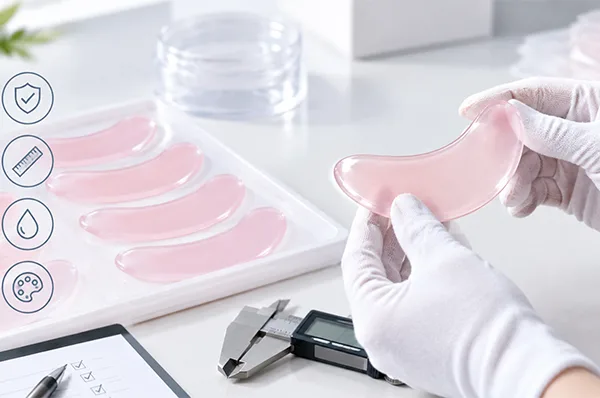
When it comes to ordering silicone under eye patches for your skincare line, distributor business, wholesale company, or private label, there is much more involved than selecting beautiful silicone under eye patches at a competitive price. You have to make sure that each and every item meets the required quality standards.
The item may seem flawless at the prototype level, but things such as non-uniform thickness, uneven edges, color variations, defects in the surface, or packing mistakes may emerge when producing a batch of items. Without a certain procedure of inspection, these defects will go unnoticed till products are delivered to the warehouse or reported by customers.
That is why a silicone under eye patches quality inspection checklist is so important.
An effective checklist allows buyers and manufacturers to assess raw materials, size, look, functionality, branding, packaging, and shipment readiness against well-articulated criteria of acceptance. It also creates a common ground of what makes an acceptable product.
For businesses that procure bulk silicone under eye patches, quality inspection of the product will allow minimizing unnecessary defects, ensuring accountability among suppliers, placing repeat orders, and maintaining a good reputation.
The OEM and ODM customization service for silicone beauty and personal care products is provided at Beaut-Lohas where B2B buyers may find product design, branding, and packaging options. Setting up the inspection criteria early will allow buyers to match their requirements with the production and quality control processes.
This guide outlines the ways to develop a proper checklist of quality inspection of silicone under eye patches and determine which features are essential for testing, how to establish criteria of acceptance, and what should buyers check to approve a bulk order.
1. Why Does a Silicone Under Eye Patch Require a Quality Inspection Checklist?
Quality inspection checklist is a document that converts general expectations into specific criteria for inspection.
A buyer can ask for a “soft, smooth, high-quality silicone eye patch” while having a different understanding of these requirements than a manufacturer. In result, he will receive a product that, on paper, is the same as approved but does not meet buyer’s expectations.
A quality inspection checklist eliminates this problem providing detailed characteristics and ways to measure them.
Manufacturing defect reduction
Performing product inspections on various production stages allows to detect any problems before the whole order becomes affected.
For instance, performing an inspection to detect a nonuniform thickness of products can help to fix the problem before producing thousands of units.
Protection of customer experience
Reversible silicone under eye patches must ensure the expected performance including comfortable feel and handling experience.
Customer dissatisfaction can occur because of different product characteristics.
Reduce purchasing cost
Poor quality may create costs due to segregation, retesting, replacements, repackaging, delayed deliveries, and customer service.
This preventive inspection system is used to recognize these risks beforehand.
Boost supplier’s responsibility
Creating a written list sets the standards that the producer needs to comply with.
Furthermore, it gives an opportunity to discuss defects, corrective measures, and ways of improvement.
Facilitate repeat orders
When a buyer reorders the same item, the list helps maintain its compliance with established standards.
For international B2B customers, this becomes especially relevant when items are produced months apart or are shipped to different countries.
2. Defining the Product Specification Prior to Inspection
The first thing that needs to be defined is what exactly the factory will need to inspect.
A proper inspection checklist cannot function without the complete product specification.
The buyers need to have a technical specification prepared and agreed upon prior to the start of production, listing all important aspects of the product.
Important aspects of the product
In case of the silicone under eye patches this might include:
- Product name and SKU
- Product technical drawing
- Size (length, width, thickness)
- Material properties
- Hardness requirement and how it is measured
- Product color or transparency
- Product surface
- Product edge
- Logo and logo placement
- Packaging
- Intended use
- Cleaning instructions
- Market requirements and regulations
Each product does not require the same types of testing. This needs to be taken into consideration when creating an inspection checklist.
Setting acceptance criteria
“Good appearance,” “soft material,” “consistent color,” and others – such terms need to be translated into requirements.
Where possible, convert them into specific requirements.
For example:
| Characteristic | Example Acceptance Requirement |
|---|---|
| Length and width | Within approved drawing tolerances |
| Thickness | Within the agreed tolerance at specified measurement points |
| Color | Matches the approved reference within agreed limits |
| Surface | Free from prohibited visible defects |
| Edges | No unacceptable sharpness, flash, or roughness |
| Logo | Correct artwork, size, and position |
| Packaging | Matches the approved packaging specification |
| Quantity | Matches the purchase order |
The numerical tolerances need to be selected based on the product itself and not taken from different products that have nothing to do with the current product.
Approval of a golden sample
The golden sample is an approved physical representation of the look and touch of the product. It is linked to the technical drawing, materials specifications, colors, and packaging.
The golden sample is good to have, but it is not a substitute for written specifications. Some features, such as the material of construction, need to be written down or measured and not compared visually.
3. Develop Incoming Material Inspection Checklist
Incoming material inspection serves to protect production from improper material usage.
Silicone formulation will affect flexibility, mechanical characteristics, appearance and processability of product. Buyers must insist on cooperation with the manufacturer in accordance with approved material specifications.
What needs to be checked?
Depending on particular product type, incoming material inspection can consist of:
- Material identification and supplier data
- Lot or batch number
- Shelf life of material (when applicable)
- Conditions of storage and handling
- Material certificates/test reports (when applicable)
- Color/pigment identification
- Mechanical characteristics requirements
- Chemical/other relevant documentation
For instance, if buyers request a particular silicone formulation, the manufacturer must have a process in place for verification of material compliance with approved material specification.
Documentation verification
A material certificate or declaration could contain valuable data; however, the document should match the real material.
In cases where the product will be sold in various countries, buyers need to determine the requirements for the target country and ask for relevant data.
Do not assume that a material certificate will prove everything about the safety and performance of the finished product.
Maintain material traceability
Note which material batch was used for each production batch.
In case of a quality problem detected later, the traceability system will help the producer find out whether it relates to the material batch, process conditions, or other production variable.
Example of an inspection record: material supplier, material code, batch number, incoming inspection date, document status, result, and inspector.
4. Check Dimension, Thickness, and Form
Dimension checking is necessary because the patches of silicone under eyes should correspond to the specified form and size.
Even small deviations may influence the ability to apply a patch under the eye correctly and look properly when applied especially if the patch is designed in such a way that it has a narrow end or a curve at the end.
Check overall dimensions
Measure the size of the product in terms of its length and width.
Measurements should be done according to the same procedure that was specified in the technical drawing.
Check thickness at several spots
If measurements are done at just one spot, it will be hard to check the presence of deviations.
For example, the patch may have the correct thickness in its center but be very thick on one side.
The inspection process should specify the spots for measurements, the device for measurements, and the method of putting the flexible product to measure.
Shape and curvature inspection
The overall contour or symmetry (where applicable) and curvature need to be verified in relation to the approved design or drawing.
Some shapes can be checked visually, while others may necessitate the use of templates, fixturing, or other techniques.
Edge dimensions check
It is expected that the edges will match the approved design.
Excessive flashing, trimming problems, distortion, and any other changes in the edge profile need to be considered.
Example dimensional inspection table
| Inspection Item | Method | Acceptance Basis |
|---|---|---|
| Length | Caliper or suitable gauge | Approved drawing |
| Maximum width | Caliper or suitable gauge | Approved drawing |
| Thickness | Suitable thickness gauge | Defined measurement points and tolerance |
| Shape | Visual comparison or template | Approved drawing and sample |
| Curvature | Fixture or defined comparison method | Approved design |
| Edge profile | Visual and tactile inspection | Approved specification |
The manufacturer should document actual results when required by the inspection plan, rather than simply marking every item “pass.”
5. Verify Surface Condition, Color, and Appearance
Appearance inspection is critical for silicone under eye patches since they are cosmetically oriented accessories that could be photographed or packed in retail packaging.
Surface defects could lower the perception of quality even if the product is dimensionally right.
Inspect the surface
Using proper lighting conditions, check for:
- Scratches
- Bubbles
- Contamination
- Surface roughness
- Unexpected gloss variations
- Molding lines
- Damage to the surface
- Defects prohibited according to the specification
All molding marks do not have to be necessarily rejected. The specification for the inspection should make it clear what is acceptable.
Verify color consistency
Compare the product against the approved color standard under the agreed lighting condition.
This is especially true in the case of specially colored patches where each batch may vary slightly.
Transparent and translucent products may need consistent inspection background and lighting setup.
Evaluate surface tackiness and texture
In case surface feel is a feature in the design of your product, ensure you conduct the necessary tests.
Too much tackiness may cause inconvenience in handling, while a change in texture may interfere with the experience intended by the product.
Do not solely rely on the opinions of the inspector. Ensure there is an approved standard and, if possible, an effective test method.
Inspect edges thoroughly
There must be smooth edges suitable for the skin contact intended by the product.
Watch out for sharp points, edges that are not uniform, flash, and damages.
As these products are designed for application near the eyes, any edge defect can be a potential hazard and thus must be taken seriously.
6. Confirm Silicone Hardness, Flexibility, and Durability
A silicone under eye patch can be visually correct and yet behave differently than the approved one.
Therefore, checking material properties and functions becomes an essential element of the inspection process.
Hardness check
In case hardness is a required feature of the product, an appropriate testing technique and tool will have to be used.
All testing parameters – testing technique, equipment, measurement location, acceptable limits of measurement should be recorded.
A hardness of a standardized material sample may not be equal to the hardness of a very thin and flexible patch.
The technique will depend on the type of the product being tested.
Flexibility check
It should be established if the patch bends and fits in as it was designed to do, without cracking, deformation or damage.
Consistent testing procedures should be used to make possible comparison of results of different production batches.
Tear and damage resistance check
In case the design is particularly thin or has narrow ends, it should be confirmed if the patch holds up under normal conditions without tearing or causing damage.
Repeated-use testing
Products that are reusable should be tested upon multiple uses and cleaning per instructions for use.
This might consist of:
- Change in shape
- Surface degradation
- Change in flexibility
- Edge damage
- Persistent contamination
- Change in appearance
- Problems cleaning the product
Tests should take into account reasonable expectations of use rather than an arbitrary number of cycles.
There is no substitute for material testing and/or durability testing for finished-product testing.
7. Fit Test, Skin Contact, and Functional Evaluation
Functional testing ensures the finished product works as expected.
In the case of reusable silicone under-eye patches, some of the features could be fit, flexibility, skin contact, retention, easy removal, and easy cleanability.
Fit and positioning
Perform a suitable test to determine if the finished product is in line with the intended location and follows the required shape.
When working on a new design, consumer trials or wear tests could help discover fit problems that might not be found through dimensional evaluation.
Retention during normal activities
Where the product is expected to maintain its position without any further adhesives, retention needs to be evaluated under the conditions for normal use.
The presence of skin moisture, residual skincare products, facial movement, properties of the silicone, and the shape of the product could influence the result.
The retention test needs to have set application procedures and pass/fail criteria.
Removal and manipulation
Check whether the patch can be removed and manipulated as desired without stretching or damaging the patch beyond acceptable limits.
Cleaning effectiveness
For re-usable patches, follow the cleaning procedure as desired and check whether residues can be removed satisfactorily.
Evaluate whether multiple cleanings lead to unacceptable changes in the patch.
Avoid unsupported performance claims
One should not make a general assumption about a product’s performance from its look or surface.
Product performance claims should be backed up with appropriate evidence and must conform to relevant requirements of the target market.
In quality inspection, concentrate on quantifiable features and intended-use requirements.
8. Checking of Logo, Branding and Packaging
Private label items include branding and packaging as an integral part of the order and not a supplementary one.
Though a silicone under eye patch can meet all the size requirements and still be unacceptable for shipping because the wrong logo or wrong product information is on the packaging.
Logo checking
The following parameters must be checked:
- Right logo artwork
- Correct spelling
- Placement and orientation
- Proportions
- Legibility
- Color, if any
- Consistency of logo on the package
In case of the molded/debossed logo, check its depth, clarity and appearance against the approved sample.
In case of printed logo, make sure that the print meets all the required criteria.
Inspection of packaging
Dependent upon the particular order, check:
- Storage cases/protective trays
- Product packaging
- Labels/bar codes
- Instructional sheets/inserts
- Product count per package
- Cartons
- Shipping markings
- Packaging integrity
Ensure that the packaging is consistent with the approved one.
Verification of labeling requirements
Product labeling requirements are dependent on the market, type of product, claim, and intended use.
Purchasers need to be aware of the correct labeling requirement for their particular market and make sure that the correct art work is approved before production starts.
Check of shipping cartons
Check carton condition, packing count, product identification, and any required handling instructions.
Incorrect carton marking or packing counts may cause problems at the receiving and distribution end even though the products are fine.
9. Use AQL sampling and define defect categories
When orders are large, it might become impossible to verify each individual unit. The buyers could use a mutually agreed sampling plan for suitable quality parameters.
AQL, which stands for Acceptance Quality Limit, is related to acceptance-sampling plans like those specified in ISO 2859-1.
It is essential to realize that AQL sampling does not guarantee absence of any defect in all units in a batch. This approach gives a method for making a lot acceptance decision based on the inspection plan.
Define defect categories
A useful checklist can include defect categories.
Critical defects – defects that would lead to unacceptable risk for safety or regulation reasons, like having a sharp or dangerous object close to the eye. It is necessary to define an acceptable response and acceptance policy depending on the risk criteria applicable.
Major defects – issues that would significantly impair function, usability, dimensions, branding, or marketing aspects.
Minor defects – issues that do not impair function and are not serious enough to be considered major defects, but meet minor defect criteria.
It is essential to understand that the classification should be product-specific.
Select the correct sampling plan
Prior to any inspection, both the buyer and the supplier need to agree on the following:
- Lot definition
- Inspection level
- Sampling method
- Sample size
- Classifications of defects
- Acceptance and rejection numbers
- Re-inspection/ Corrective action criteria
The particular sample size and acceptance numbers must be chosen from the relevant sampling plan considering the lot size and agreed inspection criteria. The sample size and acceptance numbers cannot be determined arbitrarily or used blindly in all orders.
Separate safety requirements from normal sampling
The critical safety requirements might need some controls or tests which can not be substituted with AQL sampling.
The inspection plan needs to specify such requirements well before production starts.
10. Implement Incoming, In-Process, and End-of-Line Inspection
An effective inspection checklist should consist of more stages in the manufacturing process other than just final shipment inspection.
Incoming inspection
Inspection of materials and components before starting the production process.
The aim is to find out which input materials are not suitable or not properly documented.
First piece inspection
Early products are inspected against the approved specification before the production process starts in full scale.
First piece approval becomes quite helpful after changing molds, machines, raw materials, and process modifications.
In-process inspection
Selected product features are inspected during production by the factory at certain intervals.
It helps identify the problem in time before affecting too many finished products.
Final inspection
Inspection of finished products against the inspection plan that was agreed upon before shipment.
It could include, depending on the order, the following:
- Appearance
- Dimension
- Finish
- Functionality
- Branding
- Packaging
- Quantity
- Carton marking
Capture and respond to failures
In case of failure of any attribute, the plant must capture the problem, quarantine any goods involved, determine the reason for failure, and take appropriate corrective action.
Just segregating the defectives might not necessarily solve the process problem that is causing the failure.
Corrective-action documentation will come in handy when placing subsequent orders.
11. A Ready-to-Use Silicone Under Eye Patches Quality Inspection Checklist
The following template can be adapted for OEM, ODM, wholesale, and private label orders.
| Inspection Stage | Checkpoint | Result |
|---|---|---|
| Documentation | Product drawing and specifications approved | Pass / Fail / N/A |
| Incoming materials | Material identity and batch traceability verified | Pass / Fail / N/A |
| Incoming materials | Required material documents reviewed | Pass / Fail / N/A |
| Dimensions | Length and width meet specifications | Pass / Fail / N/A |
| Dimensions | Thickness meets requirements at defined points | Pass / Fail / N/A |
| Geometry | Shape and curvature match approved design | Pass / Fail / N/A |
| Appearance | No prohibited surface defects | Pass / Fail / N/A |
| Appearance | Color and transparency match reference | Pass / Fail / N/A |
| Edges | No unacceptable flash, damage, or roughness | Pass / Fail / N/A |
| Material properties | Hardness meets agreed specification | Pass / Fail / N/A |
| Function | Fit and positioning meet requirements | Pass / Fail / N/A |
| Function | Retention meets defined test criteria, if applicable | Pass / Fail / N/A |
| Durability | Repeated-use evaluation completed, if required | Pass / Fail / N/A |
| Branding | Logo artwork and position are correct | Pass / Fail / N/A |
| Packaging | Packaging and labeling match approved artwork | Pass / Fail / N/A |
| Quantity | Order quantity and pack quantity verified | Pass / Fail / N/A |
| Shipment | Carton condition and shipping marks checked | Pass / Fail / N/A |
| Final approval | Inspection records reviewed and shipment disposition confirmed | Pass / Fail / N/A |
Fields recommended for the inspection record
These are some of the fields that should be included for easy reference during practical application of the checklist:
- Name of product
- SKU
- Order No.
- Supplier/factory
- Production batch/lot number
- Date of inspection
- Stage of inspection
- Sampling method
- Measuring data
- Description of defect
- Pictures (if necessary)
- Corrective action
- Disposition
- Approval of the inspector
This turns the checklist into a traceable quality record rather than a simple list of boxes.
12. Common Quality Inspection Pitfalls to Avoid
There are many things that could make the checklist less effective even for buyers who have one.
Vague acceptance criteria
“Goes well” is not a specific requirement. You should define the characteristic, the process of inspection, and the acceptable limit where possible.
Appearance check only
The item may seem right, yet it doesn’t comply with dimensional, material, performance or durability requirements.
Improper measuring of soft silicone
Too much pressure while measuring may distort the measurement by compressing the flexible product. You should use an appropriate instrument and the measurement procedure.
The sample as the specification
A sample can help you see what you need, but it cannot define all the tolerances, material composition and acceptable performance.
Neglecting the packaging
Faulty labels, missing inserts or broken storage cases will cause trouble even though the patches meet their specifications.
Usage of AQL without knowledge of the inspection plan
AQL inspection should use a pre-agreed sampling process. One figure cannot determine the total inspection plan or guarantee zero defects.
Not taking actions after repetitive defects
An effective correction action plan should detect the root cause and determine if the fix worked.
Implementation of unauthorized changes in production
Changes in material, mold, texture, color, and packaging can impact the final product. Identify which changes require reporting and approval from the buyer.
Avoidance of these pitfalls can make the inspection process more systematic and help buyers set clear expectations with manufacturer
13. Choosing a Trusted Silicone Under Eye Patches Manufacturer
A supplier’s capability to give a sample is just one of the criteria to consider. Consumers must also verify if the manufacturer is capable of controlling quality when there is already mass production and reordering involved.
Examine manufacturer’s manufacturing expertise
Ask whether the supplier has experience manufacturing silicone molding, thin and flexible items, customized shape, finishing of surfaces, and private labels.
Previous product expertise would enable the manufacturer to foresee potential problems that could arise during the manufacturing process even before starting production.
Ask how the supplier controls quality
An established manufacturer is expected to have an explanation on how it controls incoming materials, dimensions, finishing, production, testing of nonconformity and inspection.
Where applicable, you may ask the supplier for relevant documentation on such procedures.
Examine customization and change control
In private label projects, determine how the supplier will manage custom colors, logo, mold and packaging changes.
This will minimize the chance of manufacturing products according to old specifications.
Evaluating Communication
The supplier needs to be able to communicate any quality issues immediately and give an explanation of the corrective measures.
The buyer needs to know who is responsible for approving the samples, specifications, and manufacturing modifications.
Evaluating Repeat Order Capability
How does the manufacturer ensure that subsequent shipments stay consistent with the approved product?
The response should include material tracking, mold management, process control, specifications, and inspection.
For Beaut-Lohas customers, having this clarified in the inquiry and sample development phase will assist in customizing the product with the required quality standards.
14. Frequently Asked Questions
What should the quality inspection checklist for silicone under eye patches be like?
It should include the following criteria: product specifications, materials used, dimensions, thickness, shape, surface condition, color, edges, functional testing, branding, packaging, and shipping. The list is determined individually depending on the particular design and purpose of the product.
How to check silicone under eye patches before their bulk shipment?
It is necessary to start with the approved product specification and sample. To carry out inspections, you have to use the proper techniques to measure critical dimensions, test the appearance in the same lighting conditions, check the branding and packaging, and perform agreed upon functional testing. Where applicable, the sampling scheme should be applied.
Is visual inspection alone enough for silicone under eye patches?
No. Visual inspection may detect such things as surface and appearance issues, however, it cannot provide confirmation that materials used correspond to the specification, that dimensions are correct, and the products have the required hardness and durability.
Do I have to check each piece from my bulk order?
Not always. The type of inspection you should perform would depend on the type of product, order quantity, defect history, and requirements set in the contract.
What is the difference between AQL inspection and 100% inspection?
AQL inspection is performed according to the predetermined sample and acceptance sampling plan while 100% inspection performs the check of all units in the sample against the required characteristics. Neither method guarantees detection of all possible defects.
How do I ensure repeat orders will be identical to the sample?
You should establish a product specification, approve a golden sample, use material and color references, determine tolerances and establish change control procedure. Compare the repeat order production against the required specifications and inspecting the records for every order.
What kind of documentations should I ask for from my silicone eye patch vendor?
The documents that can be necessary based on the type of product and market will depend on the following: Technical Drawing, Approved Product Specification, Material Information, Test Report, Quality Inspection Documentation, Packaging Artwork, etc.
Conclusion: Include Quality Inspection as an Integral Element in Your Product Sourcing Strategy
When creating a silicone under eye patches quality inspection checklist, B2B buyers will learn how to transform their product requirements into manufacturing criteria.
The best checklist should include all the stages from raw materials control and dimensional measurement to quality assurance, functional testing, branding, packaging, and shipping.
For large quantities, the main aim of this tool is not just to spot the flaws during the manufacturing process. It is to minimize any unnecessary risks, detect any deviations, record results, and ensure quality consistency in repetitive orders.
Such practice will be beneficial for beauty brands, distributors, and wholesalers in terms of better communication, predictable quality, and improved customer experience.
Beaut-Lohas offers customized solutions in OEM and ODM silicone beauty product development, such as designing, branding, and packaging. With the help of the product inspection checklist created before the mass production, buyers will get a better quality standard for their silicone under eye patches.
Planning a bulk or private label silicone under eye patch order? Contact Beaut-Lohas to discuss your product specifications, customization requirements, and quality expectations before moving into sample approval and mass production.