Custom Silicone Body Scrubbers
The competitive bath and body care market of today requires brands to maintain product quality at the same level as their product design and pricing strategies when they buy specialized silicone body scrubbers from international suppliers.
The private label brands of North America and Europe need to study inspection and sampling standards because these standards help them decrease risks, limit product returns, and safeguard their brand image.
Our quality inspection process at beaut-lohas.com serves as an essential component of our OEM/ODM service. The article describes the inspection process for custom silicone body scrubbers while showing international buyers what to expect from trustworthy suppliers and which production standards hold actual value in their manufacturing operations.
1. Why Inspection Standards Matter for Silicone Body Scrubbers
A silicone body scrubber may look simple, but poor quality control can result in:
Inconsistent hardness or texture
Deformed bristles
Surface defects or flashing
Unstable colors or odor issues
Functional failures (broken handles, weak joints)
For B2B buyers, even small defect rates can lead to:
Customer complaints
Negative reviews
Repackaging or recalls
Loss of repeat business
That’s why professional manufacturers implement structured sampling inspection standards, not random checks.
2. The Role of AQL in Silicone Body Scrubber Inspection
What Is AQL?
AQL (Acceptable Quality Level) is the most commonly used international sampling inspection standard for consumer goods, including silicone body scrubbers.
It defines:
How many units are sampled from a batch
How many defects are acceptable
Whether the batch passes or fails
Common AQL Levels Used for Silicone Body Scrubbers
For most OEM/ODM orders, the following AQL levels are standard:
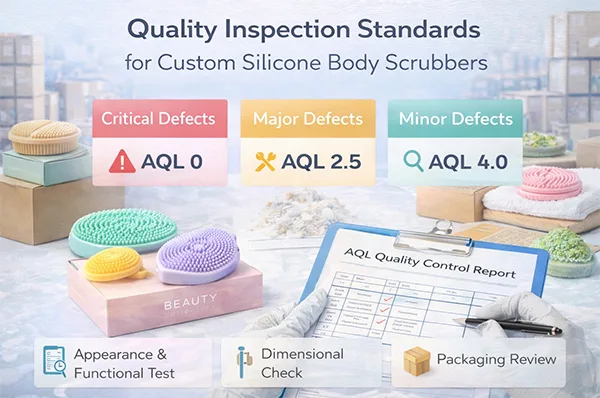
Critical defects: AQL 0
Major defects: AQL 2.5
Minor defects: AQL 4.0
This structure balances cost efficiency and quality assurance, especially for mass production.
3. Defect Classification for Silicone Body Scrubbers
Understanding defect categories is essential for buyers reviewing inspection reports.
3.1 Critical Defects (AQL 0)
Critical defects are not allowed under any circumstances, as they may pose safety or compliance risks.
Examples include:
Silicone cracking or tearing during normal use
Sharp edges that may cause skin injury
Material contamination (foreign particles embedded in silicone)
Strong chemical or irritating odor
Any single critical defect results in automatic batch rejection.
3.2 Major Defects (AQL 2.5)
Major defects affect function, durability, or user experience.
Examples:
Bristles breaking or falling off
Uneven silicone thickness
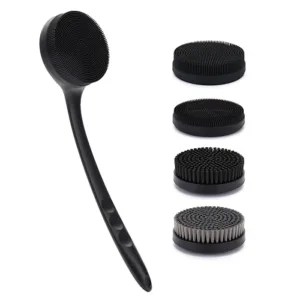
Loose or unstable long handles
Incorrect hardness compared to approved sample
Logo or branding errors
These defects may not be dangerous, but they directly impact product performance and brand perception.
3.3 Minor Defects (AQL 4.0)
Minor defects are primarily cosmetic and do not affect usage.
Examples:
Small color variations
Slight surface marks
Minor mold lines or flashing
Packaging print alignment issues
Controlled minor defects are acceptable within agreed limits.
4. Key Inspection Items for Custom Silicone Body Scrubbers
4.1 Appearance Inspection
Inspectors check:
Surface smoothness
Bristle uniformity
Color consistency
Absence of bubbles, black dots, or oil stains
For custom silicone body scrubbers, appearance must match the golden sample approved by the buyer.
4.2 Material & Hardness Verification
Silicone body scrubbers are usually tested for:
Silicone grade (food-grade or LFGB-compliant if required)
Hardness (Shore A) consistency
Typical hardness ranges:
Soft exfoliation: Shore A 30–40
Medium exfoliation: Shore A 40–55
Firm massage: Shore A 55–65
Deviation beyond tolerance is considered a major defect.
4.3 Functional Testing
Functional checks ensure real-world usability:
Bristle resilience and rebound
Handle strength and bending resistance
Head attachment stability (for removable designs)
Hanging hole durability
For long-handle silicone body scrubbers, handle stress testing is especially important.
4.4 Dimensional & Weight Checks
Inspectors verify:
Product dimensions
Thickness consistency
Unit weight tolerance
This ensures compatibility with packaging, retail displays, and shipping calculations.
5. Packaging Inspection Standards
Packaging is part of the product in Western markets.
Typical checks include:
Correct packaging type (box, polybag, vacuum pack)
Barcode and labeling accuracy
Logo and artwork alignment
Carton strength and sealing
Incorrect packaging may be classified as a major defect, especially for retail or Amazon FBA orders.
6. In-Process vs. Final Random Inspection (FRI)
In-Process Inspection (DUPRO)
Conducted during production to:
Identify molding or material issues early
Reduce large-scale defects
Improve yield rate
Final Random Inspection (FRI)
Conducted after:
100% production completed
At least 80% packed
This is the most critical inspection stage before shipment.
At beaut-lohas.com, FRI reports are shared transparently with B2B clients.
7. Buyer-Specific Custom Inspection Requirements
Different buyers may request additional checks, such as:
Drop tests for e-commerce
Odor testing
Color fastness
Logo adhesion or embossing clarity
A professional silicone body scrubber manufacturer should be able to adapt inspection criteria based on buyer needs.
8. How Beaut-Lohas.com Ensures Stable Quality
As an experienced OEM/ODM supplier, beaut-lohas.com applies a multi-layer quality control system:
Raw material inspection
First-article approval
In-process checks
AQL-based final inspection
Photo and report documentation
This approach minimizes risk for:
Private label brands
Wholesalers
Importers
Cross-border e-commerce sellers
Conclusion
For custom silicone body scrubbers, inspection standards are not just a factory concern—they are a brand protection strategy.
Understanding AQL levels, defect classifications, and inspection checkpoints allows buyers to:
Communicate clearly with suppliers
Avoid costly disputes
Maintain consistent product quality
By working with a manufacturer like beaut-lohas.com, brands gain not only production capacity, but also professional quality assurance systems aligned with Western market expectations.