Wholesale Silicone Face Scrubbers
The beauty and personal care market today experiences rapid changes which have made silicone face scrubbers the most popular skincare product used by customers who need daily skincare solutions. The product provides Western consumers perfect usage because it delivers mild yet powerful cleansing results while maintaining its hypoallergenic features and extended durability. The primary issue for organizations which include brands and distributors and B2B buyers who partner with major retailers or expand their operations through Amazon is to determine what figure represents an acceptable wholesale price range for silicone face scrubbers across worldwide markets.
The company requires price benchmarking understanding because it helps with cost planning while supporting product positioning and margin strategy development and competitive market differentiation. The website beaut-lohas.com offers international clients pricing information which matches their specific product requirements and material quality and design needs and distribution markets.
The article presents an analysis of cost drivers together with standard pricing information which exists between Asian markets and Western markets while explaining effective brand pricing methods for market success.
1. What Is Wholesale Price Benchmarking and Why It Matters
Wholesale price benchmarking refers to the practice of surveying and comparing bulk purchase prices of similar products across geographies, suppliers, and customization levels. For silicone face scrubbers, benchmarking helps:
Establish a baseline cost expectation
Compare suppliers fairly
Develop accurate product cost models
Avoid overpaying on custom features
Determine retail pricing strategies
Negotiate with buyers or retailers
For B2B buyers, having a clear benchmark means confidence in product sourcing, whether you’re distributing to salons, launching on Amazon, or pitching to big retailers.
2. Key Factors That Influence Wholesale Prices
Wholesale price isn’t a single number—it’s a function of multiple variables. Understanding these factors helps brands decide what range is appropriate for their products.
2.1 Material Quality and Silicone Grade
Silicone quality greatly impacts cost:
Standard food-grade silicone—lower cost, suitable for basic models
Medical/cosmetic-grade silicone—higher cost, appealing to premium buyers
Specialty silicone (antimicrobial, sustainable blends) — top-tier pricing
Higher grades command premiums because they offer stronger compliance (FDA, REACH) and better feel.
2.2 Design Complexity & Form Factor
Price varies with design:
Basic round or pebble shapes — lower cost
Ergonomic or double-sided textures — mid-range cost
Unique molds (heart, paw, massage angles) — higher mold cost & higher unit price
Some shapes require more silicone volume, stronger tooling, or multipart mold systems—all of which add cost.
2.3 Customization Level
Customization affects price directly:
No customization (white-label) — lowest price
Pantone color matching — adds premium
Logo (laser, deboss, print) — moderate cost
Custom retail packaging — pricing increases
B2B buyers who want complete branding often budget 20–35% more than base wholesale.
2.4 Order Quantity (MOQ and Scale)
Standard factory pricing is usually tied to the quantity ordered:
Low MOQ (500–2,000 pcs) — higher price per unit
Mid MOQ (5,000–15,000 pcs) — better scaling
High MOQ (20,000+ pcs) — best price due to economies of scale
For many brands, placing a larger MOQ reduces unit costs and improves margins.
2.5 Compliance & Testing Requirements
If you’re selling into Western markets, buyers often request:
FDA Material Compliance
REACH Chemical Testing
CPSIA / Prop 65 documentation
Safety and endurance reports
These tests incur upfront cost, which suppliers may reflect in unit pricing.
3. Typical Global Wholesale Price Ranges
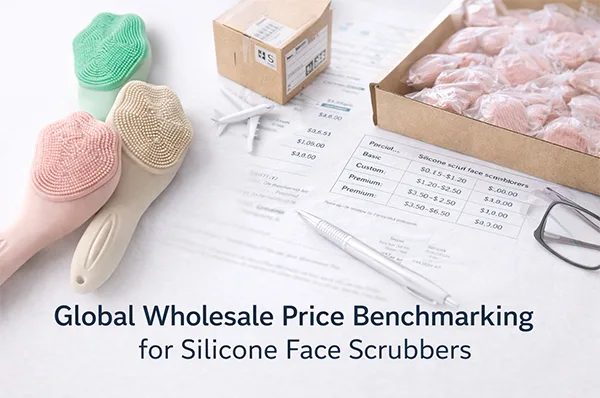
Below is a wide but realistic view of global wholesale pricing for silicone face scrubbers, based on factories with good quality and export experience (including OEM/ODM services):
3.1 Basic Manual Silicone Face Scrubbers
Low-priced white-label (large MOQ):
USD 0.35–0.65 per piece
Basic shapes, minimal texture, low customizationStandard manual silicone with basic texture:
USD 0.65–1.20 per piece
Default color choices, basic shapes
3.2 Mid-Range Customized Silicone Scrubbers
Pantone color matching & logos:
USD 1.20–2.50 per piece
More detailed texture, double-sided, ergonomic designModerate customization + packaging:
USD 2.50–3.50 per piece
Includes basic retail box or blister pack
3.3 Premium Silicone Scrubbers
Ergonomic + Full Branding + Premium Packaging:
USD 3.50–6.50 per piece
Strong aesthetic appeal, mid-to-high-grade siliconeSpecialty Materials / Antimicrobial / High-end design:
USD 6.50–9.50+ per piece
Typically reserved for professional or boutique brands
3.4 Electric & Vibration Models
While this article focuses on manual scrubbers, note that electric/sonic versions generally start from USD 8.50–15+ wholesale, depending on motor quality, waterproofing, and certifications.
4. Regional Price Variations
Wholesale pricing also varies by region due to labor, material access, and logistics.
4.1 Asia (China / Vietnam / Taiwan)
Competitive base pricing
Strong OEM/ODM support
Large factory capacity
Best for high custom orders
4.2 Turkey / Eastern Europe
Mid-tier pricing
Closer to EU compliance
Smaller scale
4.3 USA / Western Europe (Local Production)
Typically higher due to labor and overhead
Lower transit time but higher base cost
Competitive for just-in-time retail
Many Western brands adopt Asia-manufacturing + local fulfillment to balance cost with speed.
5. Price Strategy for Retail and Marketplace
Knowing the wholesale range is only half the story. Brands must also plan pricing strategy for retail.
5.1 Target Retail Price Calculation
A typical markup from wholesale to retail ranges:
Amazon or online DTC: 2.0–3.0× markup
Brick & mortar / specialty beauty retailers: 3.0–5.0×
Bundle or gift sets: 4.0–7.0×
This affects:
Perceived premium level
Ad spend allowance
Inventory valuation
Wholesale pricing must align with retail prospects to avoid margin compression.
6. How Customization Impacts Perceived Value
Customization does more than add cost—it creates differentiation:
6.1 Color Matching
Align with seasonal or Pantone trends, which improves:
Retail appeal
Social media marketing
6.2 Custom Logos
Brand identity shines when scrubbers carry:
Debossed logos
Laser engraving
Silk-screen printing
Logo techniques can determine whether a product fits economy, standard, or premium tiers.
6.3 Packaging
Retail-ready boxes increase product visibility and justify higher price tiers.
Brands that invest in packaging often sell at a 20–50% higher price point than those that sell bulk scrubbers unboxed.
7. Negotiation Tips for B2B Buyers
Strong wholesale negotiations usually hinge on:
7.1 Clear Specification
Define:
Material grade
Texture
Color and logo
Packaging style
A clear spec sheet enables accurate pricing.
7.2 Testing Responsibility
Decide whether:
Supplier handles compliance testing
Buyer purchases independently
Who pays affects price negotiation.
7.3 Volume Forecasts & Forecast Discount
Suppliers are often open to:
Tiered pricing based on volume
Forecast agreements for future discounts
8. Case Example: Price Positioning Scenarios
Scenario A: Amazon Private Label
Basic ergonomic scrubber
Logo + Pantone color
Basic retail box
Wholesale: USD 1.80–2.70
Projected Retail: USD 14.99–24.99
Scenario B: Boutique Spa Retail
Premium silicone
Unique shape
Premium printed packaging
Wholesale: USD 4.00–6.00
Projected Retail: USD 29.99–49.99
These examples show how pricing aligns with consumer expectation and margin goals.
9. Practical Tips for Selecting Supplier & Price Points
9.1 Understand Your Target Market
Luxury boutiques, mainstream eCommerce, and mass retail each require different pricing psychology.
9.2 Avoid Underpricing
Too low pricing can signal poor quality or lack of compliance.
9.3 Match Price with Story
Use price points to tell a brand story—for example:
“Dermatologist-approved”
“Eco-premium silicone”
“Spa quality at home”
Conclusion
At beaut-lohas.com, we offer tailored price guidance based on your SKU specifications, order forecast, and target market—helping you choose the right product path from concept to retail success.