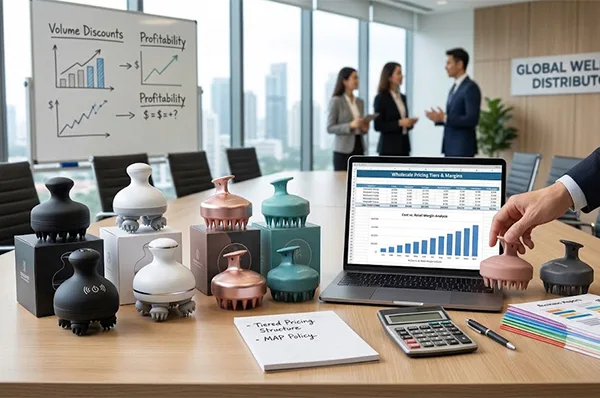
Introduction: Importance of Pricing Strategy in Relation to Wholesale Scalp Massagers
Silicone scalp massagers represent an interesting category that can be explored by beauty brands, personal care retailers, wholesalers, and private label companies. As consumers become increasingly concerned with their scalp and hair care routines, scalp massager brushes can represent a valuable product category for wholesale purchasing and brand building.
Nevertheless, sourcing a scalp massager brush at a relatively cheap price per unit will not necessarily result in a profitable venture. The consumer will need to take into consideration such factors as product quality, volume of the purchase, additional costs associated with customizing the item, packaging and shipping, import costs, fees for selling the product, and ultimately what the target consumer is ready to pay for the item.
For instance, cheap scalp massagers which may have issues with quality will lead to complaints and returns, while high-quality products featuring unique design and packaging can prove to be more valuable purchases.
Pricing will also have an impact on minimum order quantities (MOQ), private labeling, inventory risk, and competition for companies buying from a silicone scalp massager manufacturer.
In this article, you’ll learn how to create a realistic scalp massager wholesaling pricing strategy, how to work with suppliers, how to calculate your margins, and create a profitable product range. We’ll also discuss how to assess OEM and ODM deals while dealing with suppliers like Beaut-Lohas.
1. Know the Major Parameters That Determine the Costs of Scalp Massager Wholesalers’ Products
To compare quotations from suppliers, it is necessary to know why there are such differences in wholesale scalp massager prices between suppliers. Two similar-looking products based on the photos might be different in terms of material quality, design, finishing standards, packing requirements, manufacturing costs and other factors.
1.1. Material Quality and Product Design
The choice of material is one of the first parameters to analyze. Silicone scalp massagers could differ by material formula, elasticity, surface quality, bristles’ shape, structure, etc.
Products designed for daily shower usage could have some special features compared to small scalp brushes used for personal care needs. Consumers should define their requirements and evaluate samples of products.
While comparing quotations, pay attention to:
- Material characteristics and required application
- Bristles’ shape, flexibility and uniformity
- Dimensions and weight of the product
- Surface quality and possible defects
- Grip comfort and convenience in handling
- Washing and drying requirements
- Testing requirements and documents
Lower cost does not always mean more profitable offer.
1.2 Product Design and Mold Costing
Current scalp massager products can be more cost-efficient for buyers planning to launch the product quickly. A newly created mold, however, may entail additional costs such as redesigning, tooling, sampling, and approvals.
The best option is determined based on the sales approach used by the buyer.
If testing in the marketplace is needed, the buyer can rely on existing products with a unique color and logo. If an already existing brand of beauty products needs a product that will differentiate it from others, then custom shapes or custom handles will be more beneficial.
Buyers need to consider their development cost against order volume.
1.3 Quantity Ordered and Manufacturing Effectiveness
Order prices normally vary depending on quantity ordered, although the relationship between them is not usually linear. Large orders could increase manufacturing effectiveness through spreading fixed costs per unit. Nevertheless, savings vary from one product to another, considering factory capacity, buying of raw materials, packaging, and the manufacturing schedule.
One cannot assume that an order of 5,000 units will cost twice as much as an order of 2,500 units.
Ask for quotes at various realistic quantities and compare the difference in prices versus extra inventory costs.
1.4 Branding and Packaging Requirements
Each type of standard packaging, custom-printed boxes, reusable bags, or luxurious boxes has its own cost composition.
Logo personalization may also imply extra fees for setting up and manufacturing process or printing services. The range of branding options offered by our factory for silicone items depends on the design of the item and manufacturing process.
For getting your quotation accurately, you need to indicate product structure, branding option, dimensions of packaging, printing requirements, and order size.
1.5 Shipping and Import Fees
However, factory price constitutes only the part of the procurement expenses. In case of international clients, they may be required to take into account such additional fees as shipping costs, insurance, duty payment, taxes, custom clearance, warehousing, and delivery within the country.
Shipping costs are largely influenced by packaging volume. A light scalp massager packed into large gift box will incur higher shipping cost per unit compared to a compact item in optimal retail packaging.
That is why buyers should estimate the landed cost and choose the most competitive supplier.
2. Calculate Your Total Cost Before Setting a Wholesale Price
A sustainable pricing strategy begins with a complete understanding of the costs associated with acquiring and selling the product.
2. Estimate the Total Cost Before Fixing Wholesale Price
A viable pricing policy must start with a full realization of the costs incurred while purchasing and selling the goods.
2.1. Compute the Landed Cost Per Unit
A useful equation for calculation of landed cost per unit will be:
Landed cost per unit = Total procurement and importation cost ÷ Number of units ready for sale
Depending on particular deal, total costs include:
- Price of product
- Price for logo and customization
- Packaging and assembly
- Costs for molds or development divided by order
- Freight and insurance
- Import duties and taxes
- Custom clearance
- Handling costs
For example, imagine an order of 3,000 units of silicone scalp massagers.
| Cost item | Example total |
|---|---|
| Product purchase | $3,600 |
| Logo and packaging | $600 |
| Freight and insurance | $900 |
| Import and handling expenses | $300 |
| Total landed cost | $5,400 |
| Quantity | 3,000 units |
| Landed cost per unit | $1.80 |
These data are for illustration purposes only; not quotes from Beaut-Lohas company nor today’s market prices. Costs depend on product specification, number of items ordered, destination, mode of delivery, etc.
This example explains why buyers must not use factory quotation to establish the selling price.
2.2 Incorporate Sales and Operational Costs
The landed cost is not equivalent to the business total cost. The other costs that could come into play depending on the mode of sales include marketplace commission fees, payment costs, marketing, fulfillment, warehousing, returns, customer service, and general operational costs.
The distributor selling to retail stores would have a different cost structure than one selling online by direct shipment to the customers.
Determine which costs are relevant to your business before establishing the total cost.
2.3 Differentiating Between Markup And Gross Margin
Both markup and gross margin are distinct financial measures and mixing up between them would result in pricing errors.
The Markup formula:
Markup = (Selling price – Unit cost) ÷ Unit cost x 100%
The gross margin formula:
Gross margin = (Selling price – Unit cost) ÷ Selling price x 100%
Let’s say the landed cost of a scalp massager is $1.80 while its selling price is $3.00.
- Gross profit per unit = $3.00 – $1.80 = $1.20
- Markup = $1.20 ÷ $1.80 x 100% = 66.7%
- Gross margin = $1.20 ÷ $3.00 x 100% = 40%
This 40% gross margin is arrived at before other costs aside from the unit cost are considered.
To get a more accurate figure on profitability, the selling and operating costs must also be taken into account.
3. Select the Right Pricing Strategy for Your Business Model
Buyers have different needs; therefore, different pricing strategies can be used for them. For instance, a wholesaler selling to retailers should not apply the same pricing strategy as the private-label product or e-commerce.
3.1 Cost-Plus Pricing
The cost-plus pricing method entails adding a calculated margin to the overall cost per unit.
For instance, if the landed cost is $1.80 and the markup is 50%, then the selling price will be:
$1.80 × 1.50 = $2.70
This is a simple and effective way when making initial quotes. Nonetheless, it doesn’t consider competitor prices, customers’ willingness to pay, and the cost involved in the channels.
Cost-Plus Pricing should be applied as a first step.
3.2 Market-Based Pricing
Market-based pricing determines the price through comparing similar products, positioning, and the expectations of customers.
While researching similar scalp massagers, one needs to look beyond just the listed price of the product. Product size, materials, design, packaging, branding, selling mechanism, and accompanying accessories need to be considered as well.
A handheld massaging brush cannot be directly compared to an electronic scalp massager or even a gift box scalp massager because of the differences in their respective features and pricing.
Market research may help determine whether your product has to compete based on value for money, design, or brand.
3.3 Value-Based Pricing
The key element in value-based pricing is the perceived benefits which customers want to get for their money.
For example, differentiating factors in pricing of a private label scalp massager may include the following:
- The unique form of the product
- Harmonious color range
- Individual branding
- Packaging ready for retail sale
- Well-designed gift box
- Consistent quality and availability
- Combination of products specifically targeting one particular customer segment
In order to justify the value-based price, it is important for the customer to realize the difference and appreciate the added value.
3.4 Competitive Pricing
Competitive pricing could be applied where there is a lot of similarity in products within one category and customers tend to compare prices.
Matching the lowest competitor’s price could lead to a downward race as the suppliers could differ in terms of cost structure, quality, logistics, and service.
Rather than just reducing your price, try to understand what your offer could compete on. The distributor could differ from others by being more available, consistent, offering more flexible order opportunities or coordinating assortment.
3.5 Tiered Pricing
In tiered pricing, you offer different combinations of product or services at different prices.
In case of a scalp massager, you could offer a lower tier with a basic version, middle tier with custom branding, and a higher tier with improved packaging or special design.
This strategy could enable a buyer to address different customer segments using one product and price.
4. Develop a Wholesaling Pricing Structure with Tiers
For wholesalers, distributors and B2B suppliers, a structured pricing structure based on volume would make quoting much easier and prompt larger orders.
4.1 Establish Quantity Tiers
The supplier quote may feature various unit prices for different quantity levels. The actual breaks would be dependent upon production economics and expected demand from the buyer.
An example structure could be as follows:
| Order quantity | Pricing approach | Intended purpose |
|---|---|---|
| 100–499 units | Standard wholesale price | Small trial orders, if supported |
| 500–1,999 units | First quantity discount | Initial commercial orders |
| 2,000–4,999 units | Larger-volume pricing | Established demand |
| 5,000+ units | Project-based quotation | Larger or repeat programs |
These are example quantity bands, not actual Beaut-Lohas MOQs or pricing tiers. Real order minimums and discounts must be confirmed with the supplier.
4.2 Make Quantity Discounts Economically Justifiable
Discounts must reflect real savings and should not be purely arbitrary.
For instance, a bigger order might lead to lower packaging costs per unit or better efficiencies in production. Nevertheless, if there is need for a new mold, several colors or complicated packaging, there could be other cost structures involved.
Calculate gross margin and contribution of every level prior to making a price list.
4.3 Establish a Minimum Order Value Where Appropriate
In certain wholesale settings, a minimum order value may be appropriate to cover administrative expenses, sample testing, packaging preparations, and processing of the order itself.
The method might work in cases where customers ask for many different variations of the product but only in small quantities.
Nevertheless, the minimum must still be economically sensible to the targeted customer. Otherwise, an excessive minimum order value would discourage any new customers willing to try the product out.
4.4 Distinguish between Standard Products and Custom Projects
Standard products and custom projects are quite different in terms of the price calculation methodology.
The price for a standard scalp massager could be based on a unit-price table. However, a custom project might involve such additional charges as tooling, design development, logo preparation, special packaging, and testing.
Clearly separating these costs helps buyers compare quotations and understand the investment required to launch a private-label product.
5. Price OEM and Private-Label Scalp Massagers Appropriately
Customized scalp massagers have many applications in the area of private labeling and OEM; however, the process of price-making may become more complicated for this reason.
5.1 Existing Products with Custom Logos
If you are a novice manufacturer in this industry, using your own logo on an existing scalp massager might be a good idea for you.
The structure of the product does not change; however, the buyer decides to customize some components of the product: color, logo, and packaging.
Thus, the quote should include the basic price of the product, logo setup price, price per unit of branding, packaging price, and minimum orders.
This approach may reduce initial development risk compared with launching a completely new mold.
5.2 Custom Colors
Custom colors could improve branding and assist in building up a product line that customers could recognize.
Nevertheless, the use of custom colors could impact raw materials preparation, production planning, approval of samples, and minimum quantity requirements.
Before placing an order, inquire from the vendor if the required color could be made, if there is a color sample, and if different colors have separate prices.
5.3 Development of a Customized Mold
Although a customized mold will give you a more distinct product, you should assess the cost with reference to your expected sales.
Questions for Assessment include:
- How much is it going to cost to develop the mold?
- Is the mold charge built into the unit price or it’s an extra fee?
- Whose property is the mold?
- Are there any extra tooling charges in subsequent production runs?
- What happens if the design requires adjustments?
- How many units do you need to break even?
You can use a simple break-even formula for that.
Break-even units = Initial development investment ÷ Extra contribution per unit
For example, let’s assume that a customized design will cost $2,000 more than an existing product in terms of development and that the customized design will make an extra $0.40 per unit contribution.
You would have to sell 5,000 units for the extra investment to break even:
$2,000 ÷ $0.40 = 5,000 units
This is a simple example, actual results would depend on sales, prices, costs, etc.
5.4 Custom Packaging and Gift Sets
Custom packaging will raise the value of the goods, but this will raise prices and influence shipping.
When buying a custom-packaged private-label scalp massager, compare regular boxes, printed boxes, pouches, and premium gift packs.
If the purchaser intends to sell through many different channels, then one packing type will be able to cover all of these channels or not.
5.5 Estimate Custom Projects as a Whole
When asking for an OEM quote, one needs to assess the total cost of the project and not only the cost of the unit.
A good quote will contain product specifications, customization details, packaging, mold fees if any, sampling fees, quantity, terms of delivery, and fees that are not included.
This makes it easier to compare suppliers fairly and estimate the investment required for a successful launch.
6. Retail and Distributor Pricing for Different Sale Channels
The scalp massager could be distributed via distribution channels, stores, salons, online marketplaces, or direct website sale of the manufacturer. In any case, there are unique cost and pricing challenges associated with each channel.
6.1 Distributor Pricing
It is typical for distributors to have certain flexibility when setting prices, including covering expenses related to warehouses, sales, customer support, logistics, and the profitability of distribution.
When pricing the product for distributors, it is critical to know their goal price and necessary margin before sending your final offer.
Sometimes, an item that seems to be quite profitable at the manufacturing level can hardly be delivered in case of unfavorable conditions in downstream pricing.
6.2 Retail Pricing
Retailers may look at products in terms of the average category prices, forecasted volume of sales, the way of presenting the product on shelves, and the required margin.
For instance, the scalp massager with proper packaging and branding will be simpler to sell compared to the item that does not include retail packaging.
6.3 E-Commerce Pricing
Marketplace commissions, advertising, shipping costs, handling of returns, and competitive pricing need to be taken into account by e-commerce sellers.
For instance, an online retailer may procure a scalp massager at the landed cost of $1.80 and sell it at $9.99. This doesn’t mean that the difference between those amounts would be the final margin of the seller.
All other costs need to be subtracted from those two amounts, such as marketing expenses, including customer acquisition costs.
Calculate profitability based on the real costs of the ads and shipping in advance rather than using the difference between procurement and sales prices.
6.4 Bundle Pricing
Bundling a scalp massager together with the hair care accessories may result in the increased value of the entire order and make it more unique.
Some potential combinations are the scalp massager bundled with a shampoo brush, a set of hair care accessories, and a gift pack.
It’s crucial that there was a clear rationale for bundling these items for customers. Calculate the total cost of the bundle before setting the price.
7. Bargaining Effectively With Scalp Massagers Manufacturers
Negotiation is not just a process of reducing the price of each item. It involves the need to achieve a balance between cost, quality, order flexibility, and timely delivery.
7.1 Obtain Similar Quotations
Send the similar product specification to all suppliers.
Include the product type, product material requirements, color, logo type, packaging type, volume of products, destination, and expected delivery schedule.
One supplier can give a quote on basic product, while the other one can give a quote on customized retail packages. Prices will not be comparable in this case.
7.2 Require Quotations Detailing Cost Elements
Ask for detailed information on costs of the product itself, customization, packaging, tooling, sampling, and shipping arrangement.
Such quotation will help to see how to save money without reducing the quality of the product.
For instance, the buyer can make a request to simplify packaging or use fewer colors.
7.3 Base Negotiations on Forecasts
In case of regular orders, provide a realistic forecast of purchase quantity to the supplier.
A forecast may assist the supplier in planning production and raw materials; however, it should not be regarded as an order unless it is negotiated between both parties.
Talk about how repeat orders, combined shipments, or uniform specifications may lower the cost structure.
7.4 Do Not Consider Lowest Price Only
The extremely low quote may mean that the materials, specifications, packaging, or services are different.
Prior to choosing a supplier, ensure the quality of samples, production capacity, inspections, delivery terms, and supplier capability to meet the specified requirements.
It may make sense to accept a higher cost per unit if this lowers the number of possible flaws, delays, and customer dissatisfaction.
8. Common Pricing Errors to Watch Out for as a Wholesaler
Error 1: Not Accounting for Hidden Costs
It is important not to consider the factory price alone as it might result in wrong margin calculation.
A better strategy: Account for the landed cost and add channel-related costs prior to pricing the product.
Error 2: Discounting Too Much
A big discount might help to boost orders but will lower overall contribution or even create cash flow problems.
A better strategy: Define the minimum acceptable contribution for different quantities and make discounts only when it makes sense.
Error 3: Ordering Too Much Inventory
Making a large order will result in reduced per-unit cost but it will also be a greater risk, generate more storage costs and tie more money in inventory.
Error 4: Underpricing Customization
Custom logo set up, custom color, tooling and packaging might go unnoticed when estimating the cost of the project.
Better Way: List out the cost of the customization and figure out whether the cost is one time cost or recurring cost.
Error 5: Mixing Up Revenues and Profit
A high selling price will not ensure a high profit if the cost of acquiring, fulfilling and running the business is also high.
Better Way: Calculate gross margin and contribution once the variable cost is considered.
Error 6: Not Considering the Competitive Position
Setting the prices much higher than that of comparable products without any value add can hamper the demand. Setting the prices much lower than the comparable product can also affect the quality and service.
Better Way: Study the comparable product and price accordingly.
9. Choosing a Wholesale Scalp Massager Supplier
Choosing the right supplier can make it easier to control costs and minimize risks of production.
When looking for the supplier, take into account the following points.
Range of products: Does the supplier offer the scalp massager design that will be appropriate for your customer segment and price range?
Customization: Does the supplier have the ability to consult on logo positioning, color, packaging and product development?
Control of quality: Are the specifications, inspection methods and criteria clear?
Quotations: Are the tooling, sample costs, packaging and shipping fees clear?
Production schedule: Does the supplier have the ability to prepare a realistic schedule for sample production, manufacturing, inspection and shipment?
Communication: Does the supplier have the ability to respond to technical and commercial inquiries?
Beaut-Lohas is one of the suppliers that can be useful for people who are searching for the possibility to source and customize silicone personal care products. More details you can find on Beaut-Lohas.com.
Before placing the order, make sure you know all the details such as specifications, customization options, minimum quantity, quotations and production time frame.
10. Practical Pricing Example: From Factory Cost to Selling Price
Consider a hypothetical private-label scalp massager order with the following assumptions:
| Item | Illustrative amount per unit |
|---|---|
| Product purchase cost | $1.20 |
| Logo and packaging | $0.20 |
| Freight and import-related allocation | $0.30 |
| Landed cost | $1.70 |
| Selling price to a retail customer | $3.00 |
| Gross profit before other selling expenses | $1.30 |
The gross margin would be:
($3.00 − $1.70) ÷ $3.00 × 100% = 43.3%
This does not imply that the firm realizes the net profit of 43.3%. All other expenses not included in the landed cost, including storage, sales commissions, billing, or overhead, have to be taken into account.
In order to conduct a more thorough price analysis, calculate the profit margin left after all the variable selling costs. Evaluate whether this margin is enough to compensate for fixed operating costs and reach the company’s profit goals.
Conduct this price analysis for various order quantities, packaging solutions, and selling channels. It will enable you to find the optimal combination of customer value and profitability.
11. Frequently Asked Questions on Wholesale Scalp Massagers Prices
What determines the wholesale cost of silicone scalp massagers?
These may depend on materials, product design, order volume, branding options, packaging style, quality standards, and delivery details. Customized mold making and customized packaging design might result in extra development cost.
Can I pay less for purchasing scalp massagers in bulk?
It is recommended to request a quotation at a few practical volumes, unify product specifications, use simple packaging if possible, and consider repeat orders.
Is lower MOQ always a good idea?
It is not necessarily so, since lower MOQ reduces the inventory risk and facilitates entering new markets, but may increase the unit cost or involve setup fee. Careful cost calculation and market forecasting should be done.
Which option is preferable, pre-made design or a customized mold for scalp massagers?
Pre-made design could be a suitable choice for customers looking for quick entry into the market and low startup cost, while custom molded items would be justified by the need for product differentiation and brand exclusivity.
How would one calculate the profit margin on a wholesale scalp massager?
Take the selling price minus the appropriate cost and divide that figure by the selling price. For gross margin, use the cost measure that is used for the computation of gross profit in your accounting.
Would customized packaging be good for profitability?
It could communicate the value of the brand and make the product stand out, but it does come at a cost. Determine if the customers appreciate it and the additional selling price or conversion it provides justifies the investment.
What information should I provide a supplier when requesting an OEM scalp massager quotation?
Product specification, material requirement, color, logo placement, packaging, quantity, destination, delivery date and all compliance requirements should be specified. Ask for an estimate of tooling, sample and any other additional charges.
How can one evaluate two scalp massagers manufactures?
Use the same set of specifications and evaluate the product, customizability, packaging, minimum order quantity, lead time and landed costs. Physical inspection of the products is advised before making the final decision.
Conclusion: Create a Pricing Strategy for Wholesale Scalp Massager Business That Will Scale Up
An ideal pricing strategy for wholesale scalp massagers should be characterized by accurate cost estimation, correct market positioning, viable quantity discounts, and knowledge of customer expectations.
Tiered pricing works well for wholesalers and distributors provided that the cost structure allows that. Private labeling for beauty brands works well where there is enough reason to invest extra funds. For e-commerce sellers, landed costs become essential to know real profit margins.
However, one must analyze their business model and not choose a supplier just because their wholesale price per unit is lower.
One has to define his target market, select the right product, estimate costs, determine possible order quantities. Then one needs to review the samples, specify the requirements for customizing, and determine quality and delivery standards before making a bulk purchase.
Looking for a wholesale silicone scalp massager supplier for your next product launch? Visit Beaut-Lohas.com to explore silicone personal care products and discuss your wholesale, OEM, ODM, or private-label requirements. Share your target quantity, preferred design, branding needs, and packaging specifications to request a project-specific quotation.