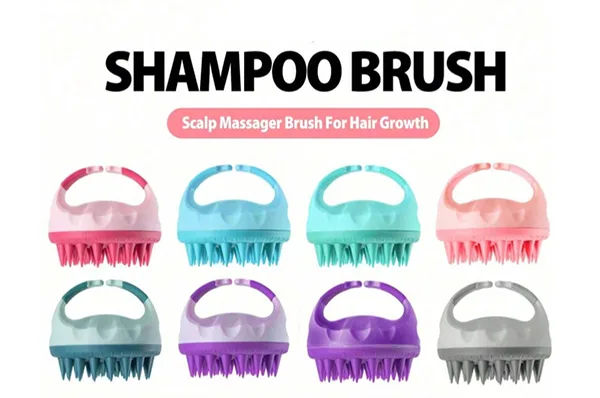
Introduction: Why Silicone Scalp Brush Design is important in the Scalp Care Market
The silicone scalp brush has evolved from a simple shampoo accessory into a recognizable product category within the hair care and personal care market.
For consumers, a scalp brush may look like a relatively simple product. For brands, however, creating a successful silicone scalp massager involves much more than choosing a silicone color and adding a logo.
A competitive product may require decisions about:
- Overall product shape
- Ergonomic structure
- Silicone hardness
- Bristle length
- Bristle density
- Handle design
- Mold construction
- Material selection
- Color matching
- Logo placement
- Packaging
- Production method
- Quality control
This is why experienced silicone scalp brush manufacturers play an important role in helping brands transform a basic product concept into a commercially viable product.
Instead of simply manufacturing a buyer’s drawing, an experienced OEM/ODM manufacturer can participate in product development, evaluate manufacturing feasibility, recommend material and structural improvements, develop molds, produce samples, and then scale the approved design into mass production.
Beaut-LOHAS provides OEM and ODM silicone product manufacturing for global brands, with capabilities covering product development, custom mold development, silicone molding, branding, packaging, quality control, and scalable production. The company reports more than 15 years of ODM experience, a team of 50+ R&D engineers, more than 1,000 existing molds, a 3,000 m² factory, and 50+ QC inspectors.
So how exactly can a silicone scalp brush manufacturer help a brand create a unique product?
Let’s examine the complete development process.
1. Start With the Brand’s Product Concept
The first stage is not manufacturing.
It is understanding what the brand wants to achieve.
Before discussing molds or production quantities, an experienced manufacturer should understand the product’s intended market and positioning.
A buyer may approach a factory with a simple request:
“We want a private label silicone scalp massager.”
But this description is not enough to develop a differentiated product.
A manufacturer may need to understand:
- Who will use the product?
- What price range is targeted?
- Is the product positioned as premium or mass-market?
- Will it be sold online or through physical retail?
- Is it designed for home users or professional salons?
- Does the brand already have a visual identity?
- Does the buyer need a completely new mold?
- Is the product intended to become part of a larger hair care collection?
These questions influence almost every subsequent design decision.
Designing for Different Brand Positions
A premium beauty brand may want:
- Minimalist geometry
- Soft-touch silicone
- Neutral colors
- Refined branding
- Premium packaging
An e-commerce brand may prioritize:
- Eye-catching colors
- Comfortable ergonomics
- Distinctive shapes
- Attractive packaging
- Social-media-friendly appearance
A professional salon brand may focus more heavily on:
- Durability
- Easy cleaning
- Comfortable handling
- Frequent-use performance
- Functional design
Therefore, a good silicone scalp massager manufacturer should not simply copy an existing product.
The design should be connected to the brand’s commercial positioning.
2. Convert a Product Idea Into a Manufacturable Design
Many brands have a concept but do not have engineering drawings.
This is common among startups, beauty companies, Amazon sellers, and product managers who understand their target customer but do not have an in-house engineering team.
An experienced OEM/ODM manufacturer can help convert the concept into a manufacturable product.
The development process may include:
- Concept discussion
- Product specification
- Structural design
- 3D modeling
- Design-for-manufacturing review
- Prototype development
- Mold development
- Sample approval
- Mass production
The goal is not simply to make the product look attractive.
It must also be manufacturable, consistent, comfortable to use, and commercially practical.
Beaut-LOHAS describes its OEM/ODM service as a one-stop process covering design through delivery and offers custom mold development for silicone products.
3. Develop a Unique Scalp Brush Shape
Shape is one of the easiest ways for a brand to differentiate a silicone scalp massager.
Instead of using a generic round brush, brands can explore:
- Round shapes
- Oval shapes
- Octagonal designs
- Ergonomic shapes
- Compact travel designs
- Wide-head designs
- Multi-function structures
For example, Beaut-LOHAS offers scalp brush designs including octagonal, round, and UFO-style concepts, while also supporting new mold development.
The important point is that shape should not be selected only for visual appeal.
It should also consider:
- Grip comfort
- Product balance
- Hand size
- Wet-hand usability
- Storage
- Manufacturing feasibility
- Packaging dimensions
A professional manufacturer can evaluate these factors before the design reaches mass production.
4. Customize the Silicone Bristle Structure
The silicone bristles are one of the most important functional elements of a scalp brush.
They determine much of the user’s physical interaction with the product.
Brands can potentially customize:
- Bristle length
- Bristle thickness
- Bristle density
- Tip shape
- Bristle arrangement
- Bristle hardness
Bristle Length
Longer bristles may create a different contact experience from shorter bristles.
A design intended for thick hair may require a different structure from a compact brush designed for general daily use.
Bristle Density
More densely arranged bristles can create a different tactile experience from widely spaced bristles.
The manufacturer needs to balance:
User experience + cleaning performance + material behavior + mold feasibility.
Bristle Tip Design
Possible designs include:
- Rounded tips
- Tapered tips
- Cone-style tips
- Different-height bristles
For consumer products, the transition between design concept and actual molded result is particularly important.
A 3D model may look excellent on a screen but require modification after sampling.
That is why prototype testing is an important stage in OEM development.
5. Select the Right Silicone Material and Hardness
Material selection has a direct impact on the final product.
A silicone scalp brush needs to balance:
- Flexibility
- Durability
- Tactile feel
- Shape retention
- Surface quality
- Intended application
A manufacturer should therefore discuss material requirements before mold production.
Beaut-LOHAS states that it assists customers with raw-material selection and offers silicone materials for different product applications. Its manufacturing solution includes both LSR injection molding and silicone compression molding.
Silicone Hardness
Different hardness levels can create noticeably different user experiences.
Softer Silicone
Potentially suitable for brands seeking:
- Gentle tactile contact
- Flexible bristles
- A softer consumer experience
Medium Silicone
Can provide a balance between:
- Flexibility
- Structural stability
- Daily-use performance
Firmer Silicone
May be considered when the brand wants:
- More pronounced bristle support
- A stronger tactile experience
- A more structured product
The correct hardness should be determined according to the product design and target application rather than simply selecting the cheapest material.
6. Use Mold Development to Create a Truly Unique Product
If a brand wants a genuinely distinctive silicone scalp brush, mold development is often one of the most important stages.
A stock product with a printed logo can create a private label product.
A custom mold can create a product that is structurally differentiated.
That difference matters.
What Can a Custom Mold Change?
A new mold can define:
- Product dimensions
- Shape
- Handle structure
- Bristle arrangement
- Logo integration
- Surface details
- Decorative elements
For example, a brand could create a proprietary scalp brush with a specific geometric shape and unique bristle configuration rather than simply adding its logo to an existing model.
Beaut-LOHAS maintains more than 1,000 existing molds and also provides custom mold development for new silicone products.
This creates two potential development paths for buyers:
Existing Mold + Customization
Best when the brand wants:
- Faster development
- Lower tooling investment
- Simpler customization
New Mold Development
Best when the brand needs:
- Unique product geometry
- Proprietary structure
- Greater visual differentiation
- Long-term product identity
7. Integrate the Brand Logo Into the Product Design
Branding should ideally be considered during product design rather than added at the very end.
A manufacturer can help determine:
- Logo size
- Logo position
- Logo orientation
- Branding method
- Surface suitability
Beaut-LOHAS supports several branding approaches, including silk-screen printing, laser engraving, pad printing, embossing, and debossing.
Molded or Embossed Branding
For silicone products, integrated branding can create a clean and durable appearance.
Possible approaches include:
- Embossed logo
- Debossed logo
- Molded logo
These methods can be particularly suitable for minimalist brands that want branding to become part of the product itself.
Printed Branding
Printing provides additional flexibility for:
- Detailed logos
- Multi-color branding
- Promotional designs
However, the appropriate method should be evaluated based on the product surface, intended use, and brand requirements.
A professional manufacturer can recommend the most practical branding method after reviewing the logo artwork.
8. Create a Signature Brand Color
Color is another powerful design tool.
A silicone scalp massager can be produced in a brand-specific color instead of a standard factory color.
Beaut-LOHAS provides Pantone color matching and allows customers to use their own brand palette.
This allows a brand to create consistency across:
- Scalp brushes
- Body scrubbers
- Facial cleansing tools
- Packaging
- Website graphics
- Social media content
For example, a skincare brand may use a consistent sage green across its silicone tools.
A premium beauty brand may use:
- Cream
- Beige
- Black
- Muted pink
A younger lifestyle brand may choose:
- Lavender
- Bright blue
- Coral
- Mint
The objective is not simply to make the product colorful.
The objective is to make the product recognizable.
9. Design for Ergonomics, Not Just Appearance
A unique design must still be comfortable to use.
This is an area where manufacturer experience can make a significant difference.
The design team should consider:
- Hand size
- Grip area
- Product weight
- Handle thickness
- Finger positioning
- Wet-hand handling
- Storage
For a shampoo brush, ergonomics are particularly important because the product is often used in a wet environment.
A beautiful product that is uncomfortable to hold may generate poor customer feedback.
Therefore, manufacturers should evaluate the physical interaction between:
Hand → Handle → Product → Scalp.
10. Consider Hygiene and Cleaning During Product Development
Scalp care products are frequently exposed to:
- Water
- Shampoo
- Hair products
- Oils
- Moisture
Therefore, hygiene and cleanability should be considered during product design.
The structure should ideally minimize unnecessary areas where water or product residue can accumulate.
A professional manufacturer can review:
- Openings
- Seams
- Cavities
- Surface geometry
- Drainage
- Cleaning access
This is especially important when developing multi-part or multi-function products.
The goal is to create a design that is not only visually unique but also practical for repeated consumer use.
11. Select the Right Manufacturing Process
The manufacturing process can influence both product quality and design possibilities.
Two important silicone manufacturing methods include:
Silicone Compression Molding
This process is widely used for silicone products and can support a variety of custom product structures.
LSR Injection Molding
Liquid Silicone Rubber injection molding is an automated, high-precision process suitable for high-volume production and complex designs.
Beaut-LOHAS states that its manufacturing capabilities include both LSR injection molding and silicone compression molding, with LSR particularly suitable for high-volume orders and detailed designs.
The appropriate process depends on:
- Product geometry
- Material requirements
- Production volume
- Tolerance requirements
- Tooling design
- Cost objectives
This is another reason brands should involve the manufacturer early in the design process.
12. Prototype Before Mass Production
One of the biggest mistakes in product development is moving directly from concept to mass production.
A prototype provides an opportunity to evaluate the actual product.
Brands can check:
- Shape
- Size
- Color
- Bristle flexibility
- Grip
- Logo appearance
- Packaging fit
Beaut-LOHAS states that prototypes and samples can typically be prepared within 3–7 business days after design confirmation, depending on the project.
The sample stage should be treated as a product-development checkpoint.
What Should Buyers Test?
Before approving a production sample, buyers should ask:
Design
Does the product look like the approved concept?
Function
Does it provide the intended user experience?
Material
Is the silicone hardness correct?
Branding
Is the logo clear and correctly positioned?
Color
Does the color match the approved standard?
Packaging
Does the product fit securely inside the packaging?
Only after these factors are confirmed should the project move toward mass production.
13. Design Packaging as Part of the Product
For consumer beauty products, packaging is not separate from product design.
The product and packaging should communicate the same brand identity.
A manufacturer that can handle both product customization and packaging can simplify the development process.
Beaut-LOHAS supports custom retail boxes, kraft packaging, gift boxes, inserts, multilingual packaging, and other OEM packaging options.
Packaging Can Be Used to Communicate:
- Brand story
- Product benefits
- Usage instructions
- Material information
- Care instructions
- Regulatory information
For Amazon or other e-commerce brands, packaging can also be designed around shipping and retail requirements.
This is particularly important because packaging must balance:
Appearance + protection + shipping efficiency + cost.
14. Combine the Scalp Massager With a Larger Product Line
A custom scalp brush does not have to exist as a standalone product.
Brands can create a complete scalp-care collection.
For example:
Scalp Care Starter Kit
- Silicone scalp massager
- Shampoo
- Scalp serum
- Hair treatment
Beauty Gift Set
- Scalp brush
- Body scrubber
- Facial cleansing tool
- Gift packaging
Salon Professional Kit
- Scalp massager
- Hair treatment accessories
- Professional packaging
This strategy allows brands to build a consistent product ecosystem rather than relying on one SKU.
Because Beaut-LOHAS manufactures multiple categories of silicone personal-care products, brands can potentially develop complementary silicone tools through the same supplier.
15. How a Silicone Scalp Brush Manufacturer Helps Reduce Development Risk
Working with an experienced manufacturer can reduce several common product-development risks.
Risk 1: Design Cannot Be Manufactured
A product may look good in a 3D drawing but be difficult to mold.
Solution: Conduct DFM review before tooling.
Risk 2: Bristles Are Too Hard or Too Soft
The final product may not match the intended consumer experience.
Solution: Test silicone hardness during sampling.
Risk 3: Logo Quality Is Poor
The logo may be difficult to see or positioned incorrectly.
Solution: Test different branding methods during prototype development.
Risk 4: Color Does Not Match the Brand
A standard factory color may not match the brand’s visual identity.
Solution: Use approved color references and Pantone matching.
Risk 5: Packaging Does Not Fit
The final product may require packaging modifications.
Solution: Develop product and packaging specifications together.
16. Existing Mold vs. New Mold: Which Development Path Should Brands Choose?
This is one of the most important decisions for buyers.
Option A: Existing Mold
Use an existing factory design and customize:
- Color
- Logo
- Packaging
Advantages
- Faster development
- Lower tooling requirements
- Lower initial risk
- Suitable for market testing
This option can be attractive for startups and brands launching their first scalp-care SKU.
Option B: New Custom Mold
Develop a completely new product.
Advantages
- Greater differentiation
- Proprietary product structure
- More control over design
- Stronger long-term brand identity
This approach is generally more suitable for established brands or companies with a clear product concept.
A manufacturer with a large existing mold library can support both approaches.
17. What Buyers Should Ask a Silicone Scalp Brush Manufacturer
Before choosing an OEM partner, buyers should ask:
- Can you develop a completely new mold?
- Can you modify an existing scalp brush design?
- What silicone materials and hardness options are available?
- Can you customize the bristle structure?
- Can you match my Pantone color?
- Which logo methods do you support?
- Can you develop custom packaging?
- What is the sample lead time?
- What is the MOQ for my specific customization?
- Can you scale production when demand increases?
These questions help buyers distinguish a true manufacturing partner from a supplier that only provides standard catalog products.
18. Why Beaut-LOHAS Is Designed for Custom Silicone Scalp Brush Projects
For brands seeking a combination of product development and manufacturing, Beaut-LOHAS offers several capabilities relevant to custom scalp brush projects.
The company describes itself as a factory-direct silicone manufacturer with in-house tooling and molding capabilities. Its stated resources include 50+ R&D engineers, 1,000+ existing molds, a 3,000 m² manufacturing facility, and 50+ QC inspectors.
Its customization services include:
- Custom colors
- Pantone matching
- Custom materials
- Logo branding
- Custom surfaces
- Custom sizes
- Mold development
- Retail packaging
- Gift packaging
- OEM/ODM manufacturing
For production, Beaut-LOHAS reports capabilities in LSR injection molding and silicone compression molding, allowing product development to transition from prototype to scalable production.
This integrated model can be particularly useful for brands that do not want to coordinate separately with:
Designer → Mold factory → Silicone factory → Printing supplier → Packaging factory → QC company.
Instead, a one-stop manufacturing partner can coordinate more stages of the project.
19. A Practical Development Roadmap for Your Custom Scalp Brush
For brands planning a new project, the following roadmap can make the process easier.
Stage 1 — Define the Market
Identify:
- Target customer
- Sales channel
- Price positioning
- Product concept
Stage 2 — Select the Product Direction
Choose:
- Existing model
- Modified model
- Completely new design
Stage 3 — Confirm Specifications
Define:
- Size
- Shape
- Bristle structure
- Silicone hardness
- Color
- Logo
Stage 4 — Engineering Review
The manufacturer checks:
- Mold feasibility
- Manufacturing method
- Material requirements
- Estimated production cost
Stage 5 — Prototype
Evaluate:
- Appearance
- Ergonomics
- Function
- Branding
Stage 6 — Mold Development
Create or modify the production mold.
Stage 7 — Final Sample Approval
Confirm:
- Product
- Color
- Logo
- Packaging
Stage 8 — Mass Production
Proceed with:
- Silicone molding
- Branding
- QC
- Packaging
- Shipment
This structured process helps reduce unexpected changes during mass production.
20. How to Make a Silicone Scalp Brush More Competitive
A unique design does not necessarily mean adding more features.
Sometimes, the most commercially effective design is simply a better-executed product.
Brands can focus on five key areas:
Better Ergonomics
Make the product easier and more comfortable to hold.
Better Bristle Design
Create a differentiated tactile experience.
Better Material Selection
Choose silicone characteristics appropriate for the intended application.
Stronger Brand Identity
Use consistent:
- Color
- Logo
- Shape
- Packaging
Better Manufacturing Consistency
Ensure every production batch matches the approved sample.
The goal should be:
Distinctive enough to stand out, practical enough to manufacture, and consistent enough to scale.
Frequently Asked Questions About Custom Silicone Scalp Brush Design
Can a manufacturer create a completely new silicone scalp brush design?
Yes. OEM/ODM manufacturers with product-development and tooling capabilities can develop new shapes and molds based on a brand’s concept, drawings, or specifications.
Can I customize the silicone hardness?
In many projects, yes. Silicone hardness can be discussed and tested according to the desired product characteristics and application.
Can I customize the bristles?
Yes. Depending on the mold and product structure, buyers can discuss bristle length, shape, density, arrangement, and hardness with the manufacturer.
Can I use my own brand color?
Yes. Beaut-LOHAS offers Pantone color matching for customized silicone products.
Can I put my logo directly into the silicone?
Yes. Depending on the product design, options may include embossed, debossed, printed, laser-engraved, or other branding methods.
Can the packaging also be customized?
Yes. Custom packaging options include retail boxes, kraft boxes, gift boxes, inserts, and other OEM packaging solutions.
Should I use an existing mold or develop a new mold?
If speed and lower initial development complexity are the priority, an existing mold with custom color, logo, and packaging can be a practical starting point.
If product differentiation and proprietary design are more important, a new mold may be more appropriate.
The best choice depends on the brand’s product strategy, budget, expected order volume, and desired level of differentiation.
Conclusion: A Good Manufacturer Can Become Part of Your Product Design Team
Creating a unique silicone scalp brush is not simply about adding a logo to an existing product.
A successful product combines:
- Market positioning
- Product concept
- Ergonomic design
- Silicone material
- Bristle structure
- Custom colors
- Branding
- Mold engineering
- Packaging
- Quality control
- Scalable manufacturing
This is where an experienced silicone scalp brush manufacturer can provide value beyond basic production.
The right OEM/ODM partner can help a brand move from:
Idea → Design → Prototype → Mold → Sample → Production → Market
Instead of treating the factory as the final step after product design, brands can involve the manufacturer from the beginning.
For emerging beauty brands, this can help identify manufacturing problems earlier.
For established brands, it can provide a pathway to develop proprietary products and expand their hair-care portfolio.
Beaut-LOHAS supports custom silicone scalp massager development with OEM/ODM manufacturing, mold development, color matching, logo customization, packaging solutions, quality control, and scalable silicone production.
If your brand has a silicone scalp brush idea, product drawing, reference sample, or simply a concept, Beaut-LOHAS can help turn that idea into a manufacturable product. Contact the team to discuss your custom silicone scalp brush project, target specifications, MOQ, sampling, branding, and packaging requirements.