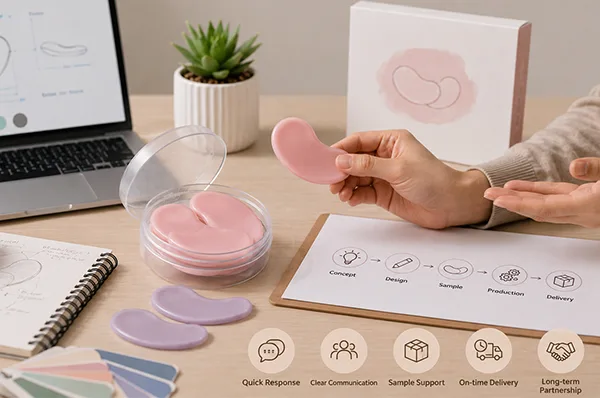
Regarding purchasing silicone eye patches, the effectiveness of communication from suppliers goes far beyond receiving a fast response to an email query. During the process of product development, fast communication, technical assistance, sample responses, accurate quotations, and information on the production process can affect the successful launch of the project.
Even if a distributor has good sales prospects, poor responsiveness from the manufacturer can become a problem immediately. Late samples will delay product testing. Lack of timely information regarding customizations will cause delays in developing packages. Poor information on production can complicate inventory planning.
For that reason, experienced distributors consider communication skills and responsiveness from silicone eye patches suppliers along with other factors such as product quality and pricing.
A good supplier should be capable of:
- Quickly comprehending product specifications
- Providing precise technical data
- Efficiently reacting to changes in designs
- Arranging samples on time
- Reporting progress in production
- Predicting possible issues in production
- Offering realistic delivery timelines
- Supporting private label and OEM product development
In case of distributors dealing with beauty stores, skincare product manufacturers, salons, spas, and even online shops, such capabilities could either lead to a successful product launch or result in additional expenses.
As a competent OEM and ODM manufacturer, beaut-lohas.com cooperates with international distributors and beauty product brands in the production of customized silicone eye patches. The following article will describe all crucial points distributors need to consider regarding supplier responsiveness during development.
1. The Importance of Supplier Responsiveness in Silicone Eye Patch Development Process
There is almost never a linear process of product development.
The common steps of development can include:
Product concept → Design → Quotation → Sample → Testing → Adjustment → Packaging → Production → Inspection → Shipping
Distributors may want to make adjustments at each step of the process.
For instance, while initially asking for a regular silicone eye patch, the distributor could change his mind and want to:
Change the shape of the patch
Alter the thickness
Change the color of silicone used
Add a logo
Adjust packaging
Make an enlarged patch
Make a private label
If the supplier reacts late, it will impact all the subsequent steps.
Hence, responsiveness must be regarded as one of the supplier’s services.
2. What Do We Actually Understand by the Term ‘Supplier Responsiveness’?
Supplier responsiveness implies a few aspects.
Communication Efficiency
How fast can the supplier respond to:
- E-mails
- Messages on WhatsApp
- Questions regarding design
- Requests for quotation
- Technical issues
Efficient communication is important, but efficiency alone will not suffice.
Response Quality
The supplier can respond to a request within ten minutes but give not all details.
The quality response from an experienced supplier should be:
- Specific
- Correct
- Relevant
- Understandable
Problem-Solving Ability
Problems during the development stage are typical.
As an example:
“Such shape is impossible to demold.”
An efficient supplier should not give an answer of “No”.
Ideally, an efficient supplier should:
- Explain why the problem arises
- Say what manufacturing limit is faced
- Tell how to change the design to get around the limit
- Tell if the modification impacts cost or delivery time
This demonstrates real manufacturing expertise.
3. The First Reaction: Assessing the Supplier for the First Time
A great deal can be learned from the first enquiry.
Before you send an enquiry, create an initial sourcing brief that will include:
- Product category
- Target market
- Quantity
- Material needed
- Product sizes
- Logo requirements
- Packaging requirements
- Target delivery date
And then see what the supplier says.
The best silicone eye patches supplier must cover all important issues, instead of giving just a standard price list.
Good reaction
The proper answer might include:
- Product suggestions
- Customization possibilities
- MOQ
- Information on samples
- Lead time in production
- Packaging possibilities
- Technical questions
Bad reaction
The bad reaction might consist of only:
“Yes, we can do it. Tell us the quantity.”
It gives little information for a distributor to assess the project.
4. How Fast Can the Supplier Get the Grasp of Your Requirements?
Requirements understanding is a priority, not fast reply.
Let’s consider a request from a distributor:
“We require reusable silicone eye patches for a high-quality European cosmetic brand.”
A competent supplier would raise some important questions, like:
- What shape do you want?
- What size is needed?
- What color silicone is required?
- Is it reusable?
- Is it with a logo?
- What kind of packaging do you need?
- How much product do you expect?
- Do you need a custom-made mold?
These questions prove that the supplier has an understanding of the process.
5. Assessing the Response for Accuracy
The distributors should assess the supplier’s response against the manufacturing needs.
If a supplier provides the following:
- New and custom shape
- Low MOQ
- Short lead time
- High customization
at an unusually low price, the distributors should dig deeper into it.
A professional manufacturer should differentiate between:
Standard Product
Easy and quick to manufacture.
Modified Product
Needs adjustment either in design or production process.
Custom Product
Can include:
- New mold creation
- Prototype testing
- Engineering analysis
- More production time
Clear understanding on this point can help the distributors to avoid any unforeseen expenses.
6. Sample Development Responsiveness
The sample development process is among the key processes that should be used to assess the supplier’s performance.
The distributor should evaluate:
- How fast samples are arranged
- If the sample corresponds to the approved design
- If any modifications are informed
- How fast modifications of the samples are made
Why Samples Are Important
In the case of silicone eye patches, even minor details may affect the final result:
- Shape
- Thickness
- Flexibility
- Edge Design
- Surface Finish
- Color
- Logo Placement
A supplier that responds efficiently to sample feedback can significantly shorten development time.
7. How Suppliers Manage Design Changes
Design changes can be expected in OEM work.
For instance:
#1 Design: Regular under-eye design
#2 Design: Extended coverage
#3 Design: Contoured shape
#4 Design: Final branded design
It will be useful for the distributor to see how the manufacturer responds to design changes.
A good supplier would make it clear if the following are true of the change:
- Can it be done technically?
- Does it need a new mold?
- Is there a new price?
- Is there a new lead time?
- Can a new sample be given?
This transparency is a strong indicator of supplier responsiveness.
8. Technical Communication for Silicone Eye Patch Production
Technical communication takes on increased significance during the development of custom silicones.
Examples of topics covered may include:
- Silicone hardness
- Product thickness
- Mold structure
- Surface finish
- Edge design
- Logo imprinting
- Color matching
- Packaging requirements
Distributors do not have to be experts in silicone manufacturing.
The distributor should thus be capable of discussing technical matters in business language.
For instance:
Instead of:
“Draft angle is insufficient.”
The proper way of explaining it would be:
“Current edge design could be causing problems with demolding. It might be wise to tweak edge angle a little bit to increase process reliability.”
Such communication helps distributors make more timely decisions.
9. Quotation Responsiveness Evaluation
The price quotations are the other crucial area that is to be evaluated.
The professional quotation will include:
- Unit price
- MOQ
- Sample cost
- Mold cost
- Packaging cost
- Logo cost
- Estimated lead time
- Shipping terms
The distributors must not choose suppliers who constantly give incomplete quotations.
Compare More Than Unit Price
For example:
| Cost Factor | Supplier A | Supplier B |
|---|---|---|
| Unit Price | Low | Medium |
| Mold Cost | Unclear | Clear |
| Packaging | Extra | Included |
| Sample Cost | Unclear | Clear |
| Lead Time | Unclear | Confirmed |
| Customization | Limited | Flexible |
Supplier B may ultimately provide better commercial value even if the initial unit price is higher.
10. Responsiveness During Packaging Development
When it comes to private label silicone eye patches, packaging development is usually directly related to product development.
The distributors might need to coordinate:
- Size of product
- Storage case
- Retail box
- Insert card
- Logo
- Barcode
- Instructions for use
The responsive supplier should facilitate compatibility between the product and packaging sizes.
For instance, if the eye patches get thicker during product development, the storage case might require changes as well.
Lack of communication will lead to packaging issues prior to mass manufacturing.
11. Logo and Private Label Communication
Branding is crucial when it comes to distributors who are designing private label products.
There needs to be confirmation on the part of the supplier regarding the following:
- logo artwork specifications
- the logo size
- logo placement
- printing method
- color specifications
- sample approval process
In the case of premium products, even one mistake in logo placement can make customers unhappy.
Hence, it’s recommended that distributors check if the supplier has a sample approval process.
12. Responsiveness to Production Update
After samples have been approved, communication should not be halted.
In mass production, distributors will require updates on:
- Beginning of production
- Production status
- Packaging
- Inspection
- Completion
- Shipping
A good supplier should update about these significant events automatically.
It is particularly useful when distributors have predetermined retail launch dates.
13. Handling of Delay by Suppliers
No production unit can ensure that something unpredictable will not arise.
The important point here is:
How does the supplier react to the unforeseen issue?
In many cases, a supplier can find:
- Delays in raw materials
- Issues with molds
- Delay in packaging
- Problems with production capacity
An inferior supplier may decide to mention the problem at the very deadline date.
A responsive supplier must inform about the problem as soon as possible.
A proper reaction is as follows:
Issue -> Problem -> Solution -> New Deadline
This makes it possible for distributors to reconsider their own schedules.
14. After-Sales Responsiveness
Supplier evaluation does not end after delivery.
The distributors may find problems like:
- Damage to packaging
- Quantity discrepancies
- Color variation
- Defective products
- Accessories missing
An efficient supplier must react swiftly and come up with an appropriate solution.
After sales responsiveness is critical when dealing with distributors who have many downstream customers.
15. Supplier Responsiveness and Inventory Management
Supplier responsiveness is tied up directly with inventory management for distributors.
The delay in responsiveness may impact:
- Re-ordering decisions
- Inventory levels
- Marketing promotions
- New product introductions
For instance, when a distributor anticipates an increase in demand before the launch of any big campaign for beauty products, the manufacturer has to be responsive regarding the following factors:
- Capacity
- Availability of raw materials
- Lead times
- Order size
Effective communication makes distributors make good purchasing decisions.
16. Measuring Supplier Responsiveness With a Simple Scorecard
Distributors can create a supplier evaluation system.
Recommended scoring categories:
| Evaluation Factor | Weight |
|---|---|
| Response Speed | 15% |
| Response Accuracy | 20% |
| Technical Support | 15% |
| Sample Development | 15% |
| Customization Support | 10% |
| Production Updates | 10% |
| Problem Solving | 10% |
| After-Sales Support | 5% |
This creates a more objective evaluation than simply asking:
“Does the supplier reply quickly?”
17. Warning Signs When Evaluating Suppliers
Distributors need to be alert about certain warning signs.
Warning Sign 1: Frequent Delays
Frequent delays are not acceptable.
Frequent delays during the critical development process could mean poor project management.
Warning Sign 2: Inconsistencies Between Different Workers
Inconsistency of information could cause serious problems.
For instance:
- Sales says MOQ is 500 units
- Factory says MOQ is 5,000 units
The distributor wants a well-coordinated supplier.
Warning Sign 3: Lack of Approval for Sample
Mass production should not start without:
- Approval of product design
- Color approval
- Logo approval
- Packaging approval
Warning Sign 4: Failure to Answer Technical Questions
In case a supplier is unable to properly explain manufacturing constraints, distributors need to probe further into this matter.
18. Direct Factory vs Trading Company Responsiveness
In addition, distributors need to determine if they are dealing with the factory directly.
Direct factory procurement is capable of providing:
- Improved technical communications
- Immediate engineering input
- Enhanced production visibility
- Effective customization discussions
Trading companies are capable of offering a lot of useful services, yet distributors need to understand who controls the production process.
In complicated projects of custom silicone eye patches, direct manufacturing capabilities may help in better communication.
19. Why beaut-lohas.com is a Good Partner for Distributors
When producing customized silicone under eye patches, it is important that the manufacturer offers something more than competitive prices.
At beaut-lohas.com, we have an OEM/ODM model to assist distributors during the product development process.
Product Development
The following things can be covered:
- Product concept discussions
- Shape customization
- Size customization
- Silicone color choice
- Product optimization
Custom Branding
Customizing can cover:
- Logo customization
- Private label products
- Custom packaging
- Brand-oriented product presentation
Sample Development
Development process includes the following steps:
Requirement confirmation → Design → Sample → Feedback → Modification → Final approval
Production Assistance
After final approval, manufacturers must stay in touch to coordinate the following issues:
- Production scheduling
- Quality control
- Packaging
- Order completion
This helps distributors manage their projects with greater confidence.
20. Questions to Ask the Supplier of Silicone Eye Patch
A distributor may consider using this list before starting their projects.
Product
- What silicone do you use?
- Is it possible to make changes in shape?
- Is it possible to change thickness?
- Is it possible to change the color of the product?
Customization
- Is it possible to print our logo?
- Can you create a new mold?
- Is it possible to make changes to the packaging?
Samples
- How long is sample development going to take?
- How many revisions of samples is available?
- Is it possible to change samples after testing?
Production
- What is the minimum order quantity?
- What is the standard time of production?
- Is it possible to increase production capacity?
Quality
- How is the material quality control done?
- How are the products checked?
- What kind of quality documentation can be provided?
Communication
- Who is going to be responsible for the project?
- How often are production updates going to be made?
- How are urgent issues going to be solved?
These answers show the capabilities of the supplier more than the price.
21. Best Practices to Establish a Sustainable Supplier Partnership
Responsiveness is not solely the role of the supplier. The distributor may enhance collaboration by ensuring the provision of sufficient information.
Provide Full Specifications
Instead of writing:
“We require a high quality eye patch.”
Write:
- Target market
- Product size
- Preferred material
- Colors
- Logo design
- Package
- Quantity estimation
Approval Process Must Be Clear
For instance:
Design approval → Sample approval → Package approval → Production approval
This prevents confusion.
Maintain a Project Folder
Include all necessary information:
- Artwork approval
- Product size
- Pictures of samples
- Package specifications
- Order form
- Quality specifications
This helps both sides work from the same information.
22. FAQs: Silicone Eye Patch Supplier Responsiveness
How responsive does a supplier need to be?
The supplier should be prompt and accurate when communicating through the quotation, sampling, customization, production, inspection, and delivery process.
Is response faster than price?
Response speed is important, yet other factors such as response quality, manufacturing capacity, product consistency, and price should not be overlooked.
Why is sample responsiveness essential?
Samples give distributors the opportunity to check the product before production. Quick and accurate samples can help save lots of time during the development phase.
Should distributors communicate directly with the factory?
It is possible for distributors to communicate directly with the factory for complex OEM projects, but what really matters is the manufacturing capacity of the supplier.
What is a good silicone eye patch supplier?
A strong supplier combines product quality, customization capability, reliable production, transparent communication, competitive pricing, and responsive after-sales support.
Conclusion
For distributors, assessment of silicone eye patches suppliers should be much more complex than just looking at prices per unit.
Manufacturer responsiveness may have a great impact on the whole process of product development starting from the quotation up to its shipment.
Among other criteria, such factors should be considered:
✅ Quick and precise communication
✅ Technical competence
✅ Sample development speed
✅ Customization flexibility
✅ Detailed quotations and costs
✅ Production notifications
✅ Problem resolution efficiency
✅ After sales services
For distributors looking to build a long-term business in beauty products, an accommodating manufacturer can help to lower development risks, increase speed-to-market, and facilitate more efficient logistics management.
Sourcing silicone under eye patches requires selecting a manufacturer who can communicate well, be accommodating, and customize the products, which is an integral part of creating a product line.
With OEM/ODM manufacturing ability, customization services, and expertise in producing silicone beauty products, beaut-lohas.com can assist in the development of private label silicone eye patches.