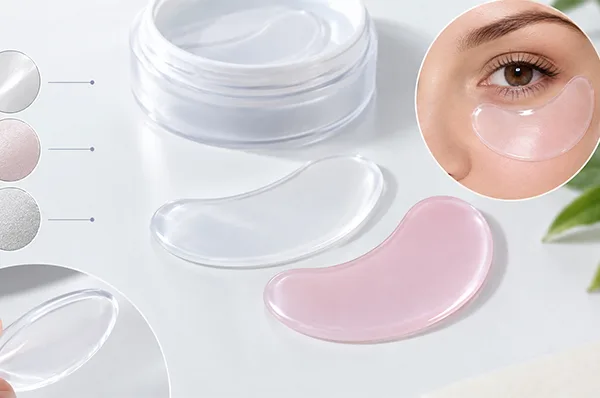
In cases where buyers purchase silicone under eye patches, the surface finish tends to be viewed as a cosmetic aspect. The truth is that this attribute may affect the tactile sensation, how secure the patch will remain in place, its ease of cleaning, appearance under different lighting, and consistent manufacturing.
Two silicone under eye patches may feature identical silicone material and shape, yet they will offer a very different experience for the customer because of a difference in their surface finishes.
In business-to-business (B2B) purchases, it becomes essential to consider surface finish as a key attribute of product development and not just as a choice in making molds.
A surface finish may be related to the following aspects:
- Smoothness/Roughness
- Gloss/Matte
- Mold Texture
- Microtexture
- Surface Uniformity
- Tactility
- Surface Defects
- Ease of Demolding
- Surface Finish on Skin Side vs Outer Side
The optimal finish for reusable silicone under eye patches depends upon the positioning and performance criteria of the product. If an upscale skin-contact patch is needed, a smooth and soft contact finish might be desired, while another brand could aim for a less sticky handling experience by using a regulated matte finish.
Studies on skin contact with silicone show that surface roughness affects friction and adhesion, even though the exact effect differs depending on factors like the hardness of the silicone, surface roughness, and application method.
Knowledge of this relationship will be helpful in avoiding costly errors in mold design and mass production of priviate lable silicone under eye patches.
What Is Silicone Surface Finish?
The surface finish of a silicone is the set of physical properties and appearance of the silicone surface post-molding process and all additional processes.
It is not a matter of defining a product as either “smooth” or “rough”.
A silicone under eye patch may have:
- High gloss smooth surface
- Satin surface or semi-matte finish
- Matte finish
- Microtexture surface
- Embossed designs
- Textured decoration
- Various surfaces for different sides
The final surface is largely determined by the surface of the mold.
For injection or compression molded silicone products, the mold cavity can be polished, textured, etched or treated in other ways to create the desired surface appearance and tactile qualities.
Therefore, the surface finish needs to be taken into account in mold design and cannot be always remedied if the silicone patch has already been molded.
For the silicone under eye patch, consumers should normally consider at least three surface areas:
- Skin contact surface
- Outer visible surface
- Edges and perimeter
Each area may have its own functional purpose.
The skin contact surface is generally the most critical one because of direct contact with the sensitive skin underneath eyes.
Reasons for Importance of Surface Finish in Under-Eye Patches
Surface finish has more importance beyond aesthetics.
With regard to reusable silicone under-eye patches, it may affect multiple properties at once.
1. Skin contact
Smooth surface will allow tight contact with the skin. It is particularly crucial when a patch relies on natural properties of soft silicone without any adhesive.
Studies of friction and adhesion between silicone materials and artificial skin revealed that surface roughness affects the process along with material hardness.
2. Comfort
Skin around and under the eyes is sensitive. Aggressive feel may become unpleasant, particularly after wearing the patch for some time.
3. Grip
Texture can affect the interaction between skin and silicone but does not guarantee better grip.
According to one experiment, increasing roughness decreased friction due to reduced contact area while soft silicone was less responsive to changes in roughness due to deformability of surface features.
4. Cleaning
Eye patches made for reuse will need to be cleaned after being worn. Some surface textures may have deep patterns that could allow for more spots for cosmetics, oils, or other residues to stick around.
5. Appearance
The three types of surface textures can affect appearance.
6. Manufacturing Consistency
An uneven mold finish can cause discrepancies from cavity to cavity, production run to production run, or areas of the same product.
When ordering bulk quantities such as thousands to tens of thousands of units, this factor is especially important for B2B clients.
Smooth Finish vs Matte Finish
The most frequent dilemma that arises while developing silicone under eye patches is choosing between smooth and matte finishes.
Neither finish is superior to the other.
The right finish varies according to the purpose of the product.
| Surface Finish | Potential Advantages | Potential Considerations |
|---|---|---|
| Smooth | Close skin contact, soft tactile feel, easy visual inspection | May feel more tacky |
| Satin | Balanced appearance and tactile feel | Requires controlled mold finishing |
| Fine matte | Less glossy, hides minor visual marks | May alter skin-contact behavior |
| Textured | Strong visual differentiation | Can affect contact and cleaning |
| Deep texture | Distinctive appearance | More difficult cleaning and potentially less comfortable |
In terms of the skin contact side, having a good finish or smooth texture is usually a rational starting point for an under-eye patch meant for reuse.
As far as the outer surface goes, there is more leeway.
A high-end cosmetic line might prefer a satin or subtle matte finish since this will give it a more upscale look.
A more common line might like a basic smooth finish that is easy to manufacture and check.
What is important is that the surface finish should be chosen depending on the purpose of the product rather than appearance alone.
How Surface Roughness Changes Skin Contact
The association between silicone and skin is much more complex than “smooth is good.”
Two touching surfaces have real contact made by the surfaces’ microscopic features. Silicone is also highly flexible, meaning that its microscopic features can be deformed due to pressure.
It produces an association between:
- Hardness of silicone
- Roughness of surfaces
- Pressure
- Contact surface
- Condition of the skin
- Moisture
- Surface oils
- Temperature
- Motion
In a study conducted in 2019 on comparing soft silicone compounds to artificial skin, it was found out that roughness was a determinant factor of friction, and that hard silicone compounds were more susceptible to surface roughness compared to soft ones. They also came up with a minimum coefficient of friction around 4 microns in their conditions.
However, this 4 microns must not be considered as a universal standard for silicone eye patch.
This research used certain silicone compounds and certain conditions. However, an under eye patch is a different geometry, thickness, contact pressure, wear condition, and use.
As such, no professional manufacturer can claim that every reusable silicone eye patch must have a specific Ra value.
It must be considered within the context of the product.
Will a More Smooth Surface Always Be Better?
Not always.
It is critical to keep in mind when designing a product.
A very smooth silicone surface can provide a lot of contact since the material will adapt well to the skin due to the high level of flexibility.
Recent scientific research about soft silicone elastomers demonstrates that both thin and intermediate silicone films have great adhesion to very smooth surfaces; however, adhesion varies depending on the surface roughness, film thickness, and contact time.
However, an under eye patch is not the same product as a silicone adhesive patch.
Reusability cosmetics patches should combine:
Contact + comfort + retention + handling + cleaning + reusability.
An extremely sticky surface may be hard to take out from the case where it was stored.
A very smooth surface may attract more dust and lint while handling.
A highly textured surface will provide less contact and may complicate the process of cleaning.
In other words, the task is not to make the surface “smoother possible”.
The task is to make the right finish for the particular application.
Surface Texture and Comfort Wearing
Comfort is especially vital when choosing a formula for under eye patches since the product will cover a sensitive area on the face.
What might be suitable in the case of a body scrubber cannot be considered appropriate in case of an under-eye patch.
In particular, the texture that seems acceptable for a massage product is rather pronounced and it adds a pleasant tactile stimulation for the customer.
However, in the case of the under-eye patch such strong texture might be excessive and even create a feeling of discomfort.
When working on the product development process, it is important to evaluate the following aspects of the design:
- Smoothness of edges
- Uniformity of surface
- Depth of texture
- Silicone hardness
- Patch thickness
- Flexibility
- Pressure on skin
- Product weight
It is important to consider surface finish and edge design simultaneously.
No matter how smooth the central surface of the product is, an unprofessional edge design will destroy the comfort perception of the product.
In the case of a private label product, one can analyze the smoothness and uniformity of the contact area along with the rounded edges.
Surface Finish and Product Retention
The reusable silicone under eye patches are usually dependent upon the combination of flexibility of the material, skin contact, and interaction between the product and its surface for positioning.
While the surface finish may impact the above interaction, it must never be taken as a separate consideration.
For instance:
Soft silicone + smooth surface + curvature
may give a different outcome than
Harder silicone + same smooth surface + different curvature.
In addition,
Soft silicone + textured surface
may have a different performance than
Harder silicone + textured surface.
That is why surface finish specifications must be considered along with material specifications.
As far as OEM purchasers are concerned, it would be helpful for the manufacturer to test the product after its completion rather than approve a surface specification based solely on the technical drawing.
Practical testing of the prototype can involve the following factors:
- Application onto clean dry skin
- Facial movement
- Activity like walking
- Removal and re-application
- Cleaning
- Repeat usage
- Storage
Therefore, the idea is to get an evaluation of the whole process rather than any lab value.
Surface Roughness and Cleanability
Cleanability is an important factor when selecting reusable silicone under eye patches.
After usage, the surface will encounter:
- Fatty acids
- Moisturizer
- Eye cream
- Serum
- Cosmetics
- Sweat
- Dust
The rougher the surface, the higher the chance of microscopic and macroscopic surface features that residues will adhere to.
It is wrong to assume that all rough surfaces are hard to clean. This is determined by several other factors such as surface topography, material composition, and cleaning method.
On the other hand, complex textures usually need some further verification.
When talking about B2B brands, manufacturers should consider the following aspects:
- Appearance before using
- Contamination after using
- Effectiveness of cleaning
- Changes on the surface after numerous cleanings
- Remaining smell or residue
- Tackiness of the surface after cleaning
- Appearance over time
This is especially important for premium-quality reusable products.
An aesthetically pleasing surface of a sample may become unattractive after many cleaning procedures.
Surface Finish and Mold Manufacturing
For silicone under eye patches, mold quality is one of the critical determinants of the surface finish.
The cavity within the mold may be:
- Polished
- Matte
- Textured Chemically
- Textured Electro-Chemically
- Textured Electro-Mechanically
The surface of the mold is replicated in the molded material.
This implies that the quality of the mold determines the quality of the end-product.
Mold factors are as follows:
- Condition of mold steel
- Quality of polishing
- Uniformity of texture
- Consistency of cavities
- Draft
- Venting
- Release characteristics
- Mold care
An ISO work item that has just been started, namely ISO/AWI 26739, addresses surface properties of plastic parts. Both geometry and visual appearance of the surface are taken into account by the standard, but it is being developed right now and therefore cannot be considered as a universal specification for silicone under eye patches.
This is one more important thing for buyers: surface quality must be specified separately between the buyer and the manufacturer.
Effect of Texture on Mold Finish
The surface finish becomes very apparent in situations where the product is being showcased under bright lights.
A shiny finish of silicone might exhibit:
- Scratches
- Flow marks
- Fingerprints
- Dust
- Tiny mold defects
A smooth matte finish tends to hide some defects in the surface.
The matte finish, however, should be even.
A rough matte finish will cause:
- Shading in the same part of the product
- Variations in texture
- Uneven reflection
- Cavity variation
For companies that sell their products using Amazon, Shopify, retail stores, or professional beauty industry channels, appearance consistency may become an important factor.
This becomes particularly important if you use studio lighting to showcase your products.
Surface Finish and Logo Customization
Surface finish can have an impact on branding.
In the case of private label silicone under eye patches, consumers could need:
- Debossed logos
- Embossed logos
- Branding through molding
- Surface printing
- Branding related to packaging
The surface finish surrounding a logo can influence its visibility.
For instance, the visual contrast between an embossed logo and a fine textured surface may be different from that of a polished surface.
When a logo needs to be applied directly onto the silicone, the manufacturer should consider:
- Logo depth
- Logo size
- Font thickness
- Surface texture
- Logo positioning
- Mold release
- Visual contrast
In the case of small under eye patches, the surface area for the logo is often restricted.
Consequently, it would make sense to develop both the surface finish and logo simultaneously.
Consumers seeking to develop their own private label silicone under eye patches at Beaut-Lohas can discuss their ideas about shape, color, branding, mold development, and packaging.
Impact of Surface Finish on Quality Control Procedures
A proper quality control procedure does not only need to consider dimensions and appearance.
Surface finish needs to be considered as well.
An appropriate checklist may consider the following:
Visual inspection
Look for:
- Scratches
- Uneven surface
- Uneven glossiness
- Molding defects
- Flash
- Air pockets
- Contaminants
- Uneven coloration
Touch inspection
Find whether the surface feels:
- Smooth
- Even
- Too sticky
- Too rough
- Uneven between cavities
Dimensional inspection
Determine whether surface finish has impacted:
- Thickness
- Edge dimensions
- Logo dimensions
- Curvature of the item
Functional inspection
Evaluate:
- Contact with skin
- Retention capacity
- Comfort
- Cleaning ability
- Reusability
In the event of repeat production, the golden sample used for approval needs to be saved as an important reference.
The objective is not necessarily to make each item look the same as a numeric surface finish measurement. The objective is to establish a repeatable production standard that meets the golden sample.
Is it Necessary for Buyers to State Ra Values?
It is one of the key questions in relation to professional buyers.
The answer is yes, surface roughness values may be helpful, but not always a sole specification.
Ra is typically used to denote average surface roughness, but average roughness value cannot define the textured silicone surface completely.
There can be two surfaces which can have the same average roughness but will differ in their texture.
In relation to under eye patches, it is better to combine:
- Roughness specification if needed
- Mold texture standard
- Visual standard
- Golden sample
- Touch standard
- Functionality test
ISO has some standards that relate to surface characteristics of rubber in particular applications, like ISO 6123-2:2015 standard for rubber or plastic covered rollers, including surface quality and surface roughness measurement. However, it is not an under-eye-patch-specific standard and thus should not be used as such.
Therefore, in relation to custom silicone eye patch, a product-specific specification would be much more appropriate.
How to Create the Correct Surface Texture
A systematic approach to development can minimize chances of picking the wrong texture.
Step 1: Define product positioning
Is the product:
- Premium Skin Care?
- Beauty Mass Market?
- Professional Salon?
- Spa?
- Private Label?
- Luxury Cosmetic Accessory?
This will set the desired tactile and visual perception.
Step 2: Define the requirement for contact
Decide what is more important for the patch:
- Skin Contact
- Removability
- Non-tackiness
- Natural Grip
- Repositional Ability?
Step 3: Choose the hardness of the silicone
Surface Texture and Silicone Hardness need to be analyzed in conjunction.
The surface texture that fits the certain silicone hardness does not necessarily fit the other one.
Step 4: Produce multiple prototypes
Rather than producing a single prototype right away, the manufacturer will be able to produce several:
- Smooth
- Fine matte
- Satin
- Textured
Step 5: Apply patches on the final product
Use the patches on the actual:
- Shape
- Thickness
- Curvature
- Silicone composition
- Surface finish
So it’s much more valuable than testing the surface finish on the separate silicone test piece.
Step 6: Make a golden sample
Once the desired surface is selected, keep it for further production reference.
Step 7: Set up QC standards
Specify acceptable and unacceptable variations.
This gives the factory and buyer a shared quality target.
Common Surface Finishing Errors
Error 1: Selection based purely on aesthetics
An aesthetically pleasing surface may work poorly in reality.
Error 2: Considering rougher to be more grippy
Scientific studies show that the connection between roughness and friction is non-linear and is contingent on certain factors like silicone material and contact conditions.
Error 3: Using the same finish everywhere
The skin-facing and exterior surfaces can have different needs.
Error 4: Neglecting silicone hardness
It influences the deformation process of surface features due to contact with the skin.
Error 5: Lack of repeatable use tests
Reusables should be tested after several washes and usages, not just when they’re brand new.
Error 6: Arbitrary selection of an Ra number
An untested numerical value does not guarantee an expected performance.
Error 7: Approval of digital models only
A surface finish should be validated physically.
Modern advice of engineers about silicone surface finishes is similar in the respect that actual molded parts should be tested because of their impact on the tactile behavior, friction, appearance, and cleaning of the surface.
Questions for B2B Buyers to Ask Suppliers
When buying reusable silicone under eye patches the questions you should ask are as follows:
- What surface finishing is done on the skin-contacting side?
- Is the surface finish done directly by the mold?
- Can the mold finish be made custom?
- Can the contacting surface and outer surface have different surface finishes?
- Which silicone hardness is used?
- How is surface consistency controlled?
- Do you have an authorized golden sample?
- How are variations from mold to mold controlled?
- If a numerical value for surface roughness is needed, how is it measured?
- Has the surface been tested for multiple cleanings?
- Does your supplier have smooth and matte prototypes for comparison?
- How do you control the final surface finish in the production specifications?
These questions will help buyers to tell the difference between a supplier that manufactures silicone products and one that manufactures for OEM development.
How Beaut-Lohas Achieves Surface Finish for Under Eye Patch
When developing a B2B silicone under eye patch, the surface finish needs to be viewed in conjunction with the entire product development process.
In the case of Beaut-Lohas, OEM and ODM development allows the surface requirements to work in connection with:
- Product design
- Silicone material used
- Development of the mold
- Color
- Logos
- Product size
- Quality control
- Packaging
- Requirements for private labels
This methodology is especially helpful in cases where a brand in the beauty industry needs a reusable silicone under eye patch with specific characteristics.
As opposed to using a standard silicone patch then adding a logo later on, brands are able to design the product for the particular customer they have in mind.
It also allows B2B customers in foreign countries to have a repeatable production specification in place before going into larger orders.
Surface Finish Specification Checklist
Before mass production, a buyer can use the following checklist:
| Specification | Buyer Requirement |
|---|---|
| Silicone material | Confirmed |
| Silicone hardness | Confirmed |
| Skin-contact finish | Defined |
| Outer finish | Defined |
| Texture | Smooth / matte / custom |
| Surface appearance | Golden sample approved |
| Logo finish | Approved |
| Edge finish | Approved |
| Color | Pantone or approved sample |
| Dimensions | Drawing approved |
| Thickness | Drawing approved |
| Cleaning test | Completed |
| Repeated-use test | Completed |
| QC standard | Documented |
| Production sample | Approved |
This simple checklist can prevent many misunderstandings between international buyers and manufacturers.
Silicone Under Eye Patch Surface Finish FAQs
Does smooth silicone eye patch have good hold on skin?
No. Skin interaction depends on surface roughness, silicone hardness, pressure of contact, moisture and other parameters. According to scientific studies on soft silicone, smooth and soft surfaces can ensure good skin adhesion, but roughness is not always associated with higher friction.
Which finish is better for silicone – matte or glossy?
There is no clear answer here. Each finish type has its unique properties and advantages. It all depends on product design and positioning.
Can the finish be customized?
Yes. Surface finish of OEM silicone products can be changed by means of mold polishing and texturing.
Will the surface finish impact cleaning?
Yes. Depending on the complexity of texture it will require additional validation because surface geometry can influence areas where residue can stay.
Should two sides of the under eye patch be with the same surface finish?
No. Skin contacting surface and other one can be designed differently depending on their specific purpose.
Are there any universal Ra standards for silicone under eye patches?
No. There is no universal Ra standard for all silicone under eye patches. Standards should be set based on the material, shape, function, and agreed upon manufacturing standards.
Does surface finish impact cost of the product?
Yes. Molds with high polish, special textures, more stringent consistency standards, more prototyping, and more complicated quality control processes can impact the cost of manufacturing.
Conclusion
Surface finish is a functional design feature of silicone under eye patches rather than a cosmetic one.
It could affect:
- Skin contact
- Friction
- Retention
- Comfort
- Texture
- Cleaning
- Appearance
- Logo legibility
- Moldability
- Consistency of manufacturing
- User experience
The scientific literature clearly indicates that skin-silicone interactions depend greatly both on the roughness of the surface and on the nature of the material. Furthermore, soft and hard silicone formulations may react to different surface finishes.
Therefore, the crucial insight for B2B buyers is that there is no such thing as “one-size-fits-all” best surface finish for silicone.
Instead, the proper surface finish for a silicone under eye patch must be chosen based on the use of that product. Specifically, it needs to be verified through testing on the real silicone material, the product shape, hardness, thickness, and application method.
For this reason, the best way for private label silicone under eye patches is to start by defining what sort of experience you want to create for your consumers. Next, design several possible surface options, test them on your product, agree on a golden sample, and finally have it translated to a production process.
In turn, this will allow both manufacturers and customers to move past requesting a “smooth silicone patch” and design a product with a controlled and repeatable surface based on the requirements of the end-user.
As such, for OEM/ODM silicone under eye patches, Beaut-Lohas is able to combine all the elements of the product design including surface finishes, custom molding, product shape, material choice, colors, branding, and packaging to help B2B beauty brands design reusable silicone eye patches.