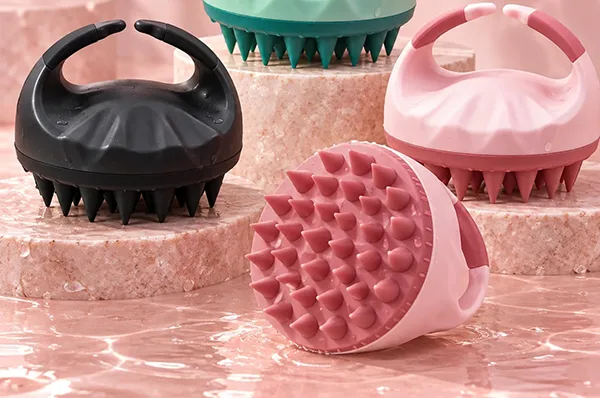
Introduction: The Importance of Handle Design for Silicone Shampoo Brushes
While a silicone shampoo brush might seem like an insignificant accessory for personal use, the way that it is designed may have quite a serious effect on its final performance and the user experience that it provides.
The initial user experience of any brush starts with holding it in the hand, and if a brush slips when wet, is hard to control, is uncomfortable in any other way, even despite having beautiful silicone bristles, the customer may not like using the brush at all.
For the B2B customer, it means that the handle design is not only about aesthetics.
Ergonomic design of a handle may affect:
- Grip
- Control
- Comfort
- Usability
- Shower safety
- Quality perception
- Differences from the competitors’ products
- Customer satisfaction
- Brand positioning
It is especially true for the brand creating its silicone shampoo brush using OEM/ODM manufacturing method.
The professional manufacturer will consider the handle along with the silicone bristles, size of the product, material hardness, mold structure, logo placement, packaging, and manufacturing process.
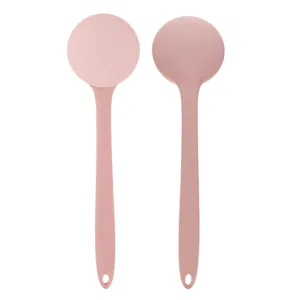
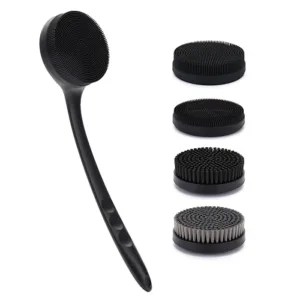
Beaut-LOHAS already has various designs of scalp brushes with ergonomic handles. For instance, its LMZ316 scalp massager features the ergonomic handle designed to ensure better handling of the product during shower usage; and its product specifications also include customization options such as color, logo, packaging, and OEM/ODM manufacturing.
The capabilities of the company also include LSR injection molding and silicone compression molding that enables the brand to go from the prototype creation to production.
However, the question is why is an ergonomic handle important, and how the manufacturer can assist brands in creating it?
1. What Is an Ergonomic Handle in a Silicone Shampoo Brush?
Ergonomic handle is a handle that is engineered according to the natural way people hold, use, and control products.
For a silicone shampoo brush, ergonomic features may include:
- Handle form
- Handle thickness
- Curvature
- Placement of fingers
- Placement of thumb
- Grip surface texture
- Weight distribution
- Size of the overall product
The point is not just making the brush look contemporary.
The idea is to make the product more usable.
For instance, a common palm-style scalp massager is held right against the palm, but a handled shampoo brush lets the user hold the product between his/her palm and fingers.
It means different design requirements.
In particular, the handle should allow enough control to move the bristles on the scalp by applying minimum grip pressure.
An existing example of Beaut-LOHAS scalp brush is LMZ316, which uses ergonomic handle in order to have better control in moist conditions and easy access to various spots on the scalp.
This kind of design can be a selling point for companies.
2. Why Wet-Hand Grip Is Essential for Shampoo Brushes
There is one major aspect that distinguishes a silicone shampoo brush from many other personal care products – the setting where it is used.
The product is typically used:
- During showers
- While having wet hands
- Using shampoo
- Using conditioner
- Surrounded by water and foam
This means that while the handle looks nice and comfortable when dry, it may work differently in a wet environment.
A good handle must give enough control even when the user’s fingers are exposed to water and shampoo.
Problems That May Occur When Handles Are Poorly Designed
Poorly designed handles can cause:
- Slippery feeling
- Unstable movement
- Increased gripping force
- Limited access to certain areas
- Decreased control
Such problems can make a product feel cheap despite the fact that the material used is high-quality.
Therefore, the development of such a product requires proper testing in conditions of wet usage.
The development team will be able to assess:
- Handle texture
- Handle curvature
- Location of fingers
- Grip zone
- Product weight and balance
The outcome will be a product which gives predictably controlled feeling during normal showering.
3. Ergonomic Design Can Increase the Usability of the Product
The primary goal of ergonomic design is to enhance the usability of the product.
In the case of a scalp brush, the usability is dependent on the nature of interaction between the user’s hand and the product.
An ergonomically designed handle will enable the user to:
- Grasp the brush easily
- Maneuver the brush on the scalp
- Apply appropriate pressure
- Access various regions of the scalp
- Control the brush during shampooing
It is particularly applicable to those products that are designed for regular use.
When the product feels uncomfortable to use even after a few minutes of usage, then it is unlikely that the consumers will adopt it in their daily routine.
Ergonomic design should thus be considered a part of product functionality.
4. Handle Shape Should Suit the Desired Consumer
There is no one-size-fits-all handle that works well with every scalp brush.
It depends on what target consumer you have in mind, and what positioning it should get.
Consumer-Centric Design: Compact Size
This type of handle can be good for:
- Travel products
- Compact bathroom items
- Beauty gift set
- Daily household use
Larger and Ergonomic Handle
This size of handle can offer better control in cases where:
- Hair is thick
- Use in professional salons
- Consumers prefer more gripping strength
- Large hands
Design for Palm
The handle can be palm-like to distribute pressure around the hand and make the handling experience unique.
Beaut-LOHAS also has its palm grip design for scalp brushes. For example, LMZ334 product features the palm grip that easily fits into the hand and gives better control when used.
For B2B buyers, this opens up the chance to manufacture different products for different market segments without the need to replicate the same handle across all SKUs.
5. Handle Size and Proportion Affect Control
One of the most crucial elements from an engineering perspective is proportion.
The handle must be big enough to ensure good control without being so big that the user can’t get a proper grip on it.
The manufacturer might assess:
- Handle length
- Handle width
- Handle thickness
- Handle angle of gripping
- Space between handle and bristles
- Diameter of the entire product
The above mentioned measurements should be also compatible with the silicone bristles on the scalp brush.
For instance, a wide brush head together with a tiny handle may result in an uneven product.
Similarly, a heavy handle with a light silicone brush head may affect the feel of the product in the hand.
In this case, it’s imperative to consider the ergonomics as a whole.
Handle + Head + Bristles + Material + Weight = Total Handling Experience
6. Silicone Hardness Also Affects Ergonomics
Ergonomics is not only related to geometry.
Material properties play their role too.
Silicon hardness can influence the ergonomic effect of squeezing and holding the handle.
While a softer material can give the desired tactile feel, it may lack structural stability for some designs.
A harder material, on the other hand, can provide better structural stability but have a different tactile feel.
Thus, manufacturers need to consider the following factors:
- Softness
- Flexibility
- Structural stability
- Grip
- Durability
- Product design
An optimal material specification varies depending on the product design.
According to Beaut-LOHAS, it offers various silicone materials and customization, whereas its scalp brush product line includes various designs and hardness types.
Thus, for OEMs, silicon hardness should be considered during the product development process.
7. Texture on the Grip May Improve the Handle’s Functionality
The next important feature is the surface texture.
While a completely smooth grip may appear simple, any texture on top of that may further increase handling qualities especially under wet conditions.
Some of the options may include:
- Fining texture
- Raised textures
- Grooves
- Shapes of finger surfaces
- Anti-slip surfaces
- Soft textures
However, texture needs to be introduced properly.
Too much texture may:
- Impact cleaning
- Complicate mold making
- Impact visual perception
- Raise costs of manufacture
A competent manufacturer must combine functional features with manufacturing feasibility.
For private-label companies, this is yet another chance to make your product recognizable.
8. Ergonomic Handle Design Is Another Option for Making a Private Label Unique
There are lots of similar scalp brushes on the market.
If the private label maker utilizes a generic product with a logo, it is not easy to make a visually different product.
Customized ergonomic handle is one more option for creating uniqueness.
Brand can customize:
- Handle shape
- Handle angle
- Handle texture
- Bristle design
- Product color
- Logo placement
- Packaging
For example, there is a possibility to have a unique curved handle with special bristle design and unique brand color.
This is not just an ordinary shampoo brush with a logo, but a product designed for this brand.
As a manufacturer of custom silicone products, Beaut-LOHAS offers customization in colors, materials, logo, surface, size, and packaging.
9. Ergonomic Design Must Be Taken into Account in the Development of the Mold
The biggest flaw in the design of silicone products is the development of the handle and then the mold.
The two must be developed simultaneously.
A custom-designed ergonomic handle can affect:
- Cavity design in the mold
- Parting line design
- Draft needs
- Flow of material
- Thickness of wall
- Logo placement
- Production cycle
- Post-processing needs
This is precisely why silicone manufacturing experts are able to provide great value in product development.
Beaut-LOHAS describes its manufacturing process as including in-house tooling and molding abilities, enabling product development to transition from design to mold construction to full production in one manufacturing process.
Its manufacturing solution involves both LSR injection molding and silicone compression molding, with LSR suitable for automated and precise production.
This makes it easy for buyers to communicate between product design and manufacturing engineering.
10. Existing Mold or New Mold: Which One Is Better?
Usually there are two strategies that B2B buyers choose for making the ergonomic silicone shampoo brush.
Strategy 1: Adapt an Existing Design
The brand adapts an existing factory design in terms of:
- Color
- Logo
- Packaging
- Silicone hardness
- Some structural characteristics
Such approach is recommended for:
- Startups
- Market test
- Small launch of a product
- Brands, which need to develop a product quickly
Strategy 2: Create a New Custom Mold
The brand creates the whole new design including handle and product construction.
It is better if the brand needs:
- Unique design
- Good differentiation
- Unique ergonomics
- Strategic positioning of the product
Beaut-LOHAS has more than 1,000 existing molds along with custom mold creation.
So, the buyer will have options to develop both the existing product and create something new.
11. The Testing of an Ergonomic Shampoo Brush
The design development process should not solely depend on the computerized drawing.
Physical prototypes must be considered.
After the design prototype is made, then the manufacturer and the buyer can test if:
Grip
Is there a good grip for the product?
Movement
Is there natural movement of the brush on the scalp?
Pressure
Is there enough pressure control by the user?
Balance
Is there balance with the grip?
Wet Use
Is the handle still maneuverable when used by wet hands?
Cleaning
Are the handle and the head easy to clean?
Appearance
Is the actual product in line with the design prototype?
According to Beaut-LOHAS, prototypes and samples will be ready from 3 to 7 business days after design confirmation, depending on the project.
Sample approval must be taken seriously especially for B2B purchases.
12. Ergonomics and Bristles Should Be Combined
The handle should not be considered separately from the bristles.
Both of these elements determine how the user will use the product on the scalp.
Imagine a brush which:
- Has very soft bristles
- Has a big head
- Has a thin handle
In order to get the required contact, the user may have to put in more effort.
Now imagine:
- Bristles that are slightly firmer
- Head of the product is small
- Ergonomic handle
In this case, the amount of pressure may also differ.
It means that while developing a product, one should take into consideration:
Geometry of the handle + length of bristles + firmness of bristles + size of the head + pressure by the user.
This integrated approach can help manufacturers create a more consistent user experience.
13. Ergonomic Handles Can Appeal to Several Market Segments
Customization can mean producing goods suitable for specific customer segments.
Beauty Branding Companies
Have the ability to produce unique goods which fit their branding.
Salon Suppliers
Should concentrate on:
- Durability
- Handle ergonomics
- Frequent use
- Professionality of look
Sellers of Amazon and other e-commerce sites
Should pay attention to:
- Small size
- Bright colors
- Strong package
- Unique design
Brands of Private Label Hair Care Products
Are able to combine:
- Shampoo
- Conditioner
- Scalp treatment
- Scalp brush
in one ecosystem of the product.
Wellness Brands
Should focus on:
- Relaxation
- Soft touch material
- Luxury looks
- Gift packaging
This is why a flexible OEM/ODM manufacturer can be more beneficial than a supplier of catalog goods.
14. Quality Control for Ergonomic Silicone Shampoo Brushes
An ergonomic product is only worthwhile if production is consistent.
A buyer may accept a sample due to:
- Correct handle size
- Correct silicone hardness
- Correct color
- Smooth surface
- Correct bristle construction
However, if the mass-produced products differ considerably, then so can the user’s experience.
So quality control should include:
Dimensional Accuracy
Checking:
- Handle size
- Height of product
- Width of product
- Dimensions of bristles
Material Consistency
Checking:
- Hardness of silicone
- Quality of material
- Color consistency
Appearance
Checking:
- Flash
- Defects on surface
- Mold marks
- Difference in color
Quality of Logo
Checking:
- Positioning of logo
- Clarity of logo
- Durability/Adhesion
Assembly
In case of multi-component product, checking:
- Connection of handle
- Fitting
- Stability
Beaut-LOHAS says that its QC process includes in-process inspection, final inspection, and tests like hardness, dimensional, compression, and tensile tests.
For international B2B buyers, quality control of this kind is significant when moving from sample to production.
15. How Beaut-LOHAS Helps Brands Create an Ergonomic Silicone Shampoo Brush
For brands creating an ergonomic silicone shampoo brush, the manufacturer’s design and customization services can prove just as vital as the cost of production.
Beaut-LOHAS specializes in making silicone personal care items like scalp massagers, body scrubbers, facial cleaning brushes and other silicone beauty accessories.
Its customization services include:
- Product design
- Size
- Material
- Color
- Logo
- Surface
- Packaging
It even offers Pantone color-matching services for customized products.
In terms of scalp brush projects, the company has many existing designs in its product line like ergonomic handle design, palm grip design, and other scalp massager designs to base a brand’s private label on.
For entirely new ideas, it also provides tooling and mold development services. Its manufacturing facilities comprise over 1,000 existing molds, 50+ quality control inspectors, and an annual production capacity of more than 50 million units.
Brands have the following options:
Existing design > Customization > Sampling > Production
or
Brand idea > Custom design > New mold > Prototyping > Mass production
Depending on the strategy the buyer wants to adopt.
Frequently Asked Questions
What is a silicone shampoo brush with ergonomic design?
Ergonomic design of the silicone shampoo brush includes the comfortable and controlled hand movements. The key features are handle design, handle size, handle grip, handle weight distribution, and interaction of the handle and the silicone bristles.
Why is ergonomic handle important for use in showers?
The use of silicone shampoo brush in shower implies presence of water, shampoo, and wet hands. Appropriate handle will help to retain control over the product without excessive gripping.
Is it possible to customize the handle of the silicone shampoo brush?
Yes. Depending on the project, customized handle designs, sizes, textures, colors, and structures can be developed through OEM/ODM manufacturing.
Is it possible to have different hardness of the handle and bristles?
Depending on the product structure and manufacturing process, different material specifications can be used. In general, it is necessary to evaluate the design and materials first before tooling.
Is it possible to put a brand logo on the ergonomic silicone shampoo brush?
Yes. Depending on the design, logo customization options might include embossing, debossing, printing, laser engraving, or integrated in the mold logo. Beaut-LOHAS provides a number of options for logo customization.
Should I use an existing mold or design a new mold?
An existing mold will prove to be helpful in launching the product quickly, while a new mold will provide better control over the product shape and differentiation. Both will depend on your target audience, budget, MOQ, and product strategy.
What do I need to ask a silicone shampoo brush manufacturer?
A buyer must ask the manufacturer the following questions:
- Materials
- Silicone hardness
- Handle customization
- Bristle customization
- Molding possibilities
- MOQ
- Sample time
- Logo options
- Packaging
- Quality control
- Capacity of production
These questions help determine whether the supplier can support both product development and long-term production.
Conclusion: Ergonomics Could Make a Simple Shampoo Brush More Than Just a Product
While a silicone shampoo brush may be just a small personal care product, there is much that needs to be done when manufacturing it.
In particular, the handle plays a crucial role since it is through it that the consumer interacts with the product.
An ergonomically designed handle can help make a product that is:
- More grippy
- More controllable
- Comfortable to use
- Easier to use with wet hands
- More differentiated from competing products
- More valuable
As for business-to-business brands, the concept of ergonomics could be included in their wider product development strategy.
Instead of buying a regular scalp brush and just branding it, brands can cooperate with an experienced silicone shampoo brushes manufacturer and customize the:
- Geometry of the handle
- Structure of the bristles
- Hardness of silicone
- Size of the product
- Surface texture
- Color of the brand
- Logo
- Packaging
The best development process starts with both design and manufacturing.
Brands at Beaut-LOHAS may begin with a pre-existing ergonomic scalp brush or design a new silicone product via OEM/ODM services, tooling, molding, branding, packaging, and quality assurance.
When developing a new product line, the proper question to ask is thus not merely:
“How much does a silicone shampoo brush cost?”
Rather, a more appropriate question would be:
“Can this manufacturer assist us in developing a product that is comfortable to use, unique in the market, scalable, and fits within our brand?”
This is where ergonomic product design and silicone manufacturing meet.
When working on the design of a custom silicone shampoo brush or scalp massager for your own brand, Beaut-LOHAS can offer assistance throughout the entire process, from the conceptualization of the product and ergonomic design through mold making, sampling, manufacturing, logo personalization, packaging, and shipping. Make a consultation request to discuss the design and production specifics.