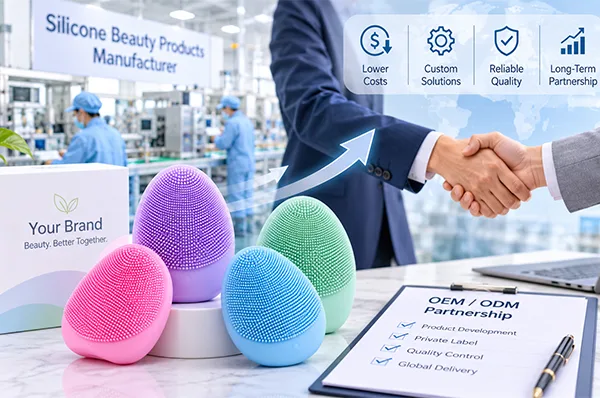
For cosmetic companies globally, decreasing the sourcing cost is not simply about getting better per-unit pricing. With increasing competition among skincare, personal care, beauty retail, and online shopping, brands should be able to assess every step in the supply chain, including the creation and material sourcing, manufacture, quality control, packaging, and logistics. By building direct silicone factory partnerships, companies could make sure that they would have visibility into the process, increase efficiency, and reduce their sourcing cost without compromising the quality.
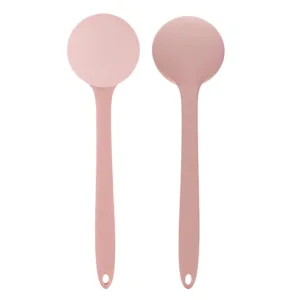
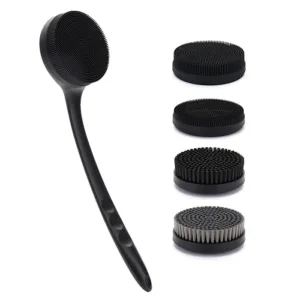
Silicones beauty products make up one of the categories of products that beauty brands seek to diversify into. Silicones beauty products such as silicone face scrubs, silicone scalp massagers, silicones body scrubs, silicones eye patches, facial cleansing silicone brushes, and other silicone personal care tools provide possibilities for private labels and customized products.
On the other hand, buying these products via intermediaries can lead to unnecessary costs and difficulties.
That is the reason why more beauty products globally are now looking into direct silicone factories partnership. Collaboration with the factory can assist the buyers to have better price visibility, reduce coordination costs, manage product specifications, and plan the production process efficiently.
For beauty brands, wholesalers, distributors, and private label companies, the real benefit lies not just in cutting out a middleman. It lies in optimizing the supply chain to lower overall costs without compromising on the quality of products.
Here is a guide for the buyers to understand how to collaborate directly with the factories and how to evaluate them.
1. Reasons for Brands to Reassess Their Silicone Product Sourcing Approaches
The beauty industry operates in a very competitive environment. There is pressure to produce appealing products, have affordable retail prices, and at the same time protect their profit margin.
The beauty accessories made from silicone are quite adaptable to the flexible product development since they can be manufactured in various shapes, colors, textures, sizes, and functions.
Some brand might want to manufacture a silicone facial cleansing brush, while another brand might require the massaging scalp brush with unique ergonomic design and branded packaging. This requirement would affect the manufacturing process and, as a result, its cost.
It is easy to source silicone products through the trading companies or distributors, especially if there is little experience with manufacturing products. However, it would also mean one more level of communication and less visibility of the manufacturing cost.
Sourcing issues that often occur are:
- The higher price on purchasing due to margins along the supply chain.
- The lack of visibility regarding the technical manufacturing details.
- Problems with modifying product specification.
- Less adaptability for customized molding and private label products.
- Lack of ability to trace quality problems to manufacturing sources.
- Inconsistent product specifications between repeat orders.
As a result, more brands are considering direct manufacturer relationships to gain greater control over sourcing decisions.
2. What Is a Direct Silicone Factory Partnership?
A direct silicone factory partnership is a type of sourcing where a brand, a wholesaler, or a distributor sources their silicone goods from the actual manufacturer of these products.
It allows to talk about product specifications, materials used, molds created, production timelines, quality requirements, packaging, etc., directly to the manufacturer.
It does not mean that a buyer should not use any sourcing agencies or trading firms. They can still offer a lot of useful services like supplier search, local communications, consolidations, logistics handling, etc.
The key here is if a buyer is directly connected to the actual production source.
A direct partnership might include:
- Product design consultancy and engineering services.
- Selection and color matching of the silicone material.
- Prototype creation and approval of samples.
- Custom mold design and production.
- Original Equipment Manufacturer and Original Design Manufacturer production.
- Logo printing and packaging with the private label.
- Quality checks at various stages of production.
- Production planning and repeat-order management.
This connection can serve to achieve better control in the long term compared with buying ready-made products from different suppliers.
3. Direct Factory Purchasing vs. Trading Company Purchasing
The decision whether to purchase from a factory or from a trading company depends on the quantity of the order, the complexity of the product, and the buyer’s experience.
It can be done both ways, but they differ in the structure of the cost and in the communication process.
| Comparison factor | Direct silicone factory | Trading company |
|---|---|---|
| Product pricing | Direct manufacturing quotation | May include intermediary margins |
| Technical communication | Direct access to production expertise | Depends on the trading company’s technical knowledge |
| Custom mold development | Can coordinate with the mold team directly | Usually coordinates through the factory |
| Product modifications | Direct discussion with production | May require additional communication |
| Quality control | Can define requirements with the manufacturer | Depends on supplier inspection arrangements |
| Product consolidation | May require multiple factory relationships | Can be convenient for mixed products |
| Order coordination | Direct production coordination | Centralized supplier communication |
| Long-term production planning | Direct capacity discussions | Depends on factory relationships |
Nevertheless, a trading company can still be a viable choice for those customers who require goods from various unconnected manufacturers or want to have a single contact person for their purchases.
However, it is better when a brand producing custom-made silicone beauty items cooperates with a manufacturer that knows how to deal with such products.
The main thing is to choose the most reasonable choice based on cost, technical ability, services offered, and risks associated.
4. How Direct Factory Partnerships Lower Cost of Product Purchase
One of the most obvious benefits of direct sourcing is the ability to lower unnecessary purchasing costs.
As a product goes through various commercial organizations, each one adds a certain margin to its price for operation, fees, or for the sake of profit.
Direct factory sourcing allows for cutting down such a purchasing chain and negotiating the cost of manufacturing with the producer itself.
Such savings can come from various sources:
Less intermediary margin: Buyers will have the chance to receive more accurate quotations coming closer to the point of manufacturing and will understand the effect of product specifications on its price.
Cost structure accuracy: The factory will be able to show the influence of the consumption of silicone material, weight of product, mold complexity, manufacturing process, and packaging.
Decrease in communication cost: Technical negotiations will help buyers to decrease the necessity for repeating clarification among buyer, trading organization, and production unit.
Order planning improvement: Manufacturers can plan their production more accurately getting better forecasts and repeat-order schedule.
Efficiency of customization: Buyers can discuss the possibilities of customization directly with the manufacturer finding the restrictions in time.
It should be emphasized that the direct sourcing process cannot guarantee the most inexpensive option. A company may be faced with higher expenses related to development, quality standards, or specific production of the company’s product.
The main goal is to lower the overall cost of product acquisition that matches all the needs of the brand.
5. Minimize the Cost of Development through OEM & ODM Direct Cooperation
Product development may be a very costly procedure for beauty products companies, in particular during the development of silicone accessories.
In such a situation, a brand will have to develop a customized silicone accessory for a face scrubber with a specific shape, bristle density, texture, location of the logo, and package type.
Through direct cooperation with OEM or ODM producer, a buyer will be able to talk about all these specifics before production on mass scale.
An expert manufacturer can assist in determining:
- If the designed product can be molded using silicon molds.
- If the design needs a completely new mold.
- If there is any way to customize the mold if the same is already available.
- How the product thickness impacts flexibility and consumption of material.
- Whether the chosen texture is feasible for manufacturing.
- Whether there will be any way to print, deboss, or emboss the logo on the product.
- How packaging dimensions influence freight cost.
For instance, a skin care company designing a new cleansing facial tool may have some complicated design idea in its mind at first.
The technical experts of the factory may suggest streamlining some aspects of the design while keeping the basic function of the product intact.
This can reduce mold complexity, shorten development time, and improve manufacturing consistency.
OEM vs. ODM: Which Model Is More Economical?
The OEM model works well when the brand has its design or technical specifications and needs a producer to manufacture the product.
The ODM model works well when the brand wishes to customize the design of the manufacturer or use the product development services of the manufacturer.
| Development model | Suitable buyer | Potential cost advantage |
|---|---|---|
| OEM | Brands with established product designs | Greater control over specifications and production |
| ODM | Brands seeking faster product development | May reduce design and development work |
| Existing mold customization | Buyers adapting an available product | Can reduce new mold investment |
| Fully custom mold | Brands requiring exclusive designs | Supports product differentiation and long-term brand identity |
The right model depends on the product’s uniqueness, expected order volume, and long-term commercial value.
6. Utilize Existing Molds to Minimize Initial Costs
The cost of developing a custom mold may become one of the largest expenses in manufacturing silicone products.
For new brands, small distributors, and companies trying a different type of products, spending money on the creation of a new mold is unnecessary.
When working directly with a factory, buyers have the chance to inquire if the existing molds are suitable for the particular product.
For instance, a buyer that is developing their own private-label silicone scalp massager can choose a ready product structure and customize it with regard to color, branding, and packaging without creating a totally new mold.
Possible benefits include:
- Reduced tooling costs.
- Quicker product development.
- Cost reduction in the engineering process.
- Faster samples’ preparation.
- Decreased risks in case of a new market test.
Nevertheless, buyers need to understand the ownership of the mold before starting the production.
Important questions to ask are:
- Whose mold is it – factory or buyer’s?
- Are there any other customers using the same mold?
- Can an exclusive mold be made?
- Who is paying for mold maintenance and customization?
- What will happen to the mold in case of the end of cooperation?
A clearly defined mold agreement helps prevent disputes and protects the buyer’s investment.
7. Increase Efficiency in Material Usage and Eliminate Waste in Production Processes
Materials play a significant role in determining the cost and efficiency of silicone beauty items.
There are different silicone materials that differ in quality, hardness, thickness, weight, flexibility, and surface texture. These characteristics should be chosen based on the application of the product and not solely based on cost.
For instance, a soft facial cleansing brush will have other hardness and bristle properties compared to a firm body scrubber.
A professional silicone manufacturer can provide assistance in minimizing the unnecessary usage of materials.
These potential cost reduction techniques might be applied:
Optimization of product thickness: Too much thickness increases material usage while not adding any value to product performance.
Modification of structure: Excessive and unnecessary features could increase material usage and the complexity of manufacturing process.
Choosing adequate hardness: Optimum silicone hardness is needed for better product performance and less defects.
Mold optimization: Adequate mold structure could help to achieve uniformity in product dimensions and minimize waste.
Product specifications optimization: Same material and dimensional requirements in batches could increase production efficiency.
However, material optimization should not affect product safety, durability and performance in any way.
In case of beauty products for skin application, consumers should demand material documentation for chosen target market and product claims.
8. Lower Quality-Associated Cost by Controlling Manufacturing
Low purchasing cost does not always equate to low overall cost.
Silicone beauty accessories of inferior quality generate further costs in form of return, rework, complaints from consumers, bad reviews, and damage to the company’s reputation.
Direct factory collaborations will help enhance quality communication as the purchaser gets the chance to establish inspection criteria with the manufacturers before the start of production.
Quality specifications for silicone beauty accessories will be as follows:
- Consistency of the material and documentation.
- Dimensions and weight tolerance of the product.
- Silicone material stiffness and flexibility.
- Finish of the surface.
- Consistency of the bristle/texture.
- Consistency of the color.
- Logo printing and its quality.
- Packaging.
- Performance.
An inspection process must include several production stages.
Material inspection prior to production: This includes verification of material specifications and supplier certificates.
First piece inspection: This confirms compliance of initial samples to approved specifications.
In-process inspection: This includes inspections of molding, trimming, surface finishing and other production operations.
Final inspection: This involves inspections for appearance, dimensional, functional features, packaging, labeling and sampling agreement prior to shipment.
The buyer must also define the criteria of acceptance in advance. An agreed sampling plan, where applicable, will help standardize the final inspection process.
For global beauty brands, quality control is not only a cost of manufacturing. It is a tool to minimize the cost of defective products through the entire chain of supply.
9. Reduce Cost of Inventory and Warehousing with Improved Manufacturing Planning
Inventory planning is yet another field where direct factory interaction would help save money.
For those brands buying their products through numerous middlemen, there might be a problem of understanding the schedule and capabilities of the factory producing these items.
Direct interaction will enable buyers to communicate about sales forecasts, lead times for manufacturing, replenishing and ordering.
A good example is a beauty brand that produces silicone face scrubbers for sale on its own site and through retailers.
Due to changing seasonal demands, the buyer should not make just one bulk order without thinking of how it sells.
Possible strategies include:
- Demand forecasting using past sales.
- Production planning prior to the selling season.
- Placing repeat orders earlier.
- Simplifying packaging for easier reordering.
- Separating regular product lines from the seasonal and experimental product lines.
- Negotiating feasible production quantities with the manufacturer.
There might be some manufacturers who will agree to phased production or scheduling of replenishments.
Such arrangements need to be made in advance. It is not safe to expect all factories to offer flexible inventory programs or finished stock at no extra cost.
The goal here is to combine purchasing convenience with inventory safety.
10. Package and Ship for Least Cost Through Direct Factory Coordination
Logistics can have a substantial impact on the total landed cost of silicone beauty accessories.
A product with an advantageous factory price can become costly due to its need for oversize packaging, non-efficient packing arrangements, and excessive transportation volume.
With direct factory coordination, buyers will be able to coordinate regarding packaging and shipping of the product even during the development phase of the process.
Optimization of the packaging can include:
Right-size packaging: Prevent unnecessary oversize retail packaging that results in oversize cartons and transportation volume.
Packaging standardization: Implement standardized packaging design across products where possible.
Flat or compact packaging: Utilize packaging designs that minimize dead space without compromising the product.
Bulk packaging: If applicable, bulk packaging can be considered for appropriate wholesale order sizes.
Carton optimization: Ensure that buyers know the quantity per carton, carton size, gross weight, and stacking requirements of the cartons prior to shipment.
Finally, buyers need to analyze different logistics quotes with respect to all aspects of the shipping process.
A factory-direct quotation is only one part of the total landed-cost calculation.
11. Increase the Efficiency of Communication and Minimize Hidden Procurement Costs
Time is a valuable yet frequently ignored purchasing cost.
In cases where the product requirement goes through several parties, miscommunication may arise.
For instance, the buyer may ask for a certain hardness of the silicone, certain bristle length, or certain positioning of the logo on the label. This, however, does not get across properly to the manufacturer and results in a different end product from the one that was approved.
This might lead to the need for re-sampling, re-production, delays in delivery, and extra costs for inspection.
Direct factory communication would eliminate such problems since it will bring buyers closer to those who develop and manufacture their products.
In order to facilitate the process, brands should provide a list of specifications including:
- Drawings or reference pictures of the product.
- Size and acceptable tolerance range.
- Material and hardness of the silicone.
- Colored samples with Pantone numbers where possible.
- Artwork with logo placement.
- Package design specifications.
- Inspection criteria.
- Certifications or test results if any.
- Expected quantity of the order and delivery date.
Additionally, the buyer should keep records of all approved samples, artwork, specifications, and changes.
A clear communication process can reduce avoidable errors and make repeat orders more predictable.
12. Develop an Adaptive Portfolio of Beauty Products without Adding Complexity to the Sourcing Process
A variety of beauty products is often required by most cosmetic manufacturers.
Some skincare products could include silicone-based face scrubbers, silicone eye patches, and facial washing accessories. The personal care products could involve silicone scalp massagers, silicone bath brushes, and body scrubbers.
Each product sourced from a different manufacturer could add complexity to the procurement process and inconsistent quality parameters.
Cooperation with a manufacturer that possesses all the required capabilities for different silicone beauty products would be beneficial.
The possible benefits may include:
- Reduced number of suppliers.
- Improved communication standards.
- Facilitated coordination in terms of color matching and branding.
- Possibility to consolidate shipments where possible.
- Visibility into the development schedule for the products.
- Simplified planning process of bundling and collections.
However, the buyer must check the manufacturer’s production capability with respect to each of the product categories.
A factory manufacturing one type of silicone accessory does not mean it has the equipment and molds for all other types of products.
Supplier consolidation should be based on proven capability, not convenience alone.
13. How to Compute the True Cost Savings from Direct Factory Buying
In determining the financial viability of using a direct silicone factory buying arrangement, it is important for consumers to consider the full landed cost and not just the per-unit cost.
One way to compute this would be to use the following formula:
Landed Cost = Product Cost + Tooling Cost + Packaging + Inspection + Freight + Insurance + Duties & Taxes + Other Import Costs
This is in relation to the same product specification, order quantity, delivery destination, and terms of delivery.
Consider this simplified example:
| Cost component | Supplier A: intermediary | Supplier B: direct factory |
|---|---|---|
| Product purchase | $5,000 | $4,500 |
| Packaging | $400 | $400 |
| Inspection | $100 | $150 |
| Freight and related shipping costs | $900 | $900 |
| Other import costs | $300 | $300 |
| Total | $6,700 | $6,250 |
For the above-mentioned situation, the costs savings through direct sourcing are $450 or about 6.7%.
Note that the above-mentioned data is for the purpose of illustrating the concept and do not reflect any real price quotes from Beaut-Lohas.
Another point worth making in this case is that direct sourcing has the advantage of slightly higher costs for inspection in this case, implying that cost saving does not necessarily imply doing away with the need for quality control measures.
In addition to this, other factors that should be considered in a comparison include payment terms, defect rate, shipment timeliness, communication efficiency, and the cost of handling the supplier.
A supplier offering a lower quotation may not be the more economical option if its products require frequent rework or arrive late.
14. How to Select a Trustworthy Direct Silicone Factory Supplier
While there may be some benefits in direct factory procurement, this would involve buyers having to check whether the manufacturer is reliable.
Below is a list of criteria which you can consider when selecting your supplier.
Manufacturing Capability
- Does the supplier manufacture silicone items?
- Does it offer factory details and evidence regarding the manufacturing process?
- Has it manufactured beauty and personal care accessories before?
- Is it capable of handling OEM/ODM/private label orders?
- Does it have suitable mold development and manufacturing capability?
Product Development
- Is the supplier able to provide product samples?
- Is it able to give information regarding the materials used and designs available?
- Can it manufacture items in different colors and with logos?
- Does it understand the issue of mold ownership and tooling?
- Is it capable of checking whether an item is appropriate for mass production?
Quality Management
- Are there material specifications documented?
- Is there any defined procedure for inspection in the factory?
- Does it have the test certificates/inspections reports?
- Is there any documentation regarding sampling and production standards?
- Does it know how to deal with defect products?
Commercial & Communication Standards
- Is the quote clear?
- Are MOQ, lead time, and payments terms known?
- Is it able to answer technical queries accurately?
- Does it offer practical production plans?
- Are all changes and extra costs put in writing?
It is suggested that buyers also carry out a factory inspection at times, depending on the order value or product risk.
15. Why Beaut-Lohas is an Efficient Supplier for Silicone Beauty Product Sourcing
For brands, wholesalers, and distributors interested in silicone beauty and personal care products production, it is essential to find the manufacturers that have expertise and the ability to customize such products.
Beaut-Lohas.com provides B2B customers with services related to silicone beauty product manufacturing and private label production.
As a company having more than 15 years of experience in silicone ODM services, Beaut-Lohas specializes in product development, customization, manufacturing, and quality management for the needs of global businesses.
The services provided by the company are:
OEM and ODM services: Customization of silicone beauty and personal care products.
Product development: Help with product design, prototypes creation, and custom molds.
Product customization: Custom colors, Pantone color matching, silk screen printing, laser marking, and debossing.
Packaging service: Customized packaging and marketing design for private label projects.
Quality management: Quality control assistance during the relevant manufacturing stages.
Testing and documentation assistance: CE, CPSIA, RoHS, REACH, and California Proposition 65, depending on the product and target market.
Order planning flexibility: Facilitation for sample requests and scalability of MOQ discussion based on product specifications.
The Beauty-Lohas provides silicone beauty care products such as silicone scalp massager, silicone face scrubber, silicone body scrubber, reusable silicone under eye patch and accessories thereof.
From the buyers’ perspective, it is about building up the sourcing relationship through competitive manufacturing, consistent products, customizable and good communication.
It would be more reasonable to not just evaluate the supplier based on its quoted unit price but rather check whether it can handle the whole product life cycle from the beginning to the end.
Looking for a direct silicone manufacturing partner? Visit Beaut-Lohas.com to discuss your product requirements, request samples, and explore OEM/ODM solutions for your beauty brand.
FAQs About Direct Silicone Factory Partnerships
1. Will working directly with the factory decrease product cost?
It could decrease cost because it eliminates intermediaries, facilitates better technical communication, and helps buyers customize their product specifications and production plans. The degree of cost reduction would be determined by many factors such as order size, product complexity, logistics and factory pricing.
2. Does it always mean that buying directly from the factory is more economical than buying from the trading company?
No, sometimes trading company can provide competitive pricing due to their volume of purchases, good relationships with suppliers or other advantages. Buyers should evaluate total cost and services.
3. What is the MOQ for custom silicone beauty products?
MOQ depends on the design, materials, color, molding process, packaging and manufacturing process setup. Sometimes MOQ of existing molds is different from MOQ of customized products.
4. Can a beauty brand utilize an existing silicone mold in its private-label production?
Yes, a manufacturer can provide such molds for customization through adding colors, logos, and packages. Buyers must verify mold ownership, exclusivity, and use before purchasing.
5. What is the difference between OEM and ODM Silicone Manufacturing?
In OEM manufacturing, a buyer provides the design of a silicone product. In ODM silicone manufacturing, the manufacture already has its own design or development capabilities, which a buyer can adapt to its needs.
6. How can buyers ensure consistent quality in their repeated purchases?
To achieve it, buyers should authorize a reference sample, specify material and dimensional characteristics, define color codes, set up quality check conditions, and keep production documentation. Buyers may perform pre-shipment inspections to assure themselves of a high quality.
7. What kind of documents should a buyer ask a silicone manufacturer for?
It depends on a particular product and the country of destination whether a buyer will need material specification, test reports, quality control records, and other necessary documents.
8. How long does custom development of silicone products take?
Development period varies depending on such factors as design complexity, availability of molds, testing needs, material choice, and approval procedures. Customization of existing mold is simpler compared to creating a new product and custom mold. Buyers have to verify the development time for specific projects.
9. Does a direct factory offer custom packaging and logo printing?
Most of silicone product manufacturers offer private label options, which might include logo printing, laser marking, debossing, custom coloring and packing creation. Buyers should check the available options and get samples prior to mass manufacturing.
10. Which criteria should be considered by global cosmetics manufacturers selecting a factory?
These criteria include manufacturing capacity, expertise, quality control, clear quoting, customization possibilities, effective communication, realistic lead times and production reliability.
Conclusion: Create a More Efficient Silicone Supply Chain
Sourcing direct from silicone manufacturers can enable global beauty brands to enhance the efficiency of their procurement process, avoid unnecessary costs, and have better control over the development and production of their products.
The most significant savings are often achieved through a combination of many factors: clear pricing, appropriate mold selection, efficient material consumption, quality control, packaging, and effective production management.
Nevertheless, the criteria for selecting the right supplier should include more than the unit cost of goods. The supplier should provide consistent specifications, good communication, reliable production, and reasonable customization services.
For beauty brands that produce silicone face scrubs, scalp massagers, body scrubs, reusable eye masks, and other personal care products, such a partnership will provide them with a solid base for further growth and differentiation.
Explore OEM and ODM silicone beauty product solutions at Beaut-Lohas.com and contact us to discuss your next private-label project.