Silicone Wrinkle Patches
Silicone wrinkle patches have become a trend in Europe and North America and meanwhile, beauty brands are looking for ways to raise the bar for their products by stressing on their merits and even differentiating them from the rest. One of the most frequently asked questions by B2B buyers and private-label brands is:
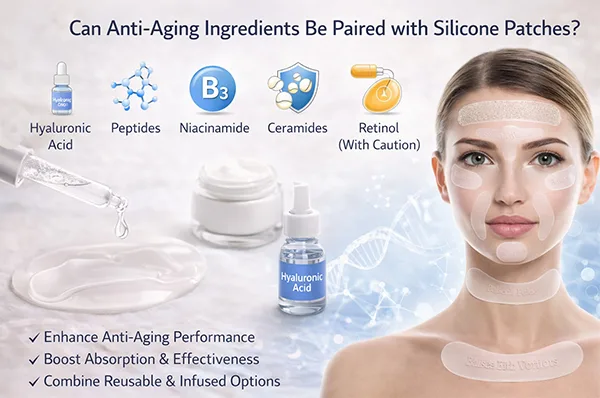
Is mixing anti-aging ingredients like peptides or hyaluronic acid (HA) with silicone wrinkle patches an option?
The response is positive, albeit with significant considerations from the technical, formulation, and regulatory points of view.
We are an OEM/ODM manufacturer that is professional and specializes in silicone skincare accessories. To develop both pure silicone wrinkle patches and ingredient-enhanced solutions, we collaborate with global partners. The subsequent text will discuss how anti-aging ingredients can be combined with silicone patches, the acceptable formats, and the safe and effective manner for brands to carry out this strategy.
1. Why Combine Silicone Patches with Anti-Aging Ingredients?
Silicone wrinkle patches work primarily through mechanical and occlusive effects:
Flattening expression lines
Preventing skin folding
Reducing transepidermal water loss (TEWL)
Improving skin hydration through occlusion
Anti-aging ingredients, on the other hand, work at a biochemical level, supporting skin structure, hydration, and renewal.
By combining the two, brands can offer:
Enhanced visible results
Stronger anti-aging positioning
Higher perceived value
Clear differentiation from basic silicone patches
This hybrid approach is especially attractive in premium and professional skincare markets.
2. How Silicone Patches Interact with Skincare Ingredients
Before discussing specific ingredients, it’s important to understand how silicone interacts with actives.
High-quality silicone used in wrinkle patches is:
Non-porous
Chemically inert
Non-absorbent
This means silicone does not release active ingredients on its own. Instead, it works as an occlusive delivery enhancer, helping ingredients applied to the skin remain in place longer and penetrate more effectively.
In practice, this leads to two main pairing strategies.
3. Strategy One: Silicone Patches Used Over Skincare Products
The Most Common and Flexible Approach
In this model, consumers apply a serum or cream containing anti-aging ingredients, then place a silicone wrinkle patch on top.
Benefits:
No ingredient stability issues
No regulatory complexity for the patch itself
Compatible with a wide range of actives
Ideal for reusable silicone patches
Silicone creates a sealed environment that:
Prevents moisture evaporation
Increases ingredient absorption
Enhances short-term visible results
This approach is widely recommended by dermatologists and is currently the most scalable option for B2B brands.
4. Key Anti-Aging Ingredients That Pair Well with Silicone Patches
4.1 Hyaluronic Acid (HA)
Why it works:
HA attracts and holds water
Silicone occlusion prevents dehydration
Enhances plumping and smoothing effects
Best use case:
Apply HA serum, then silicone patch overnight
This combination is extremely popular in under-eye, forehead, and nasolabial fold applications.
4.2 Peptides
Why they work:
Support collagen signaling
Improve skin firmness over time
Benefit from prolonged skin contact
Silicone patches help keep peptide formulations in place, allowing longer interaction with the skin.
B2B Insight:
Peptides are ideal for premium positioning, especially when paired with repeated silicone patch use.
4.3 Niacinamide
Why it works:
Improves skin barrier function
Reduces fine lines and uneven texture
Enhances tolerance when used under occlusion
Niacinamide-based serums paired with silicone patches are popular for preventative anti-aging.
4.4 Ceramides
Why they work:
Strengthen the skin barrier
Reduce moisture loss
Complement silicone’s occlusive function
This pairing is particularly suitable for dry or mature skin markets.
4.5 Retinol (With Caution)
Retinol can be used under silicone patches, but requires careful guidance.
Considerations:
Occlusion can increase potency
Risk of irritation for sensitive skin
Recommended for experienced users only
For B2B brands, retinol pairing should include clear usage instructions and disclaimers.
5. Strategy Two: Ingredient-Infused Silicone Patches
Some brands explore ingredient-infused silicone patches, where actives are embedded into a coating or gel layer.
Advantages:
“All-in-one” product concept
Strong marketing appeal
No need for separate serum
Challenges:
Limited ingredient loading capacity
Stability concerns over repeated washing
Shorter usable lifespan
Higher production complexity
Because silicone itself does not absorb ingredients, infusion typically requires:
A hydrogel or emulsion layer
Single-use or limited-use formats
At Beaut-lohas.com, we usually recommend ingredient-infused formats for disposable or semi-reusable patches, not long-term reusable silicone pads.
6. Reusability vs. Ingredients: A Key Trade-Off
One of the biggest advantages of silicone wrinkle patches is reusability. Introducing ingredients directly into the patch can reduce:
Washability
Adhesion recovery
Product lifespan
For brands targeting sustainability and long-term use, pure silicone patches paired with external skincare products remain the most reliable solution.
7. Regulatory Considerations for Ingredient Pairing
From a compliance perspective, pairing silicone patches with ingredients requires careful positioning.
Important distinctions:
Silicone patches alone are typically considered cosmetic accessories
Ingredient-infused patches may be regulated as cosmetic products
Claims must avoid medical language
Beaut-lohas.com supports B2B clients with regulatory-friendly product structures for U.S. and EU markets.
8. Packaging & Education: Essential for Ingredient Pairing Success
For brands combining silicone patches with anti-aging ingredients, consumer education is critical.
Recommended elements:
Step-by-step usage instructions
Icons showing “apply serum first”
Clear ingredient compatibility guidance
Cleaning instructions to maintain patch performance
We offer custom instruction cards and packaging layouts for OEM clients.
9. Market Trends: What Buyers Are Looking For
In Western markets, current B2B demand focuses on:
Silicone patches + HA serum bundles
Professional overnight wrinkle kits
Preventative anti-aging solutions
Clean beauty and minimalist routines
Brands that clearly explain how silicone enhances ingredient performance tend to perform better than those making vague claims.
10. How Beaut-lohas.com Supports Ingredient-Compatible Solutions
As a professional silicone manufacturer, Beaut-lohas.com provides:
Medical-grade reusable silicone wrinkle patches
Custom shapes, thickness, and firmness
OEM/ODM packaging for bundled solutions
Usage instruction design support
Scalable production for global markets
We help brands create ingredient-compatible silicone patch systems, not just standalone products.
Conclusion
So, can anti-aging ingredients like peptides and hyaluronic acid be paired with silicone wrinkle patches?
👉 Yes—very effectively, when done correctly.
Silicone patches act as powerful occlusive enhancers, improving ingredient performance without needing to embed actives directly into the silicone. For most B2B brands, the best approach is a high-quality reusable silicone patch paired with a compatible skincare routine.
At Beaut-lohas.com, we help beauty brands develop safe, effective, and market-ready silicone wrinkle patch solutions that align with modern anti-aging trends and consumer expecta