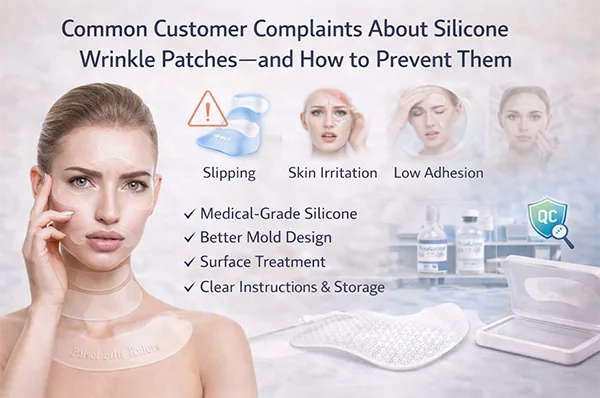
Complaints About Silicone Wrinkle Patches
The global anti-aging and beauty accessories market now includes a rapidly expanding segment which offers silicone wrinkle patches to consumers. The reusable non-invasive and drug-free products which include forehead and under-eye patches and chest and neck wrinkle pads have become increasingly popular among consumers who want to eliminate fine lines.
Customer expectations rise as demand for products increases. The primary complaints which customers repeatedly bring to brands about a product result in strong effects on online product reviews and customer repurchase behavior.
For B2B buyers and wholesalers and private-label brands it is essential to learn the reasons behind product complaints and then create strategies to stop these issues from happening during manufacturing and product development. The article first describes the main customer complaints which people have about silicone wrinkle patches. The article then presents practical solutions which factories can implement to reduce product returns and increase customer satisfaction while establishing a high-end brand identity.
1. Slipping During Wear: The #1 Customer Complaint
Why Slipping Happens
Customers frequently report that silicone wrinkle patches slide or fall off during use, especially overnight. The root causes usually include:
Incorrect silicone hardness (Shore A too low or too high)
Smooth, untreated contact surface
Excess facial oils, sweat, or skincare residue
Poor shape design that doesn’t follow facial contours
Patch size too small for target area
Slipping is especially common for forehead patches, smile line patches, and chest pads, where movement and skin curvature are more pronounced.
How Manufacturers Can Prevent Slipping
1. Optimize Silicone Hardness
High-quality wrinkle patches typically use medical-grade silicone with Shore A 10–20.
Too soft → patch deforms and loses grip
Too hard → patch cannot conform to skin
A balanced hardness ensures flexibility while maintaining structural stability.
2. Add Micro-Texture or Matte Contact Surface
Rather than a completely smooth surface, many premium manufacturers now apply:
Micro-embossed textures
Fine matte finishes
Anti-slip surface patterns
These features increase friction without irritating the skin.
3. Improve Patch Shape Engineering
Custom molds designed from real facial data (forehead curvature, nasolabial angles, neck lines) dramatically reduce movement.
B2B brands should prioritize ergonomic molds over generic shapes.
4. Educate End Users Through Packaging
Clear instructions such as:
Apply on clean, dry skin
Avoid heavy creams before use
Press firmly for 5–10 seconds
can reduce misuse-related slipping by more than 30%.
2. Skin Irritation and Redness
Why Irritation Occurs
Although silicone is widely considered skin-safe, irritation complaints still occur due to:
Use of industrial-grade or low-purity silicone
Residual chemicals from poor curing processes
Allergic reactions to added adhesives or coatings
Excessive occlusion in hot or humid environments
Rough edges or uneven trimming
These issues are especially sensitive for under-eye patches and neck patches, where skin is thinner.
How to Prevent Skin Irritation at Factory Level
1. Use 100% Medical-Grade or Cosmetic-Grade Silicone
This is non-negotiable for premium brands. Certified silicone:
Is hypoallergenic
Contains no plasticizers or latex
Passes REACH, RoHS, and FDA standards
2. Ensure Complete Vulcanization and Post-Curing
Incomplete curing leaves volatile residues that can cause redness or itching.
Professional factories use:
Controlled high-temperature vulcanization
Extended post-curing cycles
VOC testing
3. Smooth, Rounded Edges
Laser-cut or precision-trimmed edges prevent pressure marks and skin damage, especially for overnight use.
4. Optional Breathable Design
Micro-perforation or thinner silicone zones allow limited airflow, reducing heat buildup without sacrificing adhesion.
3. Low Adhesion After Reuse
Why Adhesion Weakens Over Time
Reusable silicone wrinkle patches are expected to last 20–40 uses, yet many consumers complain that adhesion drops after just a few applications. The main reasons include:
Improper cleaning by the user
Oil, dust, or skincare residue buildup
Inferior silicone formulation
Overly thin patch construction
Inconsistent surface finish
Low adhesion leads to poor results and negative reviews—even if the silicone itself is high quality.
How Manufacturers Can Improve Long-Term Adhesion
1. Increase Silicone Density and Thickness Balance
Ultra-thin patches may feel comfortable but lose grip faster.
A balanced thickness (usually 1.2–1.8 mm) improves durability without sacrificing comfort.
2. Optimize Surface Energy
Advanced silicone formulations are designed to maintain natural tackiness without glue.
This allows the patch to regain adhesion after washing.
3. Provide Clear Cleaning Instructions
Brands should include step-by-step care guidance:
Wash with lukewarm water
Use mild soap only
Air dry, adhesive side up
Avoid towels or tissues
4. Offer Protective Storage Solutions
Reusable PET sheets or silicone trays prevent dust contamination, extending product lifespan.
4. Poor Fit for Different Face or Body Types
Common Consumer Feedback
“Too small for my forehead”
“Doesn’t fit my chest properly”
“Edges lift on curved areas”
This is not a quality issue—it’s a design and sizing issue.
Prevention Through Customization
For B2B brands, this is where OEM/ODM differentiation becomes a major advantage:
Offer multiple sizes (S/M/L)
Design region-specific molds (Asian vs. Western face contours)
Provide gender-specific or body-area-specific shapes
Allow custom shape development for private labels
Custom fit significantly reduces complaints and increases repeat purchase rates.
5. Unrealistic Expectations and Perceived “No Results”
Some complaints stem not from product defects, but from misaligned expectations. Silicone wrinkle patches primarily:
Smooth fine lines temporarily
Improve hydration
Reduce sleep-crease formation
They are not instant permanent anti-aging treatments.
How Brands Can Prevent Expectation-Related Complaints
Use accurate, compliant marketing language
Avoid medical or exaggerated claims
Educate customers about cumulative benefits with regular use
Highlight prevention rather than cure
Transparent communication builds trust and long-term brand credibility.
Final Thoughts: Turning Complaints into Competitive Advantage
For silicone wrinkle patch brands, customer complaints are not just problems—they are signals for product optimization. By addressing slipping, irritation, and adhesion issues at the manufacturing, design, and education level, brands can:
Reduce return rates
Improve reviews and ratings
Command premium pricing
Strengthen private-label partnerships
At beaut-lohas.com, focusing on medical-grade materials, custom molds, and strict quality control enables B2B buyers to launch wrinkle patch products that meet global market expectations with confidence.