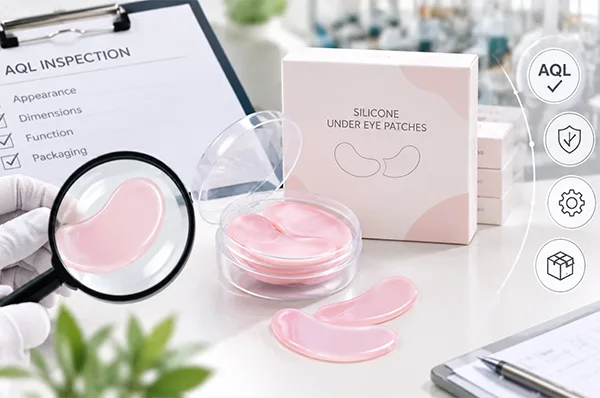
Introduction: Why AQL Inspections Are Important for Wholesale Buyers
If beauty companies, wholesalers, distributors, and retailers buy silicone under eye patches wholesale, quality can influence the satisfaction of the customers, returns, relationships with the retailer, and reputation.
While the silicone under eye patch looks like a rather simple product, the following defects can be observed during mass production:
- Non-uniform thickness
- Scratches on the surface
- Bubbles
- Flash
- Edge deformation
- Inconsistency in color
- Logo in the wrong position
- Poor packaging
- Lack of accessories
- Contamination
- Wrong quantity
Inspection of all products in the small sample is easy enough. However, with the wholesale order containing hundreds and thousands of items, the 100% inspection by the buyer is unfeasible.
Here is when the AQL inspection standards come into play.
An AQL inspection method allows buyers and manufacturers to follow a consistent inspection approach based on inspecting a random sample from the production lot to determine if the production lot meets predetermined quality criteria. Modern attribute sampling standards like ANSI/ASQ Z1.4 and ISO 2859-1 are constructed on the principles of AQL-based acceptance sampling and inspections.
The use of an effective AQL inspection method for a manufacturer purchasing silicone under eye patches can be helpful in lowering the following:
- Risk of imports
- Product returns
- Customer complaints
- Costs of rework
Unhappy customers
Buyer-vendor disputes
For OEM and private label projects, the AQL inspection process becomes crucial as the name of the buyer, not the name of the factory, is seen by the end-user.
Thus, at beaut-lohas.com, silicone beauty product development should be backed by proper product specifications, product sample approval, production control and predetermined inspection criteria for the bulk production.
This guide will tell you how to apply AQL principles to silicone under eye patches, how to classify common defects and how to develop an AQL inspection standard for international orders.
1. What Is AQL Inspection?
AQL is widely applied in the context of acceptance sampling to facilitate determining the number of units to be checked from a production batch and acceptable number of non-conformities according to the set sampling plan.
In simpler terms:
AQL inspection is not about checking each product. It includes applying a systematic sampling approach for testing the quality of a certain production batch.
Attribute sampling implies testing the presence/absence of a characteristic and applying the acceptance/rejection criteria related to the specific sampling plan.
For instance, suppose that a purchaser requests:
10,000 pairs of silicone under-eye patches.
The point is not to open and check each pair manually. The inspection process could include:
- Determination of the lot size;
- Selection of the required inspection level;
- Identification of the sample size using the relevant sampling plan;
- Inspection of the selected units;
- Classification of defects; and
- Comparison of defect counts with the agreed acceptance/rejection criteria.
The result is a more systematic approach to wholesale inspection of quality.
However, one crucial thing for the buyers is that AQL does not replace proper product specifications.
If the buyer never specifies:
- Right size
- Allowed range of colors
- Placement of the logo
- Requirements for packaging
- Surface quality requirements
then the inspector will be clueless about the appearance of the product. AQL goes hand in hand with a product specification.
2. Why AQL is Important in Wholesale Purchase of Silicone Under Eye Patches
Silicone under eye patches have become common in:
- Private label skincare lines
- Beauty salons
- Spa treatments
- E-commerce beauty products
- Amazon stores
- Shopify beauty brands
- Distributors of cosmetics
- Beauty supply channels
Such buyers usually tend to place relatively high-volume production orders.
The larger the order volume, the more costly even the smallest differences in quality will be.
For instance:
When 2% out of 50,000 products have defects, this means there are:
1,000 defective products
Without any organized approach to checking the order, such issues might remain unnoticed until:
- Product arrives at the warehouse
- The retailer gets the stock
- Consumer leaves feedback about the item
- Returns become higher
That is why quality management should be incorporated into professional wholesale sourcing.
AQL inspections enable the buyers to establish common criteria between:
Buyer -> Factory -> QC -> Third Party Inspector
Instead of simply stating:
“The quality needs to be good.”
The buyer can lay out inspection requirements.
These include:
- Clean surface of the product
- No air bubble visible
- Sharp edges avoided
- Color matching the sample
- Right logo placement
- No damage to packaging
In this way, expectations are clarified.
3. Understanding Lots, Samples, and Inspection Criteria
There are some critical points that buyers must know before the use of an AQL inspection process.
Production Lot
Production lot refers to the total number of goods inspected at a time.
For instance:
- 5,000 pairs
- 10,000 pairs
- 30,000 pairs
- 100,000 pairs
The exact lot definition should be agreed as part of the inspection process.
Sample Size
The sample size refers to the number of units picked for examination from the lot.
The sample size is chosen in relation to the sampling standard and plan agreed on—not just randomly picking a number that sounds “sufficient.”
The international sampling schemes provide clear guidelines for determining sample size and acceptance rules depending on the lot size, inspection method, and AQL needs. ISO 2859-1:2026 provides an example of AQL-indexed sampling schemes for attribute inspection lot by lot.
Acceptance Number
The acceptance number is the highest number of nonconformances or defects that are acceptable under the agreed plan until the lot is rejected.
Rejection Number
The rejection number shows when the results of the inspection mean that the lot must be considered unacceptable under the agreed sampling plan.
Critical Point
The buyers should not just copy the AQL number of another product line.
The AQL requirements must depend on:
- The product risk
- The brand positioning
- Customer expectations
- Function of the product
- Retail requirements
- The target market
The premium private label beauty product may need stricter appearance standards.
4. Understanding Critical, Major, and Minor Defects
Classification of defects is one of the most essential components of any AQL system.
In the case of silicone under eye patches, defects are usually classified into three types:
Critical Defects
Defects posing serious risk to safety, compliance, contamination or unacceptable use.
Major Defects
Defects seriously affecting appearance, usability, function or consumer satisfaction.
Minor Defects
Defects not affecting normal use of the product.
This specific classification must be agreed by both sides (buyer and seller).
5. A Recommended AQL Approach for Silicone Under Eye Patches
Different buyers may use different quality requirements depending on their market.
For many wholesale and private label projects, buyers may establish separate acceptance targets for:
| Defect Category | Typical Quality Priority |
|---|---|
| Critical Defects | Extremely strict / often zero tolerance |
| Major Defects | Strict control |
| Minor Defects | Controlled according to agreed sampling criteria |
The typical commercial approach would involve imposing more stringent specifications for critical defects and less stringent ones for cosmetic defects.
But there is no one AQL combination that will fit all silicone under eye patches.
The right strategy will depend on the following:
- Product positioning
- Customer expectations
- Retailer specifications
- Type of packaging
- End-use
- Quality agreement
In high-end brands, it might be reasonable to impose stringent specifications for:
- Visible surface defects
- Color variation
- Logo print
- Package damage
6. Critical Defects for Silicone Under Eye Patches
Critical defects deserve the highest level of attention.
Some possible examples may include:
Contamination
Examples:
- Contamination present in the silicone
- Contamination present visibly
- Unknown contamination
Silicone under eye patches being intended for use in the eye area require special attention to the issues of contamination.
Sharp or Dangerous Edges
Sharp edges should not be present on the product because it may pose undue risks during use.
Wrong Product/Material
It is a very serious issue when the final product does not correspond to the material specification that was approved by the agency.
Severe Manufacturing Contamination
Products must be protected from contamination in the process of manufacturing, handling, and packing.
Manufacturing and inspection focus on control over the materials, conditions, equipment, packaging, documentation, and quality of the final product.
Severe Labeling/Packaging
For private-label products, incorrect information about packaging may become a critical commercial and compliance issue.
Examples:
- Brand name mismatch
- Product identification mismatch
- Instruction mismatch
- Barcode mismatch
- SKU mismatch
These can be considered either major or critical depending on circumstances.
7. Common Major Defects in Silicone Under Eye Patches
The major defects become especially critical for wholesale customers because they can affect customer satisfaction directly.
Examples are:
Air Bubbles
Big or noticeable bubbles may indicate poor quality manufacturing.
In case of a premium beauty brand, air bubbles might negatively impact on the perceived quality of the product.
Severe Flash
Flash is an extra layer of silicone around the edges or mold partings.
Issues may include:
- Visual appearance
- Comfort
- Finishing of the product
Deformed Edges
It is necessary that the under eye patch preserves its shape.
Potential problems are:
- Bent edges
- Curled areas
- Misshaped contours
- Permanent deformations
Visible Color Differences
For customized silicone eye patches, the product should have the color which meets the approved standard in the agreed tolerance range.
Wrong Logo Placement
Private labels should check the following details:
- Placement
- Orientation
- Size
- Legibility
Wrong Dimensions
If the eye patch differs from the approved design considerably, it will not be able to fulfill the intended purpose.
Surface Scratches or Marks
Visible scratches negatively impact on the perceived quality of the product.
8. Common Minor Defects
Minor defects may not substantially impact performance but may impact the appearance of the product.
Examples could be:
- Minute surface scratches
- Cosmetic flaws
- Tiny color differences within tolerance limits
- Packaging flaws
- Minuscule, nonfunctional surface flaws
Definition of “minor” needs to be defined clearly.
If something is considered minor for a cheap promotional product, it may be a major flaw for an expensive skincare brand.
9. What Should Be Inspected in a Silicone Under Eye Patch?
A comprehensive inspection would generally have to be more extensive than simply having a visual examination.
An inspection checklist by professionals could include the following five categories:
- Visual Inspection
- Dimensions
- Functionality
- Branding
- Packaging
Let us look at each category.
10. Visual Inspection Requirements
It is very critical to have a good appearance of the cosmetic product.
Quality is usually judged instantly by consumers.
The visual inspection includes:
- Bubbles
- Flash
- Scratches on the surface
- Dust
- Contamination
- Unevenness
- Deformation
- Color discrepancy
- Stains
- Mold marks
In the case of high-quality silicone under eye patches, the purchaser should preferably approve the visual standard sample before production.
This sample will serve as a reference for:
- Color
- Appearance
- Shape
- General appearance
11. Inspection Standards for Dimensions
Silicone is a flexible material, so dimensions should be measured according to a clearly defined method.
Important measurements may include:
- Overall length
- Overall width
- Thickness
- Edge thickness
- Curve dimensions
The inspection specification should clearly identify:
Target dimension + allowable tolerance
For example:
Length: XX mm ± agreed tolerance
This prevents misunderstandings between the buyer and factory.
12. Functional and Performance Testing
An item can appear flawless yet be functionally subpar.
When assessing reusable silicone under eye patches, consumers might consider the following attributes:
Shape Maintenance
Can the product preserve its shape?
Flexibility
Is the silicone flexible enough to handle comfortably?
Edge Comfort
Do the edges feel smooth and comfortable?
Performance Over Multiple Uses
When dealing with reusable items, consumers may judge the performance after multiple cleanings/handlings in accordance with the intended product usage and care instructions.
Storage Performance
Can the item preserve its shape when stored in its packaging?
13. Packaging Inspection for Wholesale Orders
Poor packaging is one of the most frequent reasons why customers complain.
Even though the silicone patches are in perfect shape, poor packaging may make the product hard to sell.
The following should be checked during the process of the inspection:
Inner Packaging
- Proper quantity
- Clean packaging
- Proper product
- Proper storage case
Retail Packaging
- Proper design
- Proper logo
- Proper barcode
- Undamaged packaging
- Printing mistakes free
Master Cartons
- Proper quantity
- Proper shipping marks
- Enough protection
- No significant damage
14. Logo and Private Label Inspection
For private label projects, branding should be treated as a separate inspection category.
The QC team should verify:
- Correct logo
- Correct spelling
- Correct size
- Correct placement
- Correct orientation
- Correct color
One small spelling mistake can make an entire wholesale shipment commercially unusable.
Before mass production, the buyer should approve:
- Product artwork
- Logo artwork
- Packaging artwork
- Final pre-production sample
This significantly reduces risk.
15. Procedures for Pre-Shipment Inspection
Pre-shipment inspection is typically done when there is already an almost completed production with sufficient quantities of finished products for proper sampling.
A proper procedure includes:
Step 1: Confirming Order Details
Check:
- Purchase order
- SKU
- Quantity
- Product specification
Step 2: Verify Product Identity
Make sure the right product has been manufactured.
Step 3: Select Samples
Sample selection should be done in accordance with the inspection agreement.
Step 4: Conduct Visual Inspection
Perform inspection of appearance and workmanship.
Step 5: Measure Dimensions
Test for important specifications.
Step 6: Inspect Packaging
Inspect retail packaging and shipping boxes.
Step 7: Count Defects
Count defects as follows:
- Critical
- Major
- Minor
Step 8: Compare Findings with the Agreement
The result of the inspection should specify whether the batch:
- Passes
- Fails
- Needs improvement
16. Importance of a Golden Sample
One of the most effective methods to minimize disagreements is the preparation of a Golden Sample.
It is an officially recognized physical product sample that serves as a guideline for mass production and quality inspection.
For silicone under eye patches, it may include:
- Shape
- Size
- Thickness
- Color
- Finish of surface
- Logo
- Packaging
Both the production and quality control teams should be aware that the approved product sample means the quality standards of the buyer.
An efficient workflow is as follows:
Product Specification→Prototype Sample→Feedback from Buyer→Improved Sample→Approval→Golden Sample→Mass Production→AQL Inspection
This is a more reliable quality system compared to written communication.
17. Common AQL Inspection Errors Made by Wholesale Buyers
Error #1: Performing an AQL inspection without a product specification
An AQL inspection shows you how to perform the sample test but does not tell you what the product looks like.
Always develop specifications first.
Error #2: Failing to Define Defects
What a buyer considers a critical defect could be different from the definition used by the factory.
A written agreement is essential.
Error #3: Inspecting the Product Only
Wholesale buyers should check the following items too:
- Packaging
- Labels
- Logos
- Quantities
- Cartons
Error #4: Inspecting Only Once the Shipment Is Delivered
Defects in quality can always be addressed earlier.
Error #5: Assuming a Same Quality Standard for All Products
Higher-grade products might need more specific appearance requirements.
18. In-House Factory Inspection vs Third-Party Inspection
There are different possibilities available to wholesale buyers.
In-House Factory Inspection
Pros:
- Better communication
- Cost saving
- Continuous quality control
But the buyer must be aware of how the factory carries out its inspection process.
Third-Party Inspection
Advantages:
Pros:
- Objective inspection
- Extra assurance
- Appropriate for large orders
Buyer’s Inspection
Large wholesalers may carry out their own:
- Quality control staff
- Sourcing staff
- Inspection procedure
- The right strategy is dependent on:
- Value of order
- Risk of product
- Supplier relation
- Brand guidelines
19. Developing a Long-Term Quality Agreement
For recurring wholesale orders, it makes sense to integrate the standards into the relationship with the supplier.
These may be the following terms of the agreement:
- Product specifications
- Approved samples
- Inspection criteria
- Defect classification
- Packaging requirements
- Inspection schedule
- Procedures for corrective actions
It will provide assurance that the quality stays constant during:
Order #1 → Order #10 → Order #100
And it’s critical for distribution companies selling products to different retailers.
20. Why Quality Control Begins before Production
The most fundamental error is the thought that quality control commences with final inspection.
However, quality starts right from the time when the product is being developed.
An effective quality control process includes:
Product Design Audit
Is the product producible to specifications?
Material Verification
Is the material suitable for the agreed specification?
Sample Approval
Is the sample as expected by the buyer?
Production Control
Are the critical manufacturing process controlled?
Final Inspection
Does the batch conform to the agreed acceptance criteria?
Guidance on good manufacturing practice stresses the need for controls relating to materials, production, equipment, finished products, record-keeping, and labeling over the final inspection.
21. Beaut-lohas.com and Wholesale Quality Control
When working with global beauty brands, distributors, and private labels, the success of a silicone under-eye patch project will involve more than just manufacturing.
The OEM/ODM process will be aimed at ensuring that there is quality in the whole process.
At beaut-lohas.com, the buyer should concentrate on developing a clearer process in regard to:
Product Development
- Custom shapes
- Size alteration
- Product optimization
Private Label Customization
- Logo printing
- Custom colors
- Packaging solutions
Sample Approval
Approval of samples will help define the buyer’s expectation before large-scale manufacture.
Quality Control
It will include the inspection needs based on the agreed specification in regard to:
- Appearance
- Dimensions
- Product uniformity
- Branding
- Packaging
Wholesale Manufacturing Support
The target for distributors and brands should be making the product uniform.
22. FAQ: AQL Inspection in Silicone Under Eye Patches
What is AQL in wholesale product inspection?
AQL is an acceptance sampling method that aims at inspecting a defined sample from a production lot rather than each individual unit.
Can AQL inspection eliminate any defective units?
No.Acceptance sampling is a statistical approach of quality control and does not indicate that all units have been inspected.
In case of critical requirements, stricter controls can be put in place by buyers.
Should silicone under eye patches have specific defects categories?
Yes. The buyer should usually consider the following defects categories:
- Critical defects
- Major defects
- Minor defects
What is the main test for premium silicone eye patches?
For premium items, some of the main inspection points are:
- Surface quality
- Shape quality
- Color quality
- Edge quality
- Label
- Packing
Should buyers utilize the Golden Sample?
Yes. Golden Sample is essential as a visual reference for the factory and inspector.
Is final inspection sufficient?
Final inspection is important but the best quality approach is to start with:
- Specs
- Approved sample
- Production controls
Conclusion: Incorporate AQL Quality Standards into your Silicone Eye Patch Sourcing Process
For cosmetic brands, wholesalers, distributors, and retailers, sourcing silicone under eye patches is not just about getting the lowest price per unit.
Consistency in quality could affect:
- Customer reviews
- Return rate
- Relationships with retail partners
- Reputation
- Profitability in the long run
A well-planned AQL-based inspection process could help wholesale buyers set expectations clearly and make objective decisions on quality.
The best strategy is the one which incorporates:
✅ Product specifications
✅ Approved Golden Samples
✅ Defect classification
✅ Sampling plan and criteria
✅ Appearance inspection
✅ Dimensional inspection
✅ Functional testing
✅ Packaging inspection
✅ Pre-shipment inspection
When it comes to international wholesale orders of silicone under eye patches, the most efficient strategy would be to integrate an appropriate acceptance-sampling plan, product specifications, and manufacturing quality process.
There are ANSI/ASQ Z1.4 and ISO 2859-1 standards for attribute sampling, but the buyer needs to define its own product-specific criteria and requirements.
It is important for cosmetic brands who want to manufacture customized, private label, or wholesale silicone under eye patches to work with a qualified manufacturing partner and establish quality expectations prior to mass production.