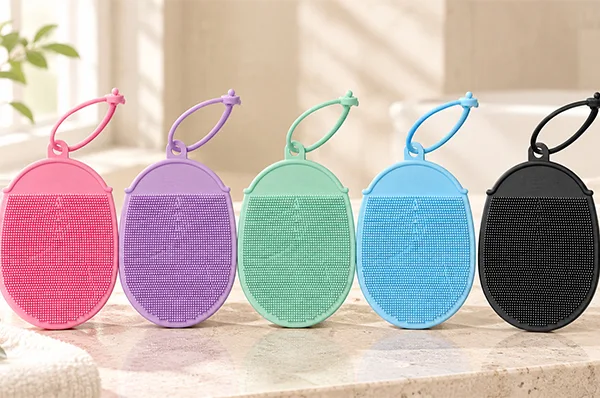
Introduction: Why Silicone Hardness Is Important For Body Scrubber?
Silicone hardness is one of the primary properties to consider when creating silicone body scrubbers. It affects bending properties of bristles, tactile properties of products, ease of handling, and consistency of their performance.
For cosmetic companies, wholesalers, distributors, and private label manufacturers choosing a right hardness of silicone also means a lot in terms of product positioning, customer satisfaction, cost of production, and competitive advantage on the market.
But at the same time, there is no optimal silicone hardness for all body scrubs. A product aimed to deliver gentle cleaning experience may be created using materials that differ from the ones used for products with firm touch. Short and thick bristles may be significantly harder than long and thin ones produced from the same silicone.
With regards to the material choice in product development, buyers could consider silicone materials within approximately 20–50 Shore A hardness, and subsequently narrow down their choice depending on the bristle shape, application, and prototype testing. This is a development hardness range but not an absolute specification or warranty of performance. In some cases, different hardness values might be needed.
With regards to companies who need customized silicone body scrubbers, the best way to do so is through hardness consideration alongside bristle shape, material formula, product construction, and quality control standards.
The following article is meant to provide information on how to select proper silicone hardness value and cooperate with OEM/ODM manufacturer for developing a product.
1. What Is Silicone Hardness?
Silicone hardness refers to how resistant the material is to indentation. In making silicone body scrubs, it is often stated according to the Shore hardness scale.
For flexible silicone products, the Shore A scale is widely used. It is a hardness tester measuring indentation under certain conditions, thus enabling manufacturers to make comparison between various materials and ensure that their production lot matches the predetermined specification.
As a rule, the smaller the Shore A scale of a material, the softer it is; and the larger – the harder.
Example:
- Softer silicone rubber tends to deform easier under pressure.
- Harder silicone rubber tends to be more resistant to indentation.
- Two silicone rubbers having the same Shore A value can have a different behavior due to the specifics of their composition and design of the product.
The hardness of a material is therefore only one of many its properties.
In discussions with a silicone body scrubber manufacturer about hardness, customers should clarify what shore scale is required, at what level, how much tolerance can be accepted, the testing method, and any conditions under which the hardness needs to be tested.
In projects for customized body scrubbers, especially when they are to be made on an ongoing basis or in various colors and batches, it is important to have a written material specification.
2. Which Level of Silicone Hardness is Best for Body Scrub Brush Bristles?
Optimal hardness depends on the desired user experience. Rather than picking a single number for each product, manufacturers should set a starting range for testing purposes via prototypes.
The following ranges are development guidelines and do not represent industry-wide standards for all body scrubs.
| Approximate Shore A hardness | General material behavior | Potential development direction |
|---|---|---|
| 10–20A | Very soft and easily deformable | Specialized ultra-soft concepts requiring careful structural evaluation |
| 20–30A | Soft and flexible | Gentle-feeling bristles and flexible product structures |
| 30–40A | Soft to moderately firm | General-purpose cleansing concepts and balanced flexibility |
| 40–50A | Moderately firm | More structured bristles and firmer tactile feedback |
| 50A and above | Increasingly firm, depending on formulation | Specialized designs requiring careful comfort and flexibility testing |
Categories are approximate. One cannot predict the firmness of a complete bristle by its Shore A hardness only.
For example, the bristles made out of 40A compound might be more flexible than those from 30A because of being long and thin, while the bristles made out of 30A compound could be short and thick. Base diameter, free length, tip shape, and spacing can affect the force required to bend the bristle.
For most commercial development projects, the optimal way is to test two or three candidate materials using the same bristle geometry. After selecting the preferable material, the company can modify the design if the bristles feel too hard or too soft.
This method is more reliable than the selection of the hardness number depending on recommendations of the supplier.
3. Matching Silicone Hardness to Its Intended Use
Before proceeding with the final silicone body scrubber specification, it is essential to identify how it is supposed to function.
Gentle daily cleansing
In case the buyers want to create a product that will be used for daily gentle cleansing, they may start from testing softer silicone materials, perhaps ranging between 20–30 Shore A.
It is important to note that despite the softer feel of such materials, the bristles may be relatively hard due to their thickness or length.
The final product must be tested in terms of comfort, bendability, easy handling, and its suitability for the intended purpose.
General-purpose body cleansing
When buyers need to develop a general-purpose product, they may choose silicone materials with hardness ranging from 30 to 40 Shore A as the initial development option.
It is often necessary when the design of the product requires the balance between flexibility and rigidity, and the final choice will depend on the bristle length, the product form, and its desired characteristics.
It is recommended to test the general-purpose product according to its design, rather than simply choosing its material.
Tougher exfoliation surfaces
If a tougher exfoliation surface is needed, buyers might test a range of materials with hardness of around 40–50 Shore A or adjust bristle structure accordingly.
However, a tough feel does not necessarily require a hard substance. Shorter bristles, larger base areas, denser spacing, and various bristle tips can also make a product seem harder.
The product needs to be tested for proper texture, which should fit the particular application. Too hard products will decrease comfort, especially when applied to sensitive skin.
Multi-functionality and dual textures of scrubbers
There are some multi-functional scrubbers, whose surfaces consist of several zones or have several bristle structures at once.
In such cases, the producer needs to determine whether different structures, different materials, or a combination thereof will work better in each case. Different hardness grades may complicate the manufacturing process, so there needs to be a good reason for that.
The main idea is to match the whole product design to the intended application rather than assign an arbitrary hardness grade to a certain type of a product.
4. The Effect of Bristle Geometry on Perceived Firmness
The bristle geometry is one of the key parameters that influence the feeling of a silicone body scrubber during its usage.
Two scrubbers manufactured from the same silicone compound may have a drastically different performance due to the difference in the dimension and geometry of their bristles.
Bristle length
Generally speaking, longer bristles will bend more easily in comparison with shorter bristles under the same load condition.
However, the bristle length should always be considered in conjunction with the base thickness, cross-section and material.
Thickness of bristles
Thicker bristles will usually be less flexible than thinner bristles under the same length and material conditions.
This parameter is especially crucial for buyers trying to tune the product firmness using only its bristles’ dimensions.
Density and arrangement of bristles
In some cases, closely arranged bristles can interact with each other upon pressing against any surface. This will give a denser and firmer effect compared to designs in which bristles are widely spaced.
Increased bristle density can also have an impact on rinsing, residue removal, molding possibility, and cleaning effectiveness.
Bristle tip geometry
Round, conical, flat, and other tips can provide various tactile experiences. Geometry of bristles’ tips should be considered in terms of comfort, manufacturability, and consistency.
In case of body scrubbers, designed to be used in daily skin contact, do not use bristle tip designs that may lead to unnecessary sharpness of contact or extra pressure.
Thickness of the base and its flexibility
Thickness of the silicone layer where the bristles are located affects the deformation behavior of the whole item. Flexible base allows the scrubber to follow body shape while the rigid base may enhance manipulative or structural properties.
When working on creating a custom silicone body scrubber, it is convenient to think of hardness and geometry as of a design system. Modification of one parameter at a time helps to find out which change leads to required effect.
5. Silicone Material Choice: Hardness Isn’t Everything
Hardness isn’t the only property to consider when choosing a material for a silicone body scrubber. There is the formulation itself, the curing process, and even the thickness of the final product.
Customers need to have the following items on their mind and speak to them with the manufacturer.
Material grade: The choice of material needs to suit the application and markets where the product is going to be sold.
Resistance to tears: Thin bristles and narrow connectors might bend multiple times during normal use, and this needs to be taken into consideration when evaluating the material and its properties.
Elastic recovery: Bristles need to recover their original shape after being deformed. This property needs to be tested on the final product design.
Surface quality: It depends not only on material but also on how the product was made.
Color compatibility: Colors and other materials and additives can impact processing and affect material properties. The end colored products should be reviewed and compared to the natural-colored one since a natural-colored sample does not necessarily represent the end product.
Odor and cleanliness: Material buyers need to develop reasonable expectations and requirements for both material and processing in order to have control over the odor, contamination, and residues.
Use-suitability: Material information and testing required should correspond with the use of the product and its target market.
Material selection process for B2B buyers is based on choosing the material that would provide the balance of tactile, durable, manufacturing, and economic performance.
Inexpensive material is not necessarily the best choice if it leads to inconsistency in bristles, early degradation, or unsatisfactory consumer experience. Equally, an expensive material is not necessarily the best choice if it provides no performance benefits over a cheaper one.
6. How to Measure the Hardness of Silicone Bristles Prior to Mass Production
Testing prototypes allows brands to detect issues before committing to production on a large scale.
For developing silicone body scrubber bristles, it makes sense to test both the raw material and the final product.
Step 1: Describe the required experience
Express the targeted effect of the product in tangible terms. The final product may be expected to feel soft and flexible, well-balanced, or relatively stiff.
The reference prototype or a physical specimen can help explain the requirements more clearly than vague descriptors.
Step 2: List potential hardness values
Ask the producer to suggest a few candidate materials. For example, a project can include 25A, 35A, and 45A materials, if such options are available for the product development.
This step allows creating a controlled environment rather than assuming that one specific hardness level is the right one.
Step 3: Stick to the same geometry
It is better to keep the dimensions of the bristles the same, at least during the first tests of the product.
Otherwise, it will be hard to understand what causes differences in its experience.
Step 4: Check completed samples
Check the samples to see if they have the following:
- Flexibility of bending and return.
- Perceived stiffness when used as intended.
- Comfortability and handability.
- Deformation of bristles from repeated loading.
- Quality of surface and presence of defects.
- Easiness to rinse and dry.
- Other considerations for durability or performance.
Test procedure must consider actual intended use rather than just material specifications.
Step 5: Approve the final specification
If the sample satisfies the requirements, record its material grade, target hardness, size, color, and other important specifications.
The sample will serve as the benchmark for future production.
This step ensures that future batches are checked based on common understanding between buyer and manufacturer.
7. Measuring and Controlling Hardness of Silicones by Manufacturers
It is possible for manufacturers to measure and control the hardness of silicone materials based on a certain specification using durometry.
In cases where soft silicone materials need to be measured, it is necessary to consider the method used and the condition of the specimen.
ASTM D2240 is an example of a test method for measuring the hardness of silicones. The correct test method should be chosen in relation to the nature of the material and specimen shape among others.
Measurement of thin and flexible materials may be difficult to do. Parameters such as the thickness of the specimen, support surface, location of measurement, temperature, and time may influence the outcome of the measurement.
To ensure effective production control, the purchasers need to reach an agreement with the manufacturer concerning the following:
- Shore scale for the material.
- Required hardness level and allowable deviation from it.
- Testing procedure.
- If hardness is tested on a standard specimen, sample of material, or finished good.
- Frequency of taking samples and documentation thereof.
- Procedure of resolving deviations.
Hardness testing needs to go hand in hand with dimensional inspection and functionality checking of the product. Even though the material satisfies the nominal requirements of Shore A, the difference in bristle size can affect how the product feels.
Thus, a strong quality program needs to cover both properties of the material and those of the finished good.
8. Common Issues in Selecting the Right Silicone Hardness
Selection of material by its hardness alone may result in problems in the development process that could have been easily avoided. The following selection problems relate to ODM/OEM projects specifically.
Selecting the hardest material for effective exfoliation
Harder materials do not necessarily perform better in cleaning or exfoliation. An item may feel overly hard and uncomfortable because of poor compatibility of material and bristle structure with their purpose.
Selecting the softest material for enhanced comfort
Too soft material may not be able to ensure necessary rigidity for all design concepts. Thin bristles may bend too much or fail to provide expected tactile feel.
Both flexibility, geometry, and functionality should be taken into account for proper selection.
Not considering bristle sizes
Silicone hardness cannot give full description of how the bristle bends. Length, diameter, thickness at the base and distance between bristles are important for product design.
Material samples approval without finished product testing
The small sample of silicone may differ from the moldable scrubber. The buyers need to test the finished product and consider its base, the design of bristles, and the handle, if any.
Changing material without re-validation
When a supplier changes the material, the formula, or the manufacturing process, the new product will differ from the old one. The change of the material needs to be tested depending on the importance of the characteristics of the product.
Using imprecise purchase specifications
Such definitions as “soft silicone” or “medium hardness” are too vague for mass production. The buyers need to formulate the requirements and the sample for that matter.
Such considerations help to avoid sample corrections and facilitate communication.
9. Impact of Silicon Hardness on Manufacturing Costs and Design
Though the hardness of the material could have an effect on the design of a product, it must never be considered the sole contributor to the manufacturing costs.
The overall cost of the body scrubber made out of silicone is also determined by the amount of material used, product size, complexity of the bristles, molding design, cycle time, quality expectations, and the order volume.
In case the product design contains numerous thin bristles, the mold design might become more complicated.
In evaluating different possibilities of hardness, buyers should consider:
Availability of the material: It should be ensured that the hardness grade in question is available and appropriate for the particular product.
Moldability: Whether it is possible to mold the selected material and bristles with certain dimensions.
Weight of the product: Larger or more substantial products require more materials.
Production consistency: The manufacturer should have control over the characteristics of the material used and the dimensions of the brushes.
Validation: Further testing may be required if there are new risks associated with the design of the product, material grade, or its application.
Retail price: Design and material should be consistent with the planned position of the product.
What is more cost-effective does not mean what is cheaper per kilogram of the material. What is more cost-effective is a combination of material and design that provides necessary characteristics at an acceptable total cost.
In developing a new product for a brand, comparing a couple of technically possible prototypes may help understand whether more expensive material delivers any consumer benefit.
10. How to Designate the Hardness of Silicone in an OEM/ODM Program
Specifying clearly avoids discrepancies between the pre-approved sample and the manufactured products.
In ordering a quotation for a customized silicone body scrubber, buyers need to give the following information:
- The purpose of use: For gentle cleansing, body wash, or hard exfoliation.
- Hardness requirement: Proposed Shore A measurement range for validation by the manufacturer.
- Bristle specifications: Measurements such as length, diameter, shape, spacing, and base thickness.
- Materials needed: The type of silicone required and all other information required.
- Dimensions of the product: The required dimension and acceptable tolerance.
- Appearance and branding: Color specification, position of logo, and acceptable application techniques.
- Quality requirements: Acceptable hardiness tolerance, appearance standards, dimensional inspection, and functional testing.
- Order quantities: Required first-time and subsequent quantities.
- Package types: Individual packaging, retail packaging, and packaging of shipping cartons.
- Required destination: Country and product requirements in that market.
Now, the producer is ready to assess feasibility, suggest materials, create samples, and establish the cost factors associated with various design choices.
Prior to any mass manufacturing, the parties must put down on paper their agreements about the last sample, materials, inspection process, packaging requirements, and business conditions.
It is critical in case of private-label goods, because one has to make sure that all samples have consistent tactile properties.
11. How Beaut-Lohas Supports Custom Silicone Body Scrubber Development
Beaut-Lohas provides B2B silicone personal care products and OEM/ODM customization support for brands, wholesalers, distributors, and retailers.
With 15 years of silicone ODM experience, a 3,000 m² factory, more than 1,000 existing molds, and dedicated R&D and quality-control teams, Beaut-Lohas can support buyers exploring different silicone body scrubber designs.
According to the scope of the project, the assistance can be given as follows:
- Consultancy in product design: The discussion on the target application, the bristles’ feeling, the product’s dimensions, and manufacturing possibility will be carried out.
- Selection of materials: Evaluation of the appropriate silicone material types and hardness requirement will be considered.
- Prototype Development: Comparison of the various designs and evaluation of the flexibility and feel of the final product will be made.
- Custom Mold Development: Investigation of differentiated bristle arrangements, designs and structures of the product if required.
- Customization of colors: Color requirements coordination by means of Pantone values, sample approvals and etc.
- Customization of logos: Evaluation of printing, debossing, laser marking and other technically viable methods for branding.
- Quality Control planning: Specification and inspection requirements for the product will be set.
- Testing assistance: Discussion about the testing and documentation requirements in accordance with the intended use and target market will be done.
It will be useful for the brands who develop new silicone body scrubber to discuss the target market, preferred texture, reference products, order volume and target cost.
These details help the development team evaluate possible materials and design directions before the project moves into sampling and production planning.
To explore custom silicone body scrubber options, visit and contact Beaut-Lohas to discuss your OEM/ODM requirements.
Conclusion: Determining Hardness via Tests Rather Than Assumptions
The optimal hardness of silicone for body scrubbers depends on the application, feel of the material, geometry of the bristles, composition of the silicone, and other factors.
While softer materials can be used for flexible models, the harder ones could be employed when the structural strength or different tactile experience are required. Nonetheless, the hardness does not guarantee that the final product will be pleasant to use, long-lasting, and commercially viable.
The most effective method would be to set up user expectations, review the available material grades, test the prototypes, and approve their parameters prior to the mass production.
In the case of business-to-business purchasing, this method will allow eliminating any additional modifications, providing consistency, and creating a silicone body scrubber consistent with the positioning of the brand and its retail market.
It is possible to discuss all these aspects with an experienced OEM/ODM manufacturer, like Beaut-Lohas.
Frequently Asked Questions
1. What Shore A value is preferable for silicone bristles of body scrubbers?
It depends on particular applications and cannot be given unambiguously. For preliminary design evaluation, potential users can take into consideration materials with values within 20-50 Shore A range.
2. Will softer silicone be more beneficial for a body scrubber?
Not always. Softer silicone will give more flexibility, but bristle length, diameter, gap, and base thickness should be considered, too. Some very soft materials may lack sufficient structure to serve in certain designs.
3. Can I assume that hardness of silicone directly correlates with its ability to exfoliate skin?
No, not necessarily. Harder materials are harder to indent, but it doesn’t mean they are going to cleanse or exfoliate any better. Geometry of bristles and their use are equally important.
4. How is silicone hardness determined?
For soft silicone materials, Shore A scale is the most common. It should be measured according to some standard procedure, like ASTM D2240, if relevant.
5. Is it possible to customize silicone body scrubber hardness?
Manufacturers may conduct tests using various grades of silicone and designs of bristles to obtain required hardness level. The possibilities are defined by the product structure, material availability, molding process, and manufacturing capabilities.
6. What information should the buyer provide for the silicone body scrubber specification?
The buyer should specify the hardness level, the required scale of measurement (Shore scale), tolerance range, bristle parameters, material specifications, product dimensions, desired color, quality standards, and application area. Approved physical sample makes it easier to understand the desired finish of the product.
7. Could Beaut-Lohas assist in developing custom silicone body scrubber?
Beaut-Lohas provides assistance to B2B projects, such as OEM/ODM products development, product customization, material discussion, color matching, logo design, molding and packaging.