Introduction: Selecting Suitable Body Scrubber for Retail Business
Body scrubbers are common elements that belong to personal care, bath and wellness goods categories. When it comes to selection of body scrubbers for global retailers, beauty brands, wholesalers and distributors, the choice is based on more factors than just unit cost. Material, consumer demands, lifespan of the product, packaging, positioning and supply chain issues can impact the commercial success of the product.
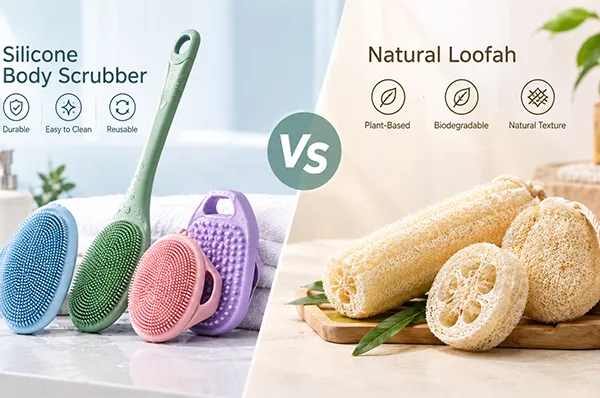
Silicone body scrubbers and loofahs are two common types of body scrubbers. Despite similar purposes, silicone body scrubber and loofah provide distinct experience and have their own market target.
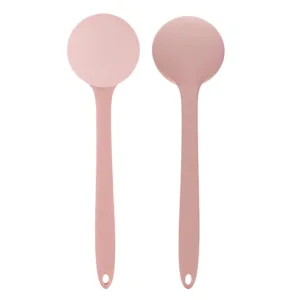
Silicone body scrubber is usually produced from molded silicone with bristles and is easy to rinse, dry and durable material. Silicone body scrubber is usually available in various designs and color shades.
Loofah is a product, which is made of inner part of loofah gourd and gives its consumer unique and traditional feeling of exfoliating.
Which would be more suitable for international retail sales? Silicone body scrubs may be a good choice when brands seek to offer durable, design-focused, and easily washable products for personal hygiene. The natural loofahs can be an interesting solution for companies that sell to customers interested in natural products, traditional scrubs, and biodegradable materials.
In case of B2B purchases, everything will depend on the target audience, price range, customer demands, and company’s marketing plans. Let’s compare these two products and see how businesses can create their competitive body care product line.
1. What Are the Distinctions Between Silicone Body Scrubber and Loofah?
When looking for products for wholesale and private labeling, it is necessary to know how these two materials are different.
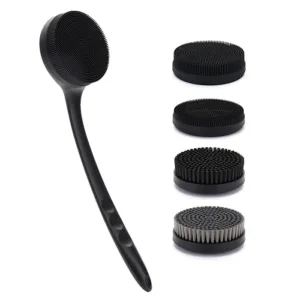
Silicone body scrubbies are created through the molding process. In accordance with the design, silicone body scrubbers can have soft bristles, massage nodes, textured surface, ergonomic handle, hanging loop, and different zones with various functions. The design of silicone body scrubbers can be tailored to fit the category of products and requirements of customers.
Natural loofahs are created from dried vegetable fibers. The natural fiber network provides rough texture which gives a feeling of traditional exfoliation. The appearance of loofah depends on the raw material, manufacturing process, and required product.
Below is the comparison chart of these materials.
| Comparison factor | Silicone body scrubber | Natural loofah |
|---|---|---|
| Main material | Molded silicone | Dried plant fibers |
| Surface texture | Adjustable through product design | Naturally fibrous and textured |
| Water absorption | Generally low | Absorbs and retains moisture |
| Cleaning | Usually easy to rinse | Requires careful rinsing |
| Drying | Generally quick, depending on design | Depends on fiber density and drying conditions |
| Durability | Often suitable for extended reuse | Can deteriorate with repeated wetting and use |
| Product consistency | Can be controlled through specifications and manufacturing | Natural variation may occur |
| Customization | Supports multiple colors, shapes, textures, and branding options | Customization depends on material and construction |
| Sustainability positioning | Reusable and potentially long-lasting, but not biodegradable | Plant-derived and biodegradable under suitable conditions |
| Retail positioning | Modern, functional, design-led, premium or mid-market | Natural, traditional, exfoliation-focused, eco-conscious |
None of these materials automatically assures improved customer experience because silicone products differ greatly in terms of the softness of the bristles and their construction while the quality of fibers of a loofah depends on the processing method used.
2. Hygiene and Cleaning: Which Item Is Easier to Care for?
Hygiene is one of the factors taken into account when buying accessories for bathing because in some markets, consumers look for easy-to-clean and maintain items.
The surface of silicone is not porous, which means that a good silicone body scrubber will absorb little water and be rinsed with ease. The efficiency of a body scrubber will also depend on the bristle placement, geometry of the product, soap residues, and how it is kept after use.
A natural loofah has plant fiber structure that retains moisture and soap residues and skin particles. If a loofah stays wet for long, microorganisms can grow inside the fibers. Hence, it should be carefully cleaned and dried.
For retail consumers, the practical aspects are as follows:
- Silicone: Easy rinsing, low water absorption, and maintenance.
- Natural loofah: Rinsing and drying should be done carefully.
- Common aspects: Appropriate care, drying, and replacement of both products.
However, it is crucial not to confound the attributes of materials with the guarantee of cleanliness. For example, silicone is not always antibacterial and the absence of pores does not imply the necessity to wash a material. Moreover, there is nothing dangerous about natural loofahs provided they are cleaned properly.
For the brands producing silicone goods, providing instructions on how to use a product will make customers feel more comfortable and avoid making misleading statements. Claims such as “antibacterial,” “germ-free,” or “infection-preventing” must be justified in some way or another.
Regarding the marketing aspect of silicone body scrubbers, the ease of care may serve as an effective attribute that appeals to potential consumers.
3. Lifespan and Rate of Replacement
The life span of the product plays an important role for consumer satisfaction, the value of the purchase, and positioning of the retail product.
A properly designed silicone body scrubber is able to withstand frequent wetting, washing, and handling without breaking down its fibers as do some other natural body scrubbers. Life span depends on material quality, design, use, maintenance, and storage conditions.
The loofah is subject to gradual wear because of its softening, breaking down or decomposing of the fibers. The replacement frequency depends on the quality of the loofah and frequency of use.
This distinction forms two value propositions for retailers.
Silicone body scrubber: The cost of the purchase is relatively high at first, however, the life span can help to justify the positioning as a reusable product.
Natural loofah: Natural feel and affordability of the product may attract consumers willing to use natural product from time to time.
Promises for an extended product life cycle, without having tested its durability specifically, must not be made by buyers. Durability can be evaluated by such means as repeating use trials, visual inspection, and others depending on the purpose of the item.
The product’s longevity also determines the approach towards the sales of the item. Scrubbers that last longer will suit those customers who seek convenience, while loofahs made of natural materials will suit those retailers who sell traditional bathing products or replace them frequently.
It all depends on the business model and not only on the frequency of replacement.
4. Exfoliation and Customer Experience
An experience of cleaning and exfoliation is among the top reasons why consumers would go for one body scrubber rather than another.
Natural loofahs have a fibrous surface. Customers who enjoy the classic feeling of scrubbing will probably enjoy using such a product. Nevertheless, the amount of pressure applied, the coarseness of fibers, and frequency of use can affect comfort.
Silicone body scrubbers provide different feelings from what natural loofahs can offer. The parameters such as the length, thickness, density, flexibility, and surface layout of silicone bristles can be varied during development. There are products designed for cleansing only and some of them include several textures or even massage capabilities.
That is where product differentiation comes into play.
- Gentle daily cleansing: Think about softer bristles or an aggressive texture.
- Classic exfoliation: A natural loofah could be a good option for customers preferring its characteristic fibrous texture.
- Two-in-one bath products: There are dual-sided silicone products that incorporate different surfaces in one product.
- Different body care lines: A variety of shapes, handles, and texture combinations could be used for product differentiation.
There is no scrub that can be considered appropriate for all skin types or uses. It is not advisable to use too much force especially on damaged or sensitive skin.
As far as global retailers are concerned, the secret is to be able to describe the desired feeling effectively. This will enable the consumer to select the right product according to the preference for texture and comfort.
5. Sustainability: Silicone vs Natural Loofah
Sustainability can be a consideration in Europe, North America, and other international markets. Nonetheless, buyers need to consider the sustainability aspects of each material without automatically assuming which one is better for the environment.
Natural loofahs are made from plants and have the potential to biodegrade under certain conditions. The impact of loofahs on the environment will be dependent upon the process involved from cultivation to transport to packaging to disposal.
Silicone body scrubbers cannot biodegrade under typical composting circumstances. Nonetheless, the reuse factor of silicone may contribute to its extended life in comparison to shorter-lived materials.
Comparing both products involves the following criteria:
Materials used: Natural loofah products use organic fiber materials, while silicone products use synthetic material.
Lifespan: While a durable silicone scrubber can last for years, a natural loofah can have to be replaced earlier.
Waste produced: Product weight, packaging, replacement frequency, and end-of-life management are the main factors to determine how much waste is produced during the product lifecycle.
Transport: Product weight, packaging size, place of sourcing, and mode of transport are to be considered.
End-of-life management: Organic fibers can biodegrade under certain circumstances. The proper disposal and recycling of silicone products depend on the local facilities.
It is important to consider the entire product lifecycle when designing a sustainability message for brands. One should not claim that silicone scrubbers are biodegradable or recyclable in any way without proving this fact about the product.
For retailers, natural loofahs can be marketed on the basis of plant-based materials and biodegradability, while silicone products can be marketed on the basis of reusability and durability.
6. Retail Pricing and Profitability
The profitability of retail sales involves factors other than the factory price. Consumers need to consider costs like packaging, shipping, duties, distribution, marketing, channel markups, returns, and other operational costs.
Silicone body scrubbers can be positioned as mid-level or luxury items because of their special shapes, unique colors, and textures. Loofahs can be effective in a budget-conscious or organic bath product line but there is also the option for a premium loofah product line.
An analysis must consider the following cost elements:
| Cost factor | Silicone body scrubber | Natural loofah |
|---|---|---|
| Product development | May involve sampling and mold development for custom designs | May involve sourcing, processing, sizing, and packaging specifications |
| Unit cost | Depends on material, weight, design, order quantity, and customization | Depends on raw material quality, processing, size, and sourcing |
| Branding | Multiple molded or applied branding options may be available | Branding is often achieved through tags, labels, sleeves, or packaging |
| Packaging | Can support premium retail and gift-set formats | Can support natural, minimalist, or gift-oriented packaging |
| Inventory planning | Color and design variants may increase SKU complexity | Natural variations and grading may require clear specifications |
| Repeat purchasing | Can be positioned around durability and complementary product purchases | Replacement demand may be relevant, depending on product lifespan and use |
Prior to selecting the product for the brand’s portfolio, its expected landed cost and contribution margin should be estimated.
In one example, a silicone scrubber featuring unique colors and packaging will merit a higher price due to its unique design and function, though additional features may also drive up the cost of production and transportation.
In another case, a natural loofah has a very simple product structure, yet will require quality grading and proper packaging.
The more commercial product will be the one that satisfies consumer needs and yields acceptable margins at the target retail price.
7. What Product is Better for Various Retail Markets?
Worldwide retail markets are heterogeneous. Consumer tastes, sensitivity to prices, regulatory compliance, retail format, and sustainability requirements may differ between countries and retailing channels.
Rather than assuming that one product will perform well anywhere, the brand needs to determine its core customer base.
North American retailers
Silicone body scrubs can be an excellent fit for retailers selling practical personal care accessories, contemporary bathroom items, product demonstrations online, and beauty collections under the brand name.
Natural loofahs will go well alongside traditional bath products and natural personal care lines.
European retailers
Material certification, safety data, special packaging, and environmental claims will likely require more attention from retailers here. Silicone products can emphasize longevity and multiple uses, whereas natural loofahs will appeal to customers interested in plant-based products.
Which choice is appropriate depends on the target audience of the brand and supporting data.
Beauty and Personal Care Channels in Asia
Where there is an inclination towards beauty aids and miniature personal care items, the opportunity to use silicone scrubbers is present due to color variations and innovation in texture and matching set items.
Natural loofahs still hold value for those that like the traditional methods of exfoliation and traditional materials.
Specialty Stores, Spas, and Gift Shops
Where silicone scrubbers can be used to complement luxury bathing products because of their unique color combination, shape, or accessories.
The natural loofahs can help in botanical, homemade feel, or traditional bathing idea.
This is a possibility not necessarily a guarantee that there is a market need for the item. The buyers must confirm through competitive intelligence and product testing.
8. Product Differentiation: The Advantages of Using Silicone
It is difficult for retailers to compete directly in pricing when it comes to similar items. Silicone production can offer several possibilities for product differentiation.
Retailers might think about:
Specific shapes: A brand can use unique shapes and proportions to distinguish it from its competitors.
Bristle structure: Bristles might vary in length, thickness, density, and distribution, providing different tactile experiences.
Two-sided brushes: Two sides might provide two unique experiences if there is a clear purpose for each of them.
Grips: Finger grooves, unique curves, and anti-slip texture might be utilized if they are designed effectively.
Brushes with long handles: Some consumers may consider brushes with long handles.
Unique coloring: Color selection can help integrate a product into an existing line of cosmetics.
Branding and packaging: Proper branding techniques and quality packaging can turn an ordinary brush into a recognizable item.
It is not always necessary to develop a new mold for every product idea. In some cases, a brand may have the ability to try out the market using a proven mold and adding its own colors, logo, and packaging.
As a product that occurs naturally, you can differentiate loofahs by using different grades, cuts, sizes, packaging, and complementary products.
The target is not to introduce numerous features in the product. The target should be developing a product with unique advantages that have commercial value.
9. Wholesale Purchasing: Criteria that Importers Need to Consider
For buyers of imported products, distributors, and retailers, it is critical to note that they should choose the right products through an evaluation process rather than judging by the appearance of samples alone.
With that in mind, some of the key factors you need to keep in mind before buying products in bulk include the following:
- Intended buyer: Who is going to buy the product, and what problem will it help solve?
- Product specifications: Dimensions, material, weight, color, texture, and packaging have been well described?
- Quality consistency: Is the supplier able to adhere to the agreed specifications in all production runs?
- Final sample approval: Have you evaluated and approved the final sample in writing?
- Regulatory compliance: Is there any material documentation, testing, labelling or any other requirement?
- MOQ: Is the minimum order quantity appropriate for the launch and inventory budget?
- Lead time: Is the sampling, tooling, production and shipping schedule clear?
- Landed cost: Has everything including the freight, duties and handling costs been considered?
- Packaging: Is the packaging appropriate for the intended retail and transport?
- Supply reliability: Can the supplier communicate changes, manage quality issues, and support repeat orders?
You need to source natural sponges and silicone scrubs differently. Silicone products would need special considerations for molding tolerances, colors, and specialized tools. The natural sponges would need special considerations with regards to materials, grading, moisture, and packaging.
The ideal supplier would need to highlight the differences and ensure that the buyer is able to set realistic specifications.
10. How to Choose the Right OEM or Wholesale Partner
Choosing an appropriate supplier plays a very important role in constructing a body care products line in foreign markets.
In the case of silicone body scrubbers, it is necessary to find out whether the manufacturer has enough experience in designing, molding, customizing, quality controlling, and packaging. The supplier will give you advice on what is possible and what will not work.
The most important questions are:
- Is it possible for the manufacturer to work on existing designs and customize the product?
- What possibilities do we have for color, logo, texture, and packaging?
- How does the manufacturer check and approve samples before mass production?
- What kind of quality control procedures does the manufacturer perform during production?
- Can the manufacturer give us necessary material data and testing?
- Who owns the tools? How they store and maintaine the tools?
- MOQ, lead time, and quotations for our project?
Regarding natural loofahs, there will be a greater emphasis on sourcing, grading, standardization of processing, control of moisture content, and reliability of supply.
There is a chance that if the same brand offer both products, the brand will need different supplier connections because of the different process involved.
It is not always the case that the ideal supplier will be the one with the least quotation. It is the one that can consistently deliver the specified product, communicate clearly, and support the brand’s long-term commercial goals.
11. Supporting Buyer Customized Silicone Body Scrubber Projects from Beaut-Lohas
Beaut-Lohas is a B2B silicone personal care products manufacturer catering to brands, wholesalers, distributors, and retailers for OEM/ODM manufacturing and private label services.
With 15 years of ODM experience in silicone, a 3,000 m² factory, more than 1,000 molds, and R&D and QC teams, Beaut-Lohas can assist customers in exploring ways of developing custom silicone body scrubbers.
Depending on project needs, the following types of assistance can be provided:
- Selection of the product: Selection of an existing silicone body scrubber according to the target market.
- Development of the customized product: Discussion of design, form, color, and structure requirements.
- Customized color: Color coordination based on references such as Pantone color values and sample approval.
- Application of logo: Evaluation of various methods of logo application: printing, embossing, laser marking, etc.
- Development of mold: Discussion of mold development in case a distinctive design is required from a commercial perspective.
- Development of packaging: Development of packaging concept for the product.
- Quality requirements: Product specification and inspection criteria development.
- Testing assistance: Discussion of testing and documentation requirements based on the use and destination market.
When buyers are comparing silicone scrubbers with loofahs, a possible way out might be to introduce silicone products as a reusable, design-oriented line, while keeping natural loofahs for those who have an inclination towards products made from natural plant material.
This is something that can help a brand cater to various customer preferences through one single product type.
In case you want to start with a project, you will need the target market, desired retail placement, design preferences, logo and package specifications, order quantity, and desired cost for the project.
See https://www.beaut-lohas.com/ for silicone personal care products or discussion of a custom body scrubber project.
Conclusion: Which Body Scrubber Is More Suitable for International Retail?
There is no single winner when comparing silicone body scrubbers versus loofahs. Both have specific benefits depending on the needs of consumers and businesses.
Silicone body scrubbers are usually the right choice for those brands focusing on ease of maintenance, durability, design freedom, and private labeling.
Natural loofahs still appeal to those customers who care about natural ingredients, traditional cleansing process, and recyclable products when conditions allow that.
As far as international retailers go, the optimal solution should start with consumer needs rather than the material itself. Consider the audience, pricing, product experience, quality, and total cost before contacting the manufacturer.
Those brands considering a unique line of silicone body-care products can rely on the help of Beaut-Lohas with regard to product selection, OEM/ODM production, logos, coloring, packaging, and quality.
It is not about merely selecting one material instead of another. The objective is to construct an array of products that would satisfy consumer expectations and be provided reliably as the company develops further.
Frequently Asked Questions
1. Is a silicone body scrubber preferable to a natural loofah?
Silicone body scrubs can be easy to wash and more durable when cared for properly. Natural loofahs provide a unique fibrous quality and can biodegrade when conditions allow. It will be up to preference which one would be better suited for a given scenario.
2. Which product is simpler to wash?
It would be simpler to wash a silicone body scrubber since it absorbs less water and its surface is somewhat non-porous. On the contrary, you should wash natural loofahs thoroughly and dry sufficiently. You should take cace of both types of products as per the care instructions.
3. Are silicone body scrubs more sustainable than loofahs?
Not always. Silicone products might reduce the need for replacement because of their durability but do not biodegrade during normal composting. Natural loofahs are made from plants and are capable of being broken down. In order to make a comparison, you should consider all factors.
4. Which body scrubber is preferable for bulk purchase?
Those brands that require design flexibility, standardization and reusable cosmetics may prefer silicone scrubbers. Natural loofah may be suitable for brands that focus on natural materials for exfoliation. Wholesale buyers must consider customer preferences, landed cost, product quality and reliability.
5. Can I customize silicone body scrubbers and use them as private label products?
Yes. Customization of these scrubbers depends upon the design and manufacturing process and may include product shape, bristle pattern, color, logos printing, packaging and mold manufacturing. It is recommended to clarify minimum order quantity, tooling charges, sample confirmation and delivery time with the supplier.
6. What information do you advise importers to consider while buying silicone body scrubbers?
Importers need to evaluate material specifications, product dimensions, sample quality, color variations, packaging, testing requirements, minimum order quantity, delivery time and landed cost of the product. Specifications and samples are helpful in reducing the risk of misinterpretation of product during manufacturing process.
7. Is it possible for Beaut-Lohas to customize silicone body scrubbers?
Beaut-Lohas is a business-to-business silicone personal care OEM/ODM customization project partner, which involves developing, color matching, putting logos on, developing molds, and coordinating packaging of the product depending on its nature.
Looking for a silicone body scrubber OEM/ODM partner? Contact Beaut-Lohas to discuss wholesale products, private-label customization, and product development for your target market.