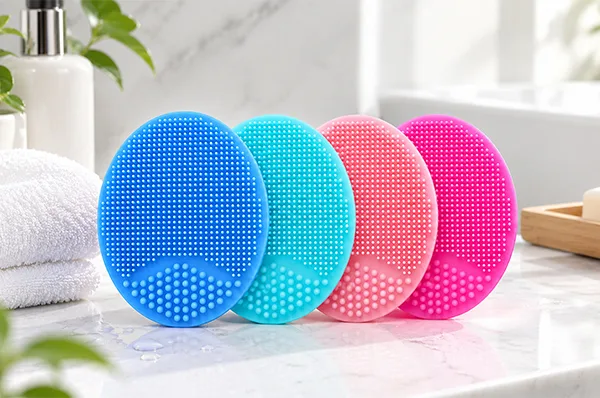
Introduction: Importance of Buyers Understanding Silicone Face Scrubber Production
Silicone face scrubber production seems to be an easy thing, but in reality, it takes much more than pouring silicone into molds.
For cosmetic brands, wholesalers, distributors, retailers, Amazon sellers, Shopify brands, and private label manufacturers, knowing the process of Silicone Face Scrubber Production will simplify supplier selection process a lot.
The manufacturing process will influence:
- Product quality
- Feel of silicone
- Softness of bristles
- Product durability
- Surface quality
- Dimensional accuracy
- Quality of logo
- Color consistency
- Cost of production
- MOQ
- Lead time
- Packaging quality
- Bulk order quality
Buyer who knows how silicone face scrubbers are made will be able to ask much more interesting questions to potential suppliers.
For instance, rather than asking:
- “What is your price?”
An experienced buyer could ask:
- “What silicone material and durometer is used?”
- “How is the mold designed to ensure uniform bristle?”
- “How is flashing and dimensional tolerance controlled?”
- “How is the approved sample converted into production?”
- “What quality control checkpoints are done prior to shipping?”
Such questions will help buyers differentiate between a supplier who only wants to sell their product from one that knows how to make silicone.
This article describes the main silicone face scrubber manufacturing processes starting from the conceptual phase up to the packaging phase, and explains what buyers should be looking for in each of them.
1. Defining Product Concept and Specifications
The first step of silicone face scrubber manufacturing process includes definition of appearance and performance characteristics of the final product.
In case of an ODM product, this step could be not as complex as in case of OEM product since the basic design is already created.
In case of OEM product, a buyer can have only an idea, drawing, reference product, or requirements for a brand.
It may be necessary to specify such aspects as:
- Product shape
- Overall size
- Weight of the product
- Material of silicone used
- Silicone hardness
- Structure of bristles
- Denseness of bristles
- Height of bristles
- Grip design
- Surface texture
- Position of logo
- Colors
- Packaging
- Target market
- Retail positioning
For example, a high-end skincare brand can require a soft and minimalistic facial cleansing device, while a mass-market beauty store requires cost effectiveness, bright colors, and scalability of manufacturing process.
This is why product development has to precede mass production.
What buyers should provide
When possible, the manufacturer should have such information from the buyer:
- Product drawings
- CAD files
- Reference products
- Dimensions
- Guidelines of the brand
- Pantone colors
- Logo design
- Requirements for packaging
- Target market
- Quantity of orders expected
The more clearly the requirements are defined, the easier it is for the factory to provide an accurate quotation and production plan.
2. Silicone Material Selection
Material selection is one of the critical stages in the manufacturing process of a silicone face scrubber.
Silicone is far from being a single standardized material. It is possible to get quite different products based on silicone formulations and hardness level.
Buyers of face scrubbers should pay attention to:
- Material quality
- Flexibility
- Elasticity
- Feel of the surface
- Heat resistance
- Durability
- Odor
- Color stability
- Expected application
- Documenting compliance
The choice of material will be based on product positioning and expectations of its target market.
A product meant for daily cleansing will have a different feel of silicone as compared to a product with dual texture.
Importance of Silicone Hardness Level
Silicone hardness affects bristles and overall body behavior.
Too soft material:
- Loses structural stability
- Deforms bristles to a high degree
- May not provide enough control during use
Too hard material:
- Will have uncomfortable feel of bristles
- May not conform to facial shapes
- Experience of user will be different from expected
So, silicone hardness level should be assessed taking into account bristle geometry, thickness, and general product body.
3. Mold Design and Development
The mold is among the most critical equipment used in the manufacturing process of silicone face scrubbers.
Even with a good design, an appropriate mold is required to be able to replicate the product effectively.
When designing molds for silicone face scrubbers, consideration must be made for:
- Product sizes
- Bristle geometry
- Bristle density
- Draft considerations
- Parting lines
- Venting
- Material flow
- Logo specifications
- Surface finish
- Demolding process
- Efficiency of production
This is even more critical where the face scrubber contains hundreds or even thousands of tiny silicone bristles.
Poor mold design may result in:
- Inconsistent bristles
- Flash visibility
- Incomplete filling
- Surface defects
- Size variations
- Difficult demolding
- Increased production time
Current Mold vs Custom Mold
Customers usually have two alternatives.
Current mold:
The factory uses an existing design which can save development time and lower tooling cost.
Custom mold:
The factory develops a new mold based on the specifications of the product provided by the customer.
Custom mold is very helpful if the brand needs a:
- Unique product design
- Unique product size
- Unique bristle design
- Customized logo
- Retail exclusive product
Long term private label products can benefit from custom mold development.
4. Prototype and First Sample Production
Once the concept of the product and mold have been finalized, the manufacturing company makes a sample/prototype.
This will help the buyer in testing the physical product prior to mass production.
It should not just be judged based on its looks.
Some of the items to test are:
Physical dimensions
Test length, width, thickness, weight, and proportion.
Silicone texture
Test its flexibility, softness, and surface feel.
Bristles
Test the following parameters:
- Density
- Height
- Softness
- Shape
- Uniformity
- Edge design
- Ergonomics
Test if the product is ergonomic to use.
Logo
Test the following:
- Position
- Size
- Clarity
- Surface texture
Color
Compare the physical sample against the approved color standard.
Packaging
If there is custom packaging, test the packaging sample, not just the digital design.
The sample approval process is quite critical since this is the basis for the mass production.
5. Silicone Mixing and Material Preparation
Upon approving the product specifications and sample, the production proceeds to material preparation.
The materials need to be prepared based on the manufacturer’s production process and the product specifications.
Based on the product and the manufacturing process, material preparation may include:
- Material weighing
- Mixing
- Coloring
- Additive preparation
- Conditioning
- Batch identification
Coloring control is especially important for private label products.
Although a brand can ask for a specific Pantone color, the factory still has to convert the color requirements into a repeatable process of production.
For example, a customer ordering a face scrubber in light green will expect the bulk production to visually match the approved sample.
This is why it is essential to document the color samples and approved master samples prior to the mass production.
Buyer question
Ask your supplier:
“How do you ensure consistency of the colors from the approved sample to bulk production?”
A reliable supplier would be able to provide information about its process instead of giving assurances about the colors being exactly the same.
6. Silicone Molding and Forming
The next important step is molding.
The prepared silicone material is molded in the production mold under controlled manufacturing conditions.
The goal is to have a product which reliably meets the approved design specification.
In the molding process, the manufacturers need to control the following:
- Amount of material
- Condition of mold
- Temperature
- Pressure
- Conditions of curing
- Cycle time
- Process of demolding
The particular parameters of the manufacturing process depend on the particular silicone compound used, product design, and manufacturing process.
The important thing for the buyer is that the production consistency depends on process control, and not just on the mold itself.
Different suppliers can use almost identical molds and get different results due to different manufacturing processes, machines, operators, and quality control system.
7. Flashing Removal and Surface Preparation
Sometimes, following the molding process, more surface preparation of silicone products is necessary.
An essential aspect is to remove any extra silicone that does not need to be there – this is what is known as flashing.
Consumers must check:
- Product borders
- Parting lines on mold
- Bristles’ tips
- Areas with logos
- Handle sections
- Small corners
- All decorative elements
If the product’s finishing is bad, it will look cheap despite the quality of the silicone used.
It is especially critical for high-end beauty products since the item will be put directly onto the shelf for sale or shown online.
The right quality control procedure should be able to spot any imperfections at this stage.
8. Bristle Inspection and Functional Quality Control
Bristles are among the main functional elements of a silicone face scrubber.
The manufacturer should control:
- Bristle height
- Bristle density
- Bristle shape
- Bristle spacing
- Bristle tip structure
- Flexibility
- Uniformity
The consumer should compare the real item to the reference sample.
In the case of a face scrubber with two textures, each surface should preserve its structure.
Why uniformity is important for bristles
Even minor variations in bristle geometry may influence the customer experience.
If there are harder, softer, longer, or shorter patches, the performance would be uneven.
For this reason, it is necessary to consider bristle inspection a visual and functional quality control measure.
A professional manufacturer should have specifications for the product and not base everything on subjective visual characteristics.
9. Logo, Colors, and Private-Label Branding
Following the necessary production and finishing processes of the base silicone product, branding can be considered or incorporated based on the design.
The typical branding options include:
- Screen printing
- Laser engraving
- Embossed logos
- Debossed logos
- Branding through molds
- Custom colors
- Packaging design
- Product inserts
- Labels
In terms of the B2B customer, it is better to discuss the branding issue earlier than at the end.
For instance, an embossed logo might need a different mold construction compared to a surface-printed logo.
Furthermore, a custom color might need material preparation and color approval before production.
Best Practice
It is always best to approve:
- Logo artwork
- Logo size
- Logo placement
- Color reference
- Sample of physical branding
prior to manufacturing.
This will eliminate the risk of discovering any issues in branding after thousands of units have already been produced.
10. Product Assembly and Final Inspection
Silicone face scrubbers may be single-component products, whereas others may have more components attached to them.
Based on their designs, assembly may entail:
- Handle
- Cover
- Storage Components
- Other Accessories
- Inserts
- Components Structures
Finally, after assembly, there should be an inspection of the product by the manufacturer. Common inspection areas may include:
| Inspection Area | Buyer Consideration |
|---|---|
| Appearance | No obvious defects |
| Dimensions | Within agreed specifications |
| Silicone | Consistent material and feel |
| Bristles | Uniform and correctly formed |
| Color | Matches approved standard |
| Logo | Correct position and appearance |
| Assembly | Components securely fitted |
| Packaging | Correct artwork and quantity |
| Quantity | Matches purchase order |
For larger B2B orders, buyers may also consider pre-shipment inspection or third-party inspection depending on their sourcing requirements.
11. Quality Control in Mass Production
It must not be done after the completion of production.
A better production process involves using many QC inspections.
This could include:
Raw Material Inspection
Inspection of material before production begins.
In-Process Inspection
Inspection of product while being molded and finished.
Semi-Finished Product Inspection
Problems detected before branding or packing.
Finished Product Inspection
Inspection of the final product before it is shipped out.
Package Inspection
Inspection of packing, labeling, quantity, and carton details.
In case of bulk orders, buyers must set some quality standards prior to starting production.
These would include:
- Allowed cosmetic defects
- Size tolerance
- Color tolerance
- Logo tolerance
- Packaging needs
- Functionality requirements
- Sampling process
The crucial point is that:
Quality must be built into the production process and not into the product at the very last stage.
12. Testing and Compliance Documentation
Depending on the target market, product design, claims and buyer specifications, the silicone face scrubber may require some testing or compliance documentation.
This will depend on the market where the products are to be sold and how the product is positioned in that particular market.
Buyers should therefore provide information about the intended target market from the early stages of product development.
For example:
- Buyers from European countries may have particular testing and documentation needs.
- Buyers in the US may have different requirements based on product positioning, material used, packaging and claims.
- Retailers may have their own supplier documentation and testing requirements.
The type of documentation can include:
- Material safety
- Chemical restrictions
- Product safety
- Packaging
- Factory quality system
- Other market specific requirements
Beaut-Lohas notes that it has testing and compliance capability for CE, CPSIA, RoHS, REACH and California Prop 65 as required by the project and product specifications.
Buyers should always ensure that the tests and documents required are those specifically required for their particular product and not assume that one certificate fits all.
13. Packaging and Carton Preparation
The packaging stage is where the product is finally turned into a retail product.
For B2B private label buyers, packaging may include:
- Boxes
- Paper cards
- Poly bags
- Custom printed cartons
- Instruction cards
- Labels
- Barcodes
- Displays
- Master cartons
Specifications for packaging need to be sorted out before mass production.
Buyers need to make sure that the packaging includes:
- Package dimensions
- Artwork
- Location of logos
- Colors
- Product information
- Barcodes
- Number of units per carton
- Carton marks
- Protection during shipping
There are also logistics costs related to packaging.
A small alteration in package dimensions will have an impact on cartonization, storage needs, and shipping efficiency.
Hence, the packaging needs to be considered during the product development process.
14. Final Packaging, Shipping, and Production Records
After final QC check and packaging, the products are packed into master cartons for shipping.
At this stage, the factory needs to ensure the following:
- Actual quantity
- Quantity in carton
- SKU number of product
- Packaging type
- Shipping marks
- Condition of the carton
- Requirements of purchase order
For recurring B2B orders, keeping production records is extremely helpful.
The buyer can place an order again after a few months’ time.
The factory should be able to refer to:
- Approved sample
- Specifications of product
- Color code
- Logo art
- Packaging art
- Information about mold
- Production records
- QC requirements
This will help minimize variations between various production lots.
For those brands which market their products in Europe, North America, or any other foreign market, consistency of each batch can be equally important as the first order.
15. What Questions Buyers Need to Ask a Silicone Face Scrubber Factory
The understanding of the manufacturing process will help buyers evaluate the supplier much more effectively.
Questions to ask before choosing a supplier include:
Product Development
- Can you develop a product based on my drawing?
- Can you customize a silicone face scrubber?
- Can you manufacture prototypes?
Materials
- What materials of silicone do you have?
- What hardness levels are offered?
- Can you provide any documentation about materials?
Mold
- Can you make custom molds?
- Who owns the mold?
- Is it possible to change the mold after the sampling stage?
Manufacturing Process
- What is your manufacturing process?
- What is your production capacity
- How do you control batch consistency?
Customization
- Are there any pantone matches available?
- Are there any customization options for the logo?
- Is there an option for custom packaging?
- Are there any options for private labeling?
Quality Control
- What kind of QC checkpoints are there?
- How are the bristles inspected?
- How is flashing controlled?
- How are bulk production compared with the approved sample?
Sampling
- How long does sampling take?
- Can I ask for changes in samples?
- Is the last approved sample taken as the production benchmark?
Order Management
- What is the minimum order quantity?
- How long is the estimated lead time for production?
- Is there an option for reorder?
- Can production be increased with increasing demand?
A manufacturer who has answers to all these questions is easier for an international buyer to judge than a company that gives only a unit price.
16. Beaut-Lohas’ Silicone Face Scrubber Manufacturing Process
When customers need a one-stop silicone face scrubber manufacturer, Beaut-Lohas offers its OEM and ODM manufacturing capabilities.
Beaut-Lohas has more than 15 years of silicone ODM expertise, and the company’s manufacturing capability is characterized by:
- 50+ R&D team members
- 50+ Sales team members
- 50+ QC team members
- 3,000 m² factory space
- 1,000+ molds
- Approximately 50 million units per year production capability
The company’s manufacturing services include the following phases of product development:
Concept → Design → Prototype → Mold Making → Sample → Mass Production → QC → Logo → Packing → Shipment
In terms of buyers, this approach will make communication easier as the needs for product development and manufacturing can be discussed together with the same supplier.
Beaut-Lohas offers the following:
- OEM
- ODM
- Private label
- Custom silicone products
- Custom mold development
- Pantone color matching
- Silk screen printing
- Logo laser engraving
- Branding with debossing/embossing
- Custom packaging
- Sample development
- Quality control
- Compliance and testing services
For the production of a standard face scrubber, buyers may use existing design and customize it for branding.
In case of differentiation of the product, buyers may start from the concept and proceed to prototype and custom mold development.
Thus, buyers have the choice according to the budget, MOQ, development needs and schedule of product launch.
17. Why Understanding Manufacturing Process Helps Minimize Sourcing Risks for Buyers
Knowledge about manufacturing process does not imply that buyers have to turn into silicone experts.
Instead, it helps procurement professionals to anticipate possible risks.
Examples:
Risk: Product Differs from Sample
Solution: Provide approved golden sample and specifications.
Risk: Bristles are Too Hard
Solution: Specify silicone hardness and bristles’ specifications before production.
Risk: Color is Irregular
Solution: Approve physical samples and specify production color.
Risk: Logo is Incorrect
Solution: Approve artwork and physical branding samples.
Risk: Flashing is Visible
Solution: Include cosmetic finish specifications in QC specification.
Risk: Bulk Production is Delayed
Solution: Verify mold, sample approval, production capacity, and lead time prior to ordering.
Risk: Packaging Issues
Solution: Approve physical packaging samples and carton specification prior to bulk production.
Risk: Product Fails to Meet Market Requirements
Solution: Identify target market testing and compliance requirements prior to production.
That’s why production knowledge is beneficial for buyers.
It transforms general purchasing process into specific manufacturing project.
18. Silicone Face Scrubber Manufacturing: Buyer Checklist
To prevent misunderstandings during the approval of bulk orders, buyers can follow this checklist.
Product
- Product size validated
- Product weight validated
- Silicone material indicated
- Silicone hardness validated
- Bristle structure approved
- Product color validated
Mold
- Existing or custom mold validated
- Mold design approved
- Mold ownership/usage validated
- Sample made using manufacturing mold
Branding
- Logo artwork validated
- Logo placement validated
- Logo technique validated
- Physical logo sample validated
- Pantone/color standard validated
Quality
- Golden sample validated
- Quality control criteria established
- Cosmetic standards validated
- Functional specifications validated
- Inspection procedure established
Packaging
- Packaging artwork validated
- Packaging sample validated
- Quantity per carton validated
- Carton specifications validated
Production
- MOQ validated
- Production lead time validated
- Shipment plan validated
- Final inspection requirements validated
This checklist will help to avoid possible misunderstandings between the buyer and manufacturer.
FAQs: Silicone Face Scrubber Production
How long will it take to produce silicone face scrubs?
It depends on whether the product will utilize an existing mold or needs a new one and the extent of customization, sample approval time, order size and the factory’s production capacity.
Which step is the most crucial in silicone face scrubber production?
There is no single step determining the quality of the whole product. The steps including material selection, mold making, molding, finishing, branding, quality control and packing all have their part to play.
Are silicone face scrubbers customizable?
Sure, depending on the supplier, they may customize silicone face scrubbers in terms of the shape, size, silicone hardness, bristles structure, color, brand, packaging and custom molds.
Do buyers need to request samples before producing in bulk?
Absolutely yes, since sample testing will let buyers know the characteristics of material texture, size, bristle structure, color, branding, ergonomics and packaging.
What are the elements influencing silicone face scrubber production cost?
The main elements may include silicone material, weight of the product, its design complexity, molds, volume of the order, personalization, logo imprinting method, packaging, testing and shipping.
What is the difference between OEM/OEM silicone face scrubbers?
ODM usually means using an existing design developed by the manufacturer which can be customized by branding, colors, packing, certain alterations. OEM implies manufacturing the product according to the customer’s requirements and design or product idea.
How do buyers ensure quality consistency from order to order?
A product specification, golden sample, QC requirements, standard color references, packaging artwork and production documentation should be used. An inspection can also reveal inconsistencies between batches.
Does Beaut-Lohas offer customized silicone face scrubbers manufacturing?
Yes. Silicone OEM and ODM service is available at Beaut-Lohas including product customization, mold creation, color matching, logo customization, packaging, quality assurance and manufacturing.
Conclusion: Learn the Process First and Then Select the Supplier
For the foreign buyer, learning about the silicone face scrubber production process can be considered one of the most practical approaches towards supplier selection and manufacturing risk minimization.
There are many interconnected steps in this process:
Product Idea → Materials Selection → Molds Development → Prototype → Sample Approval → Materials Preparation → Molding → Finishing → Branding → QC → Testing → Packing → Final Inspection → Shipping
Each of these steps affects the final product.
A supplier may have an attractive price, but still, the buyer should consider its ability to control material quality, tools, molding process, bristles quality, customization, quality control, packaging, and production schedule.
For generic products, there is a possibility to use an existing ODM design to speed up the process.
For brand companies, there is a choice between OEM design and custom molds production.
The main idea of all that is quite simple:
It is necessary to analyze not only a photo of the final product and its price from the supplier of the silicone face scrubbers. It is necessary to analyze how the supplier manufactures, controls, customizes, and ships the product.
Beauty companies, wholesalers, distributors, retailers, and private label companies will all find that Beaut-Lohas offers an all-encompassing silicone OEM and ODM manufacturing service, including product design, mold customization, production, branding, quality control, packaging, and international procurement services.
If you are looking into starting a silicone face scrubber manufacturing project on a wholesale, OEM, ODM, or private label basis, knowing how the manufacturing process works first will allow you to ask better questions and create a better product specification prior to ordering.