- Have any questions?
- +86 19574832024
- admin@beaut-lohas.com

Compression, Vacuum Packing, and Smart Logistics Solutions
The instability of global freight costs has resulted in shipping efficiency becoming one of the most significant cost factors for silicone body scrubbers and other bath accessories sold to North America and Europe. In this context, for brands, wholesalers, Amazon FBA sellers, and distributors, cutting down on shipping costs is not just an option—it is a significant competitive advantage.
At beaut-lohas.com, we collaborate with international buyers to make their products as light as possible. This includes optimizing packaging, selecting appropriate loading methods, and coming up with logistical strategies for silicone body scrubbers, a category that is lightweight but often volume-heavy. This article presents verified, factory-level tactics to minimize shipping costs while maintaining the product quality and the brand image.
Why Shipping Cost Optimization Matters for Silicone Body Scrubbers
Silicone body scrubbers are:
-
Lightweight
-
Flexible
-
Durable
-
Non-fragile
However, they also tend to have large surface areas, protruding bristles, or long handles, which can result in inefficient carton utilization if not properly engineered.
In many cases, buyers discover that:
Shipping volume, not product weight, determines total freight cost.
This is especially true for:
-
Long-handle silicone back scrubbers
-
Multi-head bath brushes
-
Ergonomic or shaped silicone scrubbers
Understanding the Key Cost Drivers in Shipping
Before discussing solutions, it is important to understand what drives shipping costs:
-
Carton Volume (CBM) – The most important factor for sea freight
-
Dimensional Weight – Critical for air freight and courier shipping
-
Packaging Inefficiency – Empty space increases cost
-
Pallet Utilization – Impacts warehouse and FBA fees
-
Destination Compliance – Improper packing can trigger repacking costs
Optimizing these factors requires collaboration between product design, packaging engineering, and logistics planning.
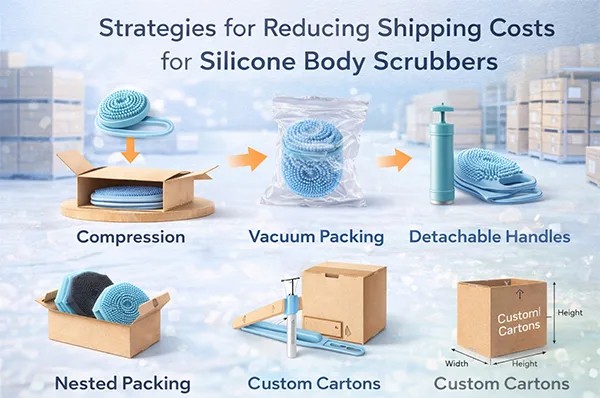
Strategy 1: Compression Packaging for Silicone Body Scrubbers
Why Compression Works for Silicone Products
Silicone is:
-
Highly elastic
-
Shape-memory stable
-
Resistant to deformation
This makes silicone body scrubbers ideal candidates for compression packaging, where products are gently flattened or reshaped during packing and naturally rebound after unpacking.
Practical Applications
Compression is commonly used for:
-
Flat silicone body scrubbers
-
Flexible bristle designs
-
Non-rigid ergonomic scrubbers
By compressing products:
-
Carton volume can be reduced by 30–50%
-
More units fit per master carton
-
Shipping cost per unit drops significantly
Key Considerations
-
Compression force must be controlled to avoid bristle stress
-
Silicone hardness (Shore A) should be suitable for compression
-
Rebound testing is required before mass production
At beaut-lohas.com, compression feasibility is evaluated during product development, not after production.
Strategy 2: Vacuum Packing for Maximum Space Reduction
What Is Vacuum Packing?
Vacuum packing removes air from packaging bags, allowing silicone body scrubbers to occupy minimal space during transport.
This method is especially effective for:
-
Silicone bath brushes with dense bristles
-
Sets or bundles of scrubbers
-
E-commerce-ready products
Benefits of Vacuum Packing
-
Reduces volume by up to 60%
-
Ideal for long-distance sea freight
-
Improves carton stacking stability
-
Protects products from dust and moisture
Common Buyer Concerns (and Solutions)
Concern: Will vacuum packing deform the product?
Answer: High-quality silicone fully recovers its shape after unpacking if Shore hardness is properly selected.
Concern: Does vacuum packing affect retail presentation?
Answer: Vacuum packing is usually used for inner transit packaging, while retail packaging is applied later.
Strategy 3: Optimized Handle Design for Long Silicone Back Scrubbers
Long-handle silicone back scrubbers often create shipping challenges due to their length.
Design-Level Optimization
Instead of reducing handle length (which affects usability), manufacturers can:
-
Introduce detachable handles
-
Use modular designs
-
Create foldable or angled handle structures
These design changes can reduce carton length by 20–40%, dramatically improving container utilization.
OEM Advantage
Custom handle engineering is only possible when working directly with a manufacturer. This is one reason private label wholesale outperforms generic sourcing in logistics efficiency.
Strategy 4: Flat-Pack and Nested Packing Methods
Nested Packing for Silicone Scrubbers
Many silicone body scrubbers can be:
-
Nested
-
Stacked
-
Interlocked
This allows multiple units to occupy the same footprint with minimal height increase.
Flat-Pack Packaging for Sets
For multi-piece products:
-
Components are packed separately
-
Final assembly happens at destination or by the end user
This approach is widely used for:
-
Retail gift sets
-
Amazon FBA shipments
-
Subscription boxes
Strategy 5: Custom Carton Engineering
Why Standard Cartons Are Inefficient
Off-the-shelf cartons rarely match silicone product geometry. This leads to:
-
Wasted space
-
Poor pallet utilization
-
Higher CBM charges
Custom Carton Benefits
Custom cartons:
-
Match product dimensions precisely
-
Improve stacking efficiency
-
Reduce filler material usage
Even a 5–10% reduction in carton volume can translate into major savings over annual shipments.
Strategy 6: Packaging Material Choices That Reduce Weight
Although volume matters more than weight, packaging materials still play a role.
Recommended options include:
-
Lightweight kraft paper boxes
-
Thin but durable PE or PLA inner bags
-
Minimalist retail packaging
Reducing packaging weight also helps:
-
Lower air freight dimensional charges
-
Reduce carbon footprint (important for EU markets)
Strategy 7: Shipping Mode Optimization by Sales Channel
Different sales channels require different shipping strategies:
For Amazon FBA
-
Optimize carton size for FBA tier thresholds
-
Reduce over-size classification risk
-
Use vacuum packing + flat cartons
For Retail & Distribution
-
Focus on pallet stability
-
Optimize master carton stacking
-
Use compression without affecting shelf presentation
For E-Commerce DTC
-
Minimize dimensional weight
-
Design packaging to fit courier size limits
Strategy 8: Supplier Collaboration and Early Planning
The most overlooked cost-saving strategy is early communication with your manufacturer.
When buyers share:
-
Target markets
-
Shipping methods
-
Sales channels
-
Cost targets
Manufacturers can:
-
Adjust mold design
-
Optimize silicone thickness
-
Engineer packaging from day one
At beaut-lohas.com, logistics optimization is treated as part of product design, not an afterthought.
Real-World Impact: Cost Reduction in Practice
In many projects, buyers achieve:
-
20–40% lower shipping cost per unit
-
Higher container loading efficiency
-
More competitive landed cost in Western markets
These savings directly translate into:
-
Higher profit margins
-
More flexible pricing strategies
-
Stronger competitiveness against generic sellers
Conclusion: Smart Packaging Is a Profit Strategy
For silicone body scrubbers, shipping cost reduction is not about cutting corners—it is about engineering smarter solutions. Through compression, vacuum packing, optimized design, and factory-level collaboration, brands and wholesalers can significantly reduce logistics costs while maintaining product quality.
In today’s competitive Western markets, logistics efficiency is no longer optional—it is part of your product strategy.