Introduction
Today, one of the most technologically advanced manufacturing processes available for producing silicone under eye patches is the silicone injection molding process.
Through the silicone injection molding process it is now possible for manufacturers to create very durable, long lasting, consistent and skin safe under eye patches that meet increasing international B2B consumer demand. Skincare companies, spa chains and private labeling businesses can now access high volumes of silicone based beauty products via injection molding technology.
For companies with OEM/ODM suppliers such as beaut-lohas.com, awareness and understanding of how this technology works will enable the best decisions regarding sourcing, product design and reliable mass production quality.
In this article we have given a full overview of the silicone injection molding process, covering materials, engineering, production workflow, quality control, customization, and industry benefits.
1. What Is Silicone Injection Molding?
- A precise replicate of the mold shape.
- Soft and safe on skin due to the smooth surface finish.
- Uniform in thickness between batches.
- Robust and elastic, even in thin dimensions.
- Highly scalable for mass manufacturing.
Injection molding is a far more industrial solution to manually molding or basic compression molding and is the standard for global skincare brands.
2. The Advantages of Injection Molding for Under Eye Patches
The eye area is very sensitive and requires a product to be:
- Soft
- Form fitting
- Lightweight
- Have safe skin material composition
The advantages of injection molding for the under eye patch product are:
Perfect Precision
All products are molded to be the same size and shape for proper symmetry.
Silky Smooth Finish
The molds create a seamless surface that is easy on the skin.
Scalability and Efficiency
Thousands of silicone under eye patches are molded every day with the same quality control.
Product Customization
Shape, thickness, edge roundness, functional textures, etc can all be changed.
Low Unit Cost
High cost of the mold creation, however unit cost can decrease greatly in large productions.
3. Choosing Raw Materials- Key to Quality
The very foundation of good quality silicone under eye patches depends on the choice of raw material. Most factories would be using the following:
Medical or Cosmetic Grade Silicone
- FDA approval compliant materials
- Non-allergenic properties
- Non-toxic components
- BPA free compounds
Liquid Silicone Rubber (LSR)
These have a tendency to be used in the high-precision injection molding machines due to LSRs superior qualities such as:
- Good flowability
- Fast curing time
- Good elasticity
- Good endurance for a long term
Material Properties Needed:
For silicone eye patches, the material should achieve:
- Shore A of 10-30 softness
- High tear strength
- Good color durability
- Skin safe elasticity
4. Mold Design and Engineering Process
Mold design is an extremely important part of the entire manufacturing process of silicone under eye patches.
Step 1: Product Concept & Design
With the help of brands engineers finalize the products’ specific characteristics. Such as:
- Shape of eye contour
- Areas to cover
- Thickness variations of the patch
- Ergonomic features of the curve.
Step 2: CAD Modeling
Using the CAD system engineers draw the 3D models to obtain:
- Perfect shape geometry and alignment symmetry
- Optimal function design
Step 3: Mold Manufacturing
Accurate Steel or aluminum molds are manufactured using CNC technology.
Important criteria:
- Surface finish must be smooth
- Must tolerate thermal changes
- Must have accurate cavity measurements
- Must have proper ventilation design
Step 4: Prototype Testing
Sample products are manufactured and tested:
- Comfort and fit will be assessed
- Refinement made if required.
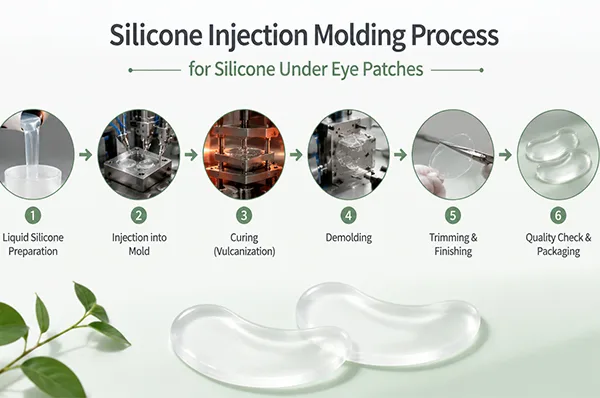
5. Silicone Injection Molding Production Process
Step 1: Material Mixing
The raw silicone materials would be mixed with: curing agents, color pigments, and performance additive. After mixed, degassed to remove air bubbles.
Step 2: Injection into Mold
Then silicone would be injected to a closed mold cavity by injection molding. Key parameters include: temperature range of 120 C – 180 C, injection pressure (based on complexity of the mold), injection speed and so on.
Step 3: Vulcanization (Curing)
Silicone in the mold is placed in a curing process. The Silicone solidifies to form a permanent structure.
This process is crucial in determining the:
- Final elasticity
- Durability of the product
- Ability to hold its shape
- Smoothness of the surface
Step 4: Demolding
Once cured, the silicone under eye patches are released from the mold. Automation equipment might be used in factories to enhance work efficiency.
Step 5: Trimming and Finishing
The raw edge of silicone from under eye patches can be cut out through automated or manual ways. Some possible finishing processes:
- Polishing of surface
- Smoothing texture of silicone
- Logo embossing and debossing
Step 6: Cleaning and Sterilization
Patches are washed thoroughly and dried in dust-free environment; maybe some static elimination process.
Step 7: Quality Inspection
Thorough quality control procedures:
- Accuracy of shape
- Uniformity of softness
- Surface examination for any defect
- Tensile testing for the elasticity
Step 8: Packaging
Final products are packed in the appropriate packaging for the appropriate consumer:
- Individual boxes or packets for retail stores
- Deluxe cosmetic gift sets
- OEM and private labeling
6. Customization Capabilities of Injection Molding
Another benefit of this manufacturing technique is the customization flexibility.
Shape Customization
- Crescent-shaped designs
- Winged additions
- Complete under-eye coverage
- Contoured-to-the-face ergonomic designs
Thickness Customization
- Ultra-thin luxury models
- Comfort-fit standard models
- Strengthened-for-durability models
Color Customization
- Translucent clear silicone
- Various skin-toned variants
- Pantone colors that match corporate branding standards
Logo Integration
- Embossed brand logo
- Debossed brand logo
- Laser engraving options
7. Quality Control in Silicone Injection Molding
High quality Manufacturers employ multi stage QC system:
Incoming material check
Make sure the incoming silicon material is up to safety standards.
In-Process Quality Control
In process QC:
- Temperature consistency
- Injection consistency
- Mold pressure management
Final Product Test
Test with:
- Tension test
- Skin-friendly test
- Aging test
8. Regulatory Standards for International Markets
US and EU markets require compliance.
Certifications:
- FDA compliant silicone
- REACH complaint
- RoHS certified
- ISO 9001-Quality management system
- GMP-Manufacturing practice.
These ensure silicone under eye patches are safe for global distribution.
9. Benefits of Injection Molding to B2B Customers
Benefits to skincare brands and wholesalers:
Consistent mass production
The right process for mass production and selling to retailers.
Reduced long term cost of products
Cost effective when production runs in high volumes.
Customized product branding
Opportunity for OEM and private label production.
Quick time to market
Rapid production upon design and mold making completion.
10. Utilization in the Global Beauty Industry
Injection molded silicone under eye patches are common for use in the following:
- High-end skincare companies
- In-salon and spa services
- Subscription boxes for beauty products
- Online skincare sales
- Hotel and spa kits
Its ability to be applied to diverse use cases makes it an essential component of any beauty collection.
11. Why Choose beaut-lohas.com
We, as an professional silicone product manufacturer, focusing on:
- OEM/ODM Silicone under eye patches
- Precision injection molding manufacturing
- Mold designing and building
- Private labeling service
- Worldwide B2B supply chains management
We support brands developing products from the concept to the mass production with reliable quality and prices.
Summary
The whole process is all based on silicone injection molding process, which contributes to producing high-quality silicone under eye patches with high accuracy, durability, mass production and all-around customization.
It’s beneficial for B2B customers to gain detailed information of the production process when making a supplier selection, assessing product quality and forecasting the future development for their brand.
Powered by modern technology, strict quality assurance system and flexible OEM capacity, manufacturers such as beaut-lohas.com could help more and more skincare brands expand competitive edges on the rapid developing international beauty market.