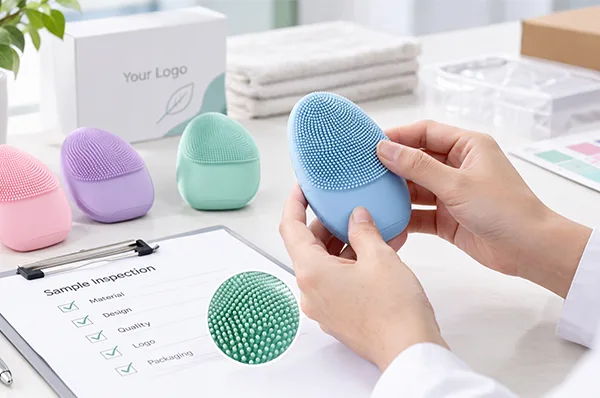
For beauty products, wholesalers, distributors, retailers, and private label companies, placing orders for samples is one of the crucial procedures before buying wholesale silicone face scrubbers in bulk.
The product may appear to be amazing from images on the supplier’s website, catalogues, Alibaba page or web shop. Yet, images can’t reveal all the information about the real silicone material used, its flexibility, texture, finish, shape of the cleansing tip, logo, packaging, and quality.
This is the reason why business buyers should never assess the supplier by only looking at photographs and quotes.
Buyers should request and carefully evaluate silicone face scrubber samples before ordering the silicone face scrubbers in large quantities.
An efficient sample evaluation process can be used to uncover possible issues before the actual costly bulk production.
The list below shows what a sample evaluation process can find out:
- Silicone hardness variations
- Low-quality surface finish
- Differences in cleansing tips
- Flashing
- Distortion
- Colored variations
- Poor logo printing
- Low-quality packaging
- Unpleasant ergonomics
- Quality control problems during production
When it comes to international buyers, it’s also important to make sure that suppliers can interpret and follow specific product specifications.
This article describes how to evaluate the silicone face scrubber samples properly before making the bulk order, taking into account the specifics of the European and US beauty markets.
The Need for Silicone Face Scrubber Sample Testing Before Placing a Large Order
The sample is not simply a free or paid product delivered by the factory.
For B2B customers, the sample serves as an illustration of what kind of production the supplier is capable of.
An evaluated sample will help to provide answers to the following questions:
- Is the material appropriate?
- Does the product have the right feeling?
- Is the design practical?
- Is the quality of the product consistent?
- Is the supplier able to replicate the approved specifications?
- Is the product suitable for the targeted retail market?
These questions are hard to answer using only product pictures.
A proper sourcing procedure will always follow the following principle:
Sample first, bulk order after.
It is particularly important in case of:
- Mass orders
- Custom colors
- Private label products
- Custom packaging
- Custom molds
- New product development
- Multiple SKUs
What Should Consumers Look for When Assessing Silicone Face Scrubber Samples?
Assessment of a full sample must include not less than eight key criteria:
- Material
- Flexibility/hardness
- Design of the cleansing part
- Dimensions
- Surface
- Color
- Logo/branding
- Packaging and presentation
When ordering samples of silicone face scrubbers from OEM companies, consumers must assess the possibility of producing the same quality product during large-scale manufacturing.
Now let us consider each criterion separately.
1. Check the Silicone Material
It is first of all necessary to check the material itself.
Material affects:
- Touch
- Flexibility
- Durability
- Visual Appearance
- Functionality
While a supplier can just label their product as “silicone face scrubber,” it is necessary to ask him or her for additional information concerning material.
It is advisable to find out from your supplier the following questions:
- What kind of silicone is used?
- What is the material specification of this product?
- Is this same material used for manufacturing in mass scale?
- Are there any materials documentation available?
- Is sample manufactured under the same conditions as mass product?
The last point is especially significant.
Sample should not be changed to some other specification without prior consent of the customer.
2. Test for Silicone Hardness
Silicone hardness can play a significant role in user experience.
A scrubber made from too soft material will be comfortable to use but lacking in structural strength.
Firmness creates an intense tactile feeling, but it may not match the positioning of a gentle face-cleansing product.
When testing samples, keep in mind the following aspects:
- Flexibility
- Tip softness
- Firmness
- Recovery from deformation
- Tactile sensation on skin contact
For custom manufacturing, buyers can order various samples in different levels of hardness.
Comparing samples with medium firmness and high firmness, for instance, will allow the brand to select the most suitable specification for their target customers.
Do not rely only on numbers when determining the level of silicone hardness.
The real structure of the product also makes a difference.
Thickness, length, density, and shape of the tip can affect the hardness of the product.
3. Examine the Cleansing Tips
The cleansing tips are one of the most important functional components of a silicone face scrubber.
Examine the product carefully.
Check the following features:
- Equal height of the tips
- Equal thickness of the tips
- Clean molding
- Proper spacing
- No broken tips
- No deformed sections
- Smooth transitions from one texture to another
Stroke the cleansing surface with your fingertips.
The tips should be uniform and not have any obvious irregularities.
In case there are several textures, test each part individually.
For instance, a two-textured product will include the following features:
- Fine cleansing tips
- Massage tips
- Various patterns on the surface
Make sure each area performs as intended.
4. Testing of the Product on the Hand Prior to the Evaluation of the Product for Facial Use
When testing the product, it will be good to test the product on the hand first prior to testing the product on the face.
Buyers will be able to know if:
- It is flexible enough
- It is comfortable to hold
- Tips are comfortable
- The surface feels good
- Overall, ergonomics of the tool
Run the tool on the skin in the intended way it is supposed to be used.
- Is it too soft?
- Is it too hard?
- Are the tips comfortable?
- Is it easy to control?
- Is the product stable when wet?
This simple test can reveal design problems that are not obvious from visual inspection.
5. Evaluate Ergonomics
Though a silicone face scrubber can be of high material quality, its performance can be poor due to the fact that its form is inconvenient.
Consider how easy it is to handle the product.
Evaluate:
- Handling
- Thickness
- Form
- Placement of fingers
- Total weight
- Ease of motion
If a product is intended for use in a wet bathroom, make sure to carefully evaluate grip since smooth or inconvenient form may be hard to handle while wet.
For brand-specific products, ergonomics can be an important feature to highlight.
6. Measure Product Dimensions
You cannot only go by the dimensions quoted for the product.
Take physical measurements.
Verify the following:
- Length
- Width
- Thickness
- Weight
- Tip height
Your measurements should match those of the supplier.
Minor variations in the dimensions might be acceptable; however, any major discrepancies should be brought up prior to mass production.
In the case of customized products, there must be verification of the dimensions prior to placing an order.
7. Examine Surface Finishing
An excellent silicone facial scrubber must be well-finished.
Check carefully for:
- Flash
- Burrs
- Unsmooth edges
- Scratches
- Bubbles
- Deformations
- Molding lines
- Surface contamination
Place the item under strong light.
Turn it around slowly and examine from all sides.
Some flaws will not be visible in the light of an ordinary room.
For high-end beauty products, surface finishing is especially significant since people tend to associate visual flaws with the low quality of goods.
8. Look for Excessive Flashing
This is a form of excess material that is present on the edges of molded products.
A small amount may be produced during silicone molding, but an excessive amount of flash may have an adverse impact on:
- Appearance
- Feel of the product
- Consistency of the product
- Retail appearance
Swipe your finger along the edges of the test product.
Look for edges that are:
- Smooth
- Clean
- Even
If you find excessive flashing, ask the supplier how it is controlled during mass production.
9. Check Color Consistency
When dealing with private label products, color accuracy is of high importance.
The brand can have its own color identity that needs to be maintained consistently throughout:
- Product
- Packaging
- Website
- Promotion
- In-store displays
When checking the custom-color sample, make sure to compare it to the authorized color reference.
For instance, if the customer uses a Pantone reference, the plant should make use of the proper process in order to create and verify the silicone color.
Never rely only on your computer or smartphone screen.
Colors will look different depending on the lighting.
It is better to authorize the color sample when you have an opportunity.
10. Logo and Branding Evaluation
When you order a private label silicone face scrubber, you have to make sure that the logo is good enough.
Check:
- Positioning of the logo
- Size of the logo
- Alignment of the logo
- Sharpness
- Integration into the surface
- Colors
- Durability
In some cases, brand will consist of:
- Printed logo
- Embossed logo
- Debossed logo
- Integrated into the mold logo
In case of molded logo, make sure the letters and symbols are clearly visible.
And in case of printed logo, make sure the print is:
- Sharp
- Uniform
- Well-positioned
An acceptable logo on one sample that cannot be replicated in thousands of units is a big quality issue.
11. Test the Basic Durability of the Logo
If the logo is printed, lightly rub the print using an average testing technique for the specific product and surface.
This step is not meant to conduct any official lab tests but to find any visible flaws.
Watch out for:
- Smudging
- Peeling
- Fading
- Misprint
In case of professional orders, customers should check from the supplier if an official test on the durability of the logo is needed for the selected printing method.
12. Test the Product in Wet Environment
Since silicone face scrubbers are used with water or some cleansing solutions, wet testing alone will suffice.
Get the product wet and test for:
- Grip
- Flexibility
- Texture
- Ease of rinsing
- Product handling
Use any suitable cleanser if necessary.
Note whether the product can still be controlled easily.
Also see whether there are parts of the product which are hard to rinse.
When dealing with reusable beauty devices, ease of cleaning is one of the critical factors of the user experience.
13. Assess Cleaning and Maintenance
The cleaning and maintenance of a reusable silicone face scrubber should be quite manageable by consumers.
Consider the following during assessment of the sample:
- Is the cleanser easily rinsed off?
- Does the scrubber have difficult-to-clean crevices?
- Is the surface easy to clean?
- Can the item dry easily?
A complex design is unnecessary and may present additional challenges when it comes to cleaning.
Simple and functional designs often work well in mass products.
14. Test Shape Recovery
The flexible silicone item should retain its original shape in everyday usage.
Bend or squeeze the specimen depending on its intended application.
Questions to ask:
- Does it revert to its initial form?
- Has it retained a new form?
- Is it permanently wrinkled?
- Is the item structurally sound?
This is particularly important for customized products that may have thin or intricate sections.
15. Evaluate Several Samples from the Same Supplier
One sample is good.
Several samples are even better.
When it is possible, ask for a few pieces from the same production lot.
Evaluate:
- Color
- Weight
- Size
- Hardness
- Tip design
- Surface finish
The aim is to detect variations.
For instance, if one sample feels significantly softer compared to another, inquire with the vendor why that might be so.
This can reveal potential manufacturing consistency issues before a bulk order is placed.
16. Compare Samples From Different Suppliers
For larger projects, consider requesting samples from several silicone face scrubber suppliers.
Create a comparison table:
| Evaluation Area | Supplier A | Supplier B | Supplier C |
|---|---|---|---|
| Silicone Feel | ✓ | ✓ | ✓ |
| Hardness | ✓ | ✓ | ✓ |
| Tip Quality | ✓ | ✓ | ✓ |
| Surface Finish | ✓ | ✓ | ✓ |
| Color | ✓ | ✓ | ✓ |
| Logo | ✓ | ✓ | ✓ |
| Ergonomics | ✓ | ✓ | ✓ |
| Packaging | ✓ | ✓ | ✓ |
| MOQ | ✓ | ✓ | ✓ |
| Lead Time | ✓ | ✓ | ✓ |
| OEM Capability | ✓ | ✓ | ✓ |
This prevents price from becoming the only deciding factor.
17. Package Design Samples
The packaging design should also be examined prior to mass production.
Considerations:
- Box size
- Quality of printing
- Protection of the product
- Accuracy of artwork design
- Positioning of logo
- Product information
- Placement of barcode if necessary
For products sold through e-commerce, the packaging design should also be tested for shipping protection.
AlsoFor retail products, take into account:
- Box aesthetics
- Visibility of product
- Consistency of brand
In subscription box products, smaller packaging may be preferred.
18. Confirm the Exact Sample Specification
Before approving a sample, create a clear specification sheet.
It should include:
Product
- Product name
- Model
- Dimensions
- Weight
Material
- Silicone specification
- Hardness
- Color
Design
- Shape
- Tip pattern
- Surface texture
Branding
- Logo
- Logo size
- Logo position
- Branding method
Packaging
- Packaging type
- Dimensions
- Printing
- Inserts
This document becomes an important reference for mass production.
19. Make Sure That Your Bulk Purchase Is In Accordance With the Approved Sample
This is one of the most crucial aspects of the sourcing process.
Your approved sample needs to be used as a basis for production.
When making your bulk purchase, indicate in writing that your order needs to be produced according to your approved sample and specifications.
Important variables may be:
- Material
- Hardness
- Color
- Size
- Tip construction
- Brand logo
- Packaging
In case of a custom OEM project, the clearer these details are, the better.
20. Inquire on Production Quality Control
Before making a purchase of large volume, inquire on the process used to control the quality of products in production.
The professional process of manufacturing might include:
Raw Material Inspection → Mold Inspection → First Article Inspection → In-process QC → Appearance Inspection → Branding Inspection → Final Inspection → Packaging Inspection
Buyers need to know how non-conformable production parts will be managed.
21. AQL or Any Inspection Standard
If a buyer decides to go for larger wholesale orders, then the buyer could consider using a certain inspection standard.
Based on the product or the purchasing arrangement, the following could be considered in an inspection process:
- Critical defectives
- Major defectives
- Minor defectives
The buyer needs to decide on the appropriate inspection method with the supplier even before manufacturing the products.
The main thing here is to determine the quality standard before producing the items.
22. Verify Bulk Production Timeframe
A good sample does not necessarily mean a quick production process.
Request from the supplier a realistic schedule including:
- Sample approval
- Material preparation
- Production
- Brand/logo printing
- Packaging
- QC
- Preparation for shipping
Custom OEM products will need additional time for mold development.
Also talk about the production capacity for bulk orders.
23. Check the Supplier’s Production Capacity
The supplier may have the capability to manufacture samples but may not cope with high-volume manufacturing.
Question:
- What is your normal production capacity?
- How many production lines do you have?
- What is the lead time for bulk orders?
- Do you handle repeat orders?
- How do you cope with peak season demands?
This becomes very critical for retailers who operate with seasonal promotions or online businesses experiencing rapid growth in sales.
24. Learn About MOQ before Approving the Product
Sampling approval should be followed up by commercial confirmation.
Inquire about:
- MOQ for standard products
- MOQ for custom-colored products
- MOQ for custom-logo products
- MOQ for custom-packaged products
- MOQ for custom-molded products
While a product might have a nice per-unit cost, its minimum order quantity might be more than what you expect from your initial sales forecast.
Learn about MOQ early helps reduce inventory risk.
25. Comparison between Sample Cost and Long-Term Product Value
A sample can cost more than the final unit price due to the following reasons:
Individual packing
Delivery charges
Customization
Bulk manufacturing
Sample cost cannot be the only parameter for judging the supplier.
The real question should be:
How would the cost and product quality be at bulk level?
Request the complete quote after getting approval of the sample.
26. Calculate the Total Landed Cost
For international buyers, factory cost will only be one of the cost elements considered.
Take into account:
Product Cost + Mold Cost + Logo Cost + Packaging Cost + Inspection + Freight + Import Cost = Estimated Landed Cost
This provides a more accurate basis for comparing suppliers.
27. Be on the Lookout for Warning Signs When Evaluating Samples
Some warning signs warrant extra attention.
Warning Sign 1: Supplier Refuses to Give You Samples
It becomes difficult to evaluate the quality of the material or product.
Warning Sign 2: The Specification of Sample and Quotation Does Not Match
Ask for more clarification.
Warning Sign 3: Supplier Is Unable to Clarify Material Specifications
This could imply lack of transparency on their part.
Warning Sign 4: Significant Variation in Quality of the Samples
Find out the reason for such difference.
Warning Sign 5: Supplier Offers Extremely Short Lead Time Without Explanations
Inquire about production capacity.
Warning Sign 6: Supplier Refuses to Provide Written Specifications
Material or product requirements should be in writing.
Warning Sign 7: Supplier Alters Product or Material Without Your Permission
It should be taken as an issue of quality control.
OEM vs ODM: What Should Buyers Inspect During Sample Approval?
The process of sample inspection is different for ODM and OEM projects.
ODM Silicone Face Scrubber
In the case of ODM projects, buyers begin with a preexisting design by a certain manufacturer.
Things to be checked include:
- Product quality
- Material
- Color
- Logo
- Packaging
- Simple modification
This method gives faster access to the market.
OEM Silicone Face Scrubber
In the case of OEM projects, the product may be totally new.
Things to be inspected include:
- Product design
- Custom mold
- Dimensions
- Silicone hardness
- Tip shape
- Ergonomics
- Logo placement
- Production viability
OEM projects require more thorough communication between buyer and manufacturer.
Support from Beaut-Lohas for Silicone Face Scrubber Samples Development
In cases where brands are in need of a silicone face scrubber manufacturer, the team at Beaut-Lohas can provide support for the sourcing process starting from the product selection and samples development till customization and large-scale production.
The sample stage allows ensuring that all key specifications are checked before placing the order for the large-scale production.
Depending on the nature of the project, customization may involve:
- Product design
- Silicone properties
- Color
- Logo
- Surface finishing
- Packaging
- Custom mold development
It allows converting a product idea into manufacturing specifications.
In case of B2B buyers, the task is not only to receive a sample but also to establish a product standard.
A Practical Silicone Face Scrubber Sample Evaluation Checklist
Prior to acceptance of a sample, buyers can utilize the following checklist:
Material
- Silicone material verified
- Material information checked where necessary
- Hardness verified
- Material feel verified
Product
- Dimensions verified
- Weight verified
- Tip structure verified
- Surface texture verified
- Ergonomic design verified
Quality
- No apparent molding flaws
- No excessive flashings
- No deformation
- Color uniform
- Tip structure uniform
Branding
- Position of logo verified
- Size of logo verified
- Process of logo verification
- Logo appearance verified
Packaging
- Packaging design verified
- Artwork verified
- Product protection verified
- Retail packaging verified
Commercial
- MOQ verified
- Price verified for bulk order
- Cost of mold verified
- Lead time verified
- Payment terms verified
Production
- Quality control process verified
- Sample accepted and kept for future reference
- Production specifications verified
- Inspection requirements agreed upon
FAQs About Silicone Face Scrubber Samples
Why do I need to ask for samples before making a wholesale order of silicone face scrubbers?
Samples will let you assess the material, design, quality, branding, and functionality prior to placing a large order.
How many samples do I need to ask for?
For simple goods, a few samples will help understand whether the quality is consistent. In case of customized OEM items, several rounds of development might be needed.
What is the most important characteristic to look for in a silicone face scrubber sample?
The material quality, silicone hardness, cleansing brush tip design, surface quality, dimensions, ergonomics, and other characteristics are the most important among others.
Is it possible to ask for samples of various hardness of silicon?
Yes, for example in case of development of an OEM product.
Does the bulk order have to be the exact same as the approved sample?
The bulk order must conform to the approved specifications. All material, design, color, and packaging changes must be communicated and approved prior to production.
Do I need to test the sample when it is wet?
Yes, because the facial cleansing tools are normally used with the application of water and a cleanser, testing when wet will uncover problems not found in dry testing.
Can I customize the logo on the silicone face scrubber?
Yes. Based on the design, there could be options available for printing, embossing, debossing or mold integration of the branding on the product.
Is it necessary to receive multiple samples from various suppliers?
Comparing multiple suppliers may be useful for important projects or high volume orders.
Conclusion: Approve the Sample Before Approving the Purchase of Bulk
The assessment of samples is among the best ways to avoid risks for international beauty products manufacturers, wholesalers, retailers, and distributors when buying silicone face scrubbers in bulk.
An experienced buyer needs to assess many aspects apart from the looks of the product.
The sample should be checked for:
- Silicone material
- Hardness
- Flexibility
- Cleansing tip structure
- Dimensions
- Ergonomics
- Surface finishing
- Color
- Logo quality
- Packaging
- Wet-use performance
- Manufacturing consistency
Buyers should also confirm commercial factors such as:
- MOQ
- Bulk pricing
- Production capacity
- Lead time
- QC procedures
- Customization
- Packaging
- Total landed cost
Most importantly, the approved sample needs to be the benchmark for mass production.
A reputable silicone face scrubber supplier needs to have communication skills, provide samples, discuss specifications, customize and maintain quality throughout the bulk production process.
If the beauty tool brand is making its beauty tools on its own then the OEM and ODM manufacturing can give some extra flexibility in design, silicone properties, color choices, branding and packaging.
Beaut-Lohas can assist B2B clients with silicone beauty products development, OEM/ODM manufacturing, customization and bulk production services.
The best way to source silicone face scrubber is simple:
Don’t approve the order until you approve the product.
By evaluating the sample, buyers will have the chance to see possible flaws, check the product specification and increase the confidence level prior to placing the bulk wholesale order.
For every beauty brand, distributor and retailer this small investment into evaluating the sample will guarantee protection of the bulk production investment.