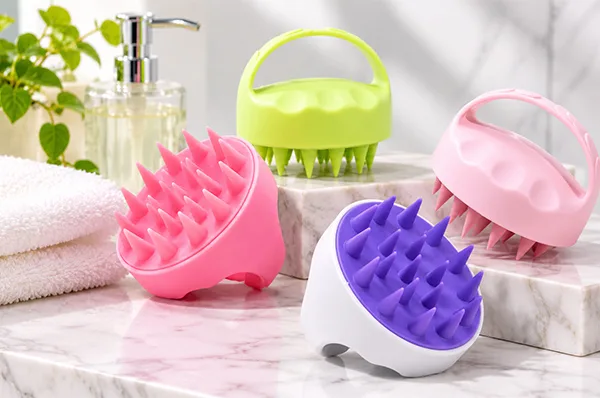
1. Introduction: The Need for Better Scalp Brushes with Regards to Thick and Coily Hair
There is a growing diversification in the global hair care industry. Consumers demand personal care products that cater to different hair textures, styles, and scalp treatments. As a result, there are numerous possibilities for beauty brands, wholesalers, and professional hair care companies to create products that target certain consumer segments.
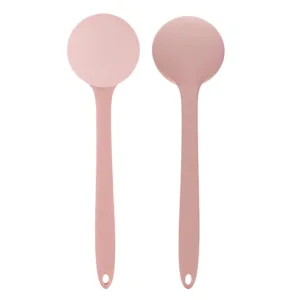
Silicone scalp brushes belong to the product categories whose potential is still underestimated. Most scalp brushes available on the market are designed to suit general hair care needs, while paying little attention to people with thick, curly, and coily hair.
Nevertheless, people with thick hair, curls, and coily hair might have their own preferences concerning selection of scalp brushes. Different hair density, curl patterns, hair styling, scalp accessibility, and product use can play a role here.
As far as manufacturing a scalp brush, there is more to do than simply change the color or design of the product. There are certain things to consider including the bristle length, spacing, flexibility, head geometry, grip design, and the properties of silicone.
The well-thought-out product must be convenient for reaching the right scalp spots without any unnecessary tugging, catching, or exertion of too much pressure. It should also be easy to clean, dry, store, and be used in combination with other hair care products.
Cooperation with an experienced silicone scalp brush manufacturer will make it easier for beauty brands and their wholesalers to translate those needs into a real commercial product.
The following text describes how manufacturers can produce scalp brushes for thick and coily hair, the features that buyers need to check on the scalp brush, and how the OEM/ODM manufacturing will help brands to produce unique products for the international hair-care market.
Short answer: How should manufacturers design scalp brushes for thick and coily hair?
Manufacturers need to think about long or properly arranged flexible bristles, right bristle spacing, comfortable grip structures, silicone hardness, and brush head shape allowing the proper movement through thick hair. The testing of prototypes among people with different hair curls and densities is crucial before mass production.
2. Identifying the Differences between Thick, Curly and Coily Hair
Manufacturers should understand the difference between hair types and how the differences affect their use before designing a scalp brush.
The terms “thick hair” and “coily hair” have similarities but they are not the same terms. The term “thick hair” could mean the diameter of the strands or the density of the hair, depending on the context. The term “coily hair” refers to the hair pattern that is usually curly, and is mostly used in describing hair patterns like Type 4 hair.
A person could have thick and dense coily hair, but it does not mean that every person with coily hair has the same hair density and strand thickness.
This distinction matters because a single brush configuration may not work equally well for every user.
2.1 High Density of Hair and Access to the Scalp
High density of hair may affect how easy it would be for the brush to touch the scalp when applied on dry or well-combed hair.
It would thus be appropriate for the manufacturer to design the brush using controlled contact rather than packing the brush with a high number of bristles.
It would also be useful for the manufacturer to consider the spacing, length, and packing of the silicone tips since short or highly packed bristles might only come into contact with the hair rather than the desired area.
However, long bristles or overly spaced bristles may also lead to an uncomfortable experience.
2.2 Curl of the Hair and Tangling of the Hair
Hair that is coiled up tightly may easily tangle while being brushed or manipulated.
The scalp massager is not necessarily meant to untangle the hair; it is supposed to achieve controlled contact with the scalp during a good hair care routine.
This differentiation is important for product development.
Product manufacturers need to think about rounded bristles, smooth surfaces, flexible silicone components, and movements that do not cause unnecessary pulling.
It is necessary to understand that the product cannot be considered a detangling brush unless it has been specifically designed for that purpose.
2.3 Hair Care Routines Differ
People with thick and coily hair will have different hair care routines using shampoo, conditioner, protective hairstyles, pre-shampoo products, and other hair care products.
Scalp brushes intended for use during showers need to be tested under realistic shower conditions. Scalp brush for dry scalp massaging will have different handling requirements.
This information is important for determining the intended use of the product prior to selection of materials and molding process.
3. Bristle Structure Designing for the Suitable Silicone Bristles
Bristle structure design is among the most important engineering tasks when creating scalp brushes for thick and coily hair.
There can be many factors affecting the interaction between bristles and scalp, including the length, diameter, pitch, flexibility, and the shape of bristle tip.
3.1 Bristle Length Selection for the Suitable Silicone Bristles
The bristle length depends on the targeted hair density, application procedure, and overall user experience.
For dense hair applications, the manufacturers can try bristles of various length in order to check the efficiency of scalp reaching.
It does not mean that the longer bristle is the better option. Flexible bristles might be too flexible and bend while using; rigid bristles might cause an additional pressure.
The good way to develop is creation of the several prototypes with various bristle height.
3.2 Optimize Bristle Spacing
Bristle spacing influences the performance of a brush on the scalp and the hair strands.
Where bristles are placed too close to each other, hair strands will get stuck between them, and movement will become more difficult.
In cases where the spacing is wide, the brush will have uneven contact with the working surface.
The manufacturers should experiment with different spacings such as uniform and strategic spacing of bristle bunches.
For dense and curly hair, the aim should not be increasing the density of the bristles, but rather movement, comfortable contact with the scalp, and easier cleaning.
3.3 Use Rounded and Smooth Bristle Tips
Bristles form direct contact with the scalp surface and may come into direct contact with the hair strands as well.
Rounded and smooth surfaces are likely to minimize sharp contact areas.
When creating the mold, manufacturers should consider:
- Geometry of bristle tips.
- Smoothness of the bristles’ surface.
- Prevention of flash and burr formation.
- Consistency among individual bristles.
- Bristles’ structural stability from the base.
This should be considered while testing samples for mass production.
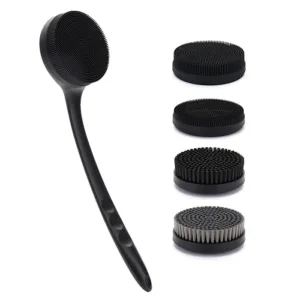
3.4 Explore Other Bristle Configurations
Not all scalp brushes have to be made with the usual circular bristle configuration.
Brands may experiment with various configurations like:
- Radial bristle arrangement.
- Combination of long and short bristles.
- Bristles arranged in sections.
- Spacing at the edges of the bristles.
- Varied density of the bristles.
All of the configurations must be tested with regard to their comfort, mobility, and effectiveness.
When it comes to creating a unique product for the brand, bristle configuration becomes a significant element of its appearance and performance.
4. Selecting the Correct Silicone Hardness and Material
Material selection of silicone will influence the properties of flexibility and structural stability of a scalper brush.
Selecting the right silicone hardness and formula is critical for manufacturing companies.
4.1 Why Does Silicone Hardness Matter?
Silicone hardness will affect the flexibility of the bristles as well as their ability to resume initial position.
While soft materials will allow more flexibility, firm material will allow more resistance in usage.
Neither of these options is better in absolute terms.
For people with thick and curly hair, the manufacturer will have to choose between flexibility and structural stability of the bristles.
Too soft material may cause bending of bristles without providing required scalp contact, while too hard material may lead to excessive pressure due to the structure of the bristles.
Thus, correct hardness should be chosen based on prototyping.
4.2 Assessment of Material Consistency
Material consistency is essential for product performance and consumer experience.
Material specifications that need to be controlled include hardness, color consistency, surface condition, and material properties.
As changes in material formulation or manufacturing process conditions might impact the end product, it is necessary to record and control material specifications throughout production lots.
4.3 Assess Resistance to Everyday Hair Care Products
A silicone scalp brush will likely be exposed to shampoos, conditioners, hair masks, and other hair care products.
Material compatibility must be assessed based on the intended use of the product and testing requirements.
The assessment may take into account appearance, surface condition, color, and material property changes from repeated exposures.
It is suggested to ask suppliers what material information and test results they can provide for the intended market.
5. Design of an Ergonomic Brush Head and Handle
For a scalp brush, ergonomics play a very vital role because such brushes should be easily controllable when people have thick hair or they use it with wet hands.
Thus, the problem of ergonomic design is a key element that should be taken into account by manufacturers when they produce new products for particular consumer segments.
5.1 Design a Comfortable Hand Grip Structure
A comfortable hand grip will allow people to keep control of the movement of the brush on the head.
Design approaches can include the following:
- Palm-shaped brush body.
- Elevated grips.
- Indented areas of fingers.
- Wider contact areas.
- Ergonomic handle structures.
- Slip-resistant surface.
The configuration of design elements is determined by particular types of products and the segment of customers.
A small palm style scalp massager would be appropriate for customers preferring hand control, whereas a handle style would suit customers who need more reach.
5.2 Take into Account Hand Size and Grip Force
A too small brush would be hard to grasp, and a too big one may not be comfortable for those having small hands.
The manufacturer needs to test the product on people of different hand sizes and preferences.
It is important that a brush provides a good grip without excessive pressure of the hand.
5.3 Controlled Movement Capability
A brush should be easily movable with small movements.
The right shape, proper weight and bristles’ layout would help in achieving this.
Controlled movement capability is especially important for dense and coily hair; otherwise, strong pulling or dragging may lead to pain or disheveling the hairstyle.
You should take into account when preparing instruction for product use.
6. Design of Scalp Brushes for Different Applications in Hair Care
One scalp brush design may not suit every situation in hair care.
The manufacturers may design different kinds of their products based on the customers’ usage of them.
6.1 Wet Usage Shampoo Brushes
You can use these brushes while shampooing.
Design considerations in these products include:
- A firm grip when using wet hands.
- Bristles with appropriate flexibility.
- Ease in rinsing.
- Minimal water retention.
- Effective drying and storing.
- Suitability with the cleansing process.
Here, the manufacturers need to assess the effect of the shampoo foam and wet hair on movement and handling.
6.2 Dry-Use Scalp Massage Brushes
Dry-use scalp brushes are designed for application without shampoo or water.
Comfortable grip, controlled motion, and right bristles’ contact could be the main criteria of their design.
Manufacturers need to specify clearly the use case and shouldn’t assume that the same wet-use product will have the same efficiency on dry hair.
6.3 Scalp Brushes for Protective Hairstyles
There is a certain number of people using braided hairstyles, twists, locs, and other protective hairstyles.
They require different approach to the accessibility of scalp and product’s ability to move around the head.
Manufacturers may consider designing smaller brushes, well-placed bristles, or different shapes of handles.
Nevertheless, one shouldn’t assume that such product will work with all types of protective hairstyles. Testing needs to cover representative customers and use cases.
6.4 Travel-Friendly Scalp Brushes
Traveling-friendly scalp brushes may attract customers interested in hair care products.
Travel-friendly design should combine small size, comfortable grip, and necessary strength.
Packaging should also prevent the deformation of bristles when storing and transporting the product.
7. Prototype Testing: Methods Used by Manufacturers to Verify the Scalp Brush Design
An aesthetically appealing prototype is not necessarily a user-friendly one.
Before manufacturing the product on a large scale, the manufacturer should better test the prototype in realistic situations and receive feedback from people of varied hair types.
It is particularly crucial when the product is made specifically for thick and coiled hair since the expectations of the user may vary.
7.1 Create Several Prototype Versions
Instead of approving the design straightaway, the manufacturer could produce several prototypes with slight variations.
For example:
| Prototype | Design Variable | Evaluation Objective |
|---|---|---|
| A | Shorter bristles | Evaluate handling and scalp contact |
| B | Longer bristles | Evaluate reach through dense hair |
| C | Wider bristle spacing | Evaluate movement and cleaning |
| D | Softer silicone | Evaluate flexibility and comfort |
| E | Firmer silicone | Evaluate structural support |
Only one or two variables should be changed at a time where practical. This makes it easier to identify which design features influence the results.
7.2 Carry out Real-User Testing
Testing should involve subjects with varying levels of hair density, curly pattern, and styling.
Some helpful questions that you can use in obtaining feedback are as follows:
- Is the brush comfortable to use?
- Do the bristles reach where they are supposed to reach on the scalp?
- Does the product glide easily through the user’s hair?
- Does the brush pull on hair?
- Can you rinse and clean the brush easily?
- Does the product stay comfortable while in use for the intended time?
7.3 Repeat Use Testing
The manufacturers need to test the performance of the product under repeated use conditions.
These could include tests for:
- Bending of bristles upon repeated use.
- Deformation and ability to recover after bristle deformation.
- Stability of grip.
- Condition of surface after cleaning.
- Color retention after contact with hair care products.
- Structural integrity of connected parts.
The test conditions and pass/fail criteria will be determined according to the product specification.
7.4 Modify the Design Before Tooling and Production
Feedback from the users could indicate that the brush requires more bristles, different spacing arrangement, larger handle, or new design of the body.
It is easier to make any modifications in the early stages of product development rather than later when large-scale manufacturing process starts.
Custom designs require the approval of the product and specifications before tooling and production.
8. Manufacturing Considerations for Silicone Scalp Brush Production
There is potential to have more issues related to manufacturing when developing a brush with complicated bristle arrangements.
The manufacturers need to convert the accepted design to an effective manufacturing process.
8.1 Mold Design and Formation of Bristles
Long, narrow, or closely arranged bristles necessitate effective mold design.
The mold should be able to provide consistent bristles formation and proper demolding of the bristles.
It is important for manufacturers to consider the following factors:
- Bristle design.
- Cavity design.
- Flow of material.
- Venting needs.
- Direction of demolding.
- Flashing.
- Mold maintenance.
Poorly controlled molding conditions can lead to inconsistent bristle shapes or surface defects.
8.2 Strength of Bristle Base
Another design feature to be considered is the strength of each bristle base.
Bristles that have weak connections may be more susceptible to damage when repeatedly bent.
The manufacturer should take into account the transition from the bristle to the main body while engineering the product.
This part of the product should be included in prototype assessment and mass-production inspection.
8.3 Appearance
Silicone scalp brushes must have a uniform surface finish and appearance.
The possible production defects are as follows:
- Flash on bristles.
- Irregular surfaces.
- Deformation.
- Irregular coloring.
- Presence of contamination.
- Incomplete molding.
These defects influence the appearance and quality of the final product.
8.4 Product Consistency in Mass Production
After approving a certain product, the manufacturer should maintain consistent specifications for mass production.
The following aspects are to be controlled:
- Choice of material.
- Hardness.
- Color.
- Dimensions.
- Bristle shape.
- Appearance of the final product.
The presence of an inspection process allows brands to prevent receiving products different from their approved samples.
9. Quality Standards for Brush of Thick & Coily Hair Scalp
Quality standards must focus not only on manufacturing precision but also usability.
In case of business-to-business customers, examination of the supplier’s inspection procedure is a crucial part of the manufacturing capability evaluation.
9.1 Incoming Materials Inspection
Incoming silicon materials should be tested against approved quality standards.
This may vary from project to project and can consist of material identification, hardness testing, color testing, etc.
9.2 In-process Inspection
At the moment of manufacturing, companies should control molding conditions and examine the samples for defects.
Special attention should be paid to bristles formation, base condition, dimensions and finish.
9.3 Finished Product Inspection
Finished-product inspection may include:
| Inspection Item | What to Check |
|---|---|
| Bristle structure | Consistent height, spacing, and shape |
| Bristle tips | Smooth edges without unwanted sharp defects |
| Material hardness | Within approved specifications |
| Product dimensions | Consistent with the approved drawing |
| Color | Consistent with the approved sample |
| Surface finish | No unacceptable flash or contamination |
| Grip structure | No visible deformation or structural defects |
| Packaging | Correct product, labels, and presentation |
Buyers should establish acceptance criteria and inspection requirements before mass production.
9.4 Consistency between Sample and Production
You can use the approved sample as a standard to inspect the products during mass production.
In case of any change to the material, mold, or design, the manufacturer must inform the changes and get approval.
This is especially true when considering branded companies selling products through their own brands.
10. Ways to Differentiate Coily Hair Scalp Brush in Beauty Brands
An adequately made scalp brush is an integral part of the whole hair care products line.
To differentiate the brand that targets consumers who have thick and coily hair, you should focus on usability and proper positioning of the product.
10.1 Create a Product Line
Instead of producing only one common scalp brush, brands can think about producing a line of the products.
For instance:
- Flexible silicone shampoo brush.
- Scalp brush with a long handle.
- Compact scalp massager for travel.
- Premium scalp care gift set.
- Product that is designed for specific protective hairstyles.
Each product should have a clearly defined use case and target audience.
10.2 Leverage the Use of Colors and Aesthetics
The use of color customization will help brands come up with distinguishable collections of products.
You can use some possible colors include neutral beige, dark brown, lavender, light pink, sage green, and many other colors associated with the brand.
Use of Pantone color matching will help in the consistent reproduction of colors.
10.3 Create Bundles of Products
A scalp brush can be combined with other hair care accessories to form a bundle for sale.
Possible product bundle ideas include:
- Combining a scalp brush and a microfiber hair towel.
- Combining a scalp brush and shower accessories.
- Combining a scalp brush and a travel hair care kit.
- Combining a scalp brush and a shampoo gift set.
You should design a bundle based on the consumer.
10.4 Leveraging Inclusive Product Development Strategy
Brands need to ensure that they show the use of different hair types in their photographs, tutorials, and product descriptions.
For instance, showing the use of a scalp brush only on straight hair will not convey the applicability of the brush on users of dense and coiled hair.
The demonstration with a variety of hair types will allow customers to get acquainted with the appropriate application of the product.
It is important that the marketing claims match the real product tests and do not give an impression that the one scalp brush is applicable for any hair type.
11. The Questions That B2B Buyers Must Ask a Scalp Brush Manufacturer
Choosing the right manufacturer implies much more than just choosing the lowest unit cost price.
The buyer must check how well the producer is familiar with the hair-care application and can create a manufacturing process based on product requirements.
Here are some questions that you should consider prior to the OEM/ODM order:
Product development
- Is it possible to develop brushes with various bristle length and arrangement?
- Is it possible to regulate the hardness of the silicone based on product requirements?
- Are you able to produce prototypes for various densities of hair?
- Is it possible to customize the design of the brush head and grips?
- Is it possible to develop a whole new product design?
Material and Manufacturing
- Which materials you use for silicone?
- What method you use to control the material hardness and color?
- How can you avoid the flash defect on silicone bristles?
- Can you provide the product drawings and specification for approval?
- How can you control the changes from samples to mass production?
Commercial Cooperation
- What is the MOQ of standard designs and customized products?
- Are there any customization services of the logo and packaging?
- What is the delivery time for the samples and mass production?
- Are repeat orders possible?
- What kind of quality inspection records are available?
These questions will allow buyers to differentiate suppliers who are capable of designing the product from those who supply the standard products for resale.
12. Reasons for Choosing Beaut-Lohas for Silicone Scalp Brush Development
For beauty brand companies, wholesalers and distributors looking for scalp brushes for thick and coily hair, product development will require a manufacturer who knows about the performance of silicone materials, product structures, and international B2B requirements.
Beaut-Lohas specializes in silicone beauty products and personal care product development and manufacturing with OEM and ODM solutions available for international business clients.
Having more than 15 years’ experience in silicone ODM, Beaut-Lohas provides product projects starting from design discussion and samples development up to the customized production.
12.1. Product Design & Development
Beaut-Lohas can assist buyers in evaluating product ideas, such as bristle layout, brush-head size, grip structure, and product appearance.
In the case of brands looking for a particular hair-care product segment, these discussions can help to define requirements for the product before its production.
12.2. Custom Mold Development
In case the buyer wants to have a unique scalp brush, custom mold development can provide new product shapes and structural arrangements.
You need to approve mold design by considering bristle sizes, spaces, materials and manufacturing requirements.
12.3 Silicone Material and Color Customization
The brands can explore appropriate silicone material specifications and color customization based on the position targeted by the brands.
Color match using Pantone could ensure that the brand maintains consistency in its products’ collection.
12.4 OEM and Private Label Services
Beaut-Lohas can offer custom branding options, including logo printing through processes such as silk screening, laser engraving, and debossing among others based on the product design.
Customized packaging and presentation of the products can also be discussed.
12.5 Quality Control and Testing Services
Quality checking is an important process in the manufacturing process.
Beaut-Lohas can offer support on quality control and discuss any testing requirements such as CE, CPSIA, RoHS, REACH, and California Proposition 65 testing requirements.
Testing and certification criteria vary depending on the product, destination market, and legal requirements. It is important that buyers know what documentation and tests should be performed for each individual project.
12.6 Product Development Flexibility According to Various Business Models
No matter whether the buyer wants a ready-made scalp brush with its own brand or a completely new product design for a special hair care line, Beaut-Lohas can talk about the project in terms of:
- Target group of customers.
- Product specifications.
- Silicone requirements.
- Level of customization.
- Price target.
- Quantity.
- Packaging requirements.
- Sales market.
Looking for a silicone scalp brush manufacturer for your next hair-care collection? Contact Beaut-Lohas to discuss custom designs, OEM/ODM development, wholesale supply, and private-label opportunities.
13. Frequently Asked Questions
Q1. What kind of brush should I use for thick and coily hair?
It is best to pick a brush with a good balance of bristle length, spacing, flexibility, and comfort of handling. And it depends on many parameters such as hair density, curling, purpose of use, and personal preferences. It is advised to test your brush before production.
Q2. Should I use brushes with long silicone bristles for coiled hair?
Longer bristles would facilitate brushing through dense hair and reaching the scalp, but it is not the only factor that affects the brush performance. The flexibility, spacing, bristle thickness and arrangement should also be considered. Manufacturers should test their prototypes.
Q3. What hardness of silicone is suitable for thick hair scalp brushes?
The appropriate hardness will depend on each particular product design and its purpose. Soft silicone is flexible, while hard one allows for creating stiff brushes.
Q4. Are silicone scalp brushes applicable on Type 4 hair?
It depends on the specific design and intended purpose of certain silicone scalp brushes; therefore, users should read the manufacturer’s instruction and apply light and soft strokes to avoid any forceful pulling. Product validation can be done with representative users.
Q5. What is the difference between a scalp massager and a detangling brush?
The scalp massager is made primarily to facilitate scalp contact while the detangling brush is to help untangle the hair strands. These two products may vary in bristles structure and performance characteristics. You should not necessarily consider the scalp massager as detangling device.
Q6. Is it possible to manufacture various lengths and distances between silicone bristles?
Yes. Depending on the design and product feasibility, it will be possible to create various silicone bristles lengths, distances, shapes, and arrangement.
Q7. What aspects you should test before releasing the scalp brush for coily hair?
Brands should test grip comfort, access to the scalp, bristle flexibility, movement in real hair, possible snags, cleaning ability, and durability. You should do the tests with people with different hair density and curl.
Q8. Is it possible for Beaut-Lohas to develop scalp brushes under an international beauty brand’s private label?
The company provides OEM/ODM service for silicone personal care items. Buyers can negotiate on their product design, silicone color, logo placement, packaging, and other manufacturing details based on their project needs.
Q9. Are longer silicone bristles always better for dense hair?
No. Long and flexible bristles can easily bend. While hard bristles can generate too much pressure on the hair. There is a necessity to consider bristle height, thickness, space, and bristle material hardness.
Q10. What information should buyers share for ordering a custom scalp brush?
Buyers need to state their target market, application purpose, reference designs, bristle requirements, product size, target colors, estimated quantity, packaging requirements, and destination markets.
14. Conclusion: Design Scalp Brushes in Accordance with Hair-Care Needs
Designing silicone scalp brushes for thick and coily hair is more challenging than modifying the regular silicone shampoo brush.
Manufacturers should take into account hair density, curly patterns, scalp access, bristle shape, silicone hardness, ergonomic design, and the intended hair-care application routine.
The best approach to creating a product includes the following stages: material knowledge, engineering analysis, prototyping, and testing by the users with various types of hair.
For beauty brands, wholesalers, and distributors, cooperation with a silicone scalp brush manufacturer will allow for turning these specifications into unique products.
Beaut-Lohas provides OEM/ODM services for silicone scalp brushes, including product design, custom molds creation, color matching, private label manufacturing, packaging, and quality control.
Contact Beaut-Lohas to discuss your next custom silicone scalp brush project and develop products designed around the needs of diverse hair-care consumers.