Introduction
For beauty brands, distributors, wholesalers, and retailers, sourcing strategy is one of the most crucial aspects in the procurement of silicone eye patches.
With increasing customer demand for reusable beauty products in the US and European markets, it is increasingly becoming important to seek out quality sources for silicone eye patches at competitive prices and with guaranteed quality, customization, and regular supply.
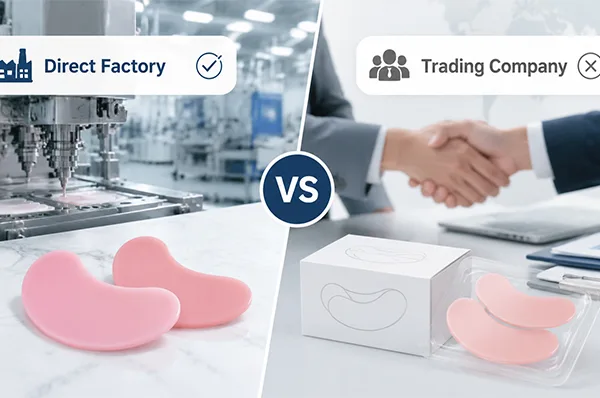
When sourcing for silicone eye patches, buyers will generally find two options available:
- To work directly with a silicone eye patch factory
- To purchase from trading company or sourcing firm
The two methods of sourcing each come with their benefits and drawbacks. It is therefore important to decide which option is best suited for you considering your business model, volume of orders, customization requirements and future growth prospects.
For those looking for OEM/ODM/private-label products, knowing the pros and cons of both direct factory sourcing and trading company can help eliminate sourcing risks. Beaut-lohas.com is a professional silicone beauty products manufacturer working directly with global brands, distributors and skincare firms to offer customized silicone eye patches with production assurance.
This guide explains how to compare factory sourcing versus trading companies and how to choose the best suppliers for your business.
1. The Importance of Supplier Selection for Silicone Eye Patches
The silicone skincare market has been highly competitive recently. Many companies are starting to compete in the reusable beauty accessories market, such as:
- Skincare brands
- Beauty stores
- Amazon vendors
- Spa providers
- Cosmetic wholesalers
- Subscription box organizations
However, supplier selection directly impacts:
- Product quality
- Production cost
- Delivery efficiency
- Customization capabilities
- Brand reputation
A wrong supplier decision may result in:
❌ Inconsistent product quality
❌ Complicated communication
❌ No customization
❌ Unexpected costs
❌ Late delivery
Reliable supplier cooperation will help your brand grow sustainably.
2. What is Direct Factory Sourcing?
Direct factory sourcing involves getting goods directly from the manufacturer who makes the silicone eye patches.
The factory takes care of:
- Source of raw materials
- Development of molds
- Production
- Quality control
- Packaging
- Packaging for shipment
For example, when a brand communicate with beaut-lohas.com directly, it engages the actual manufacturer, not the intermediary.
3. What Is a Trading Company?
The trading company serves as an intermediary between the purchaser and the manufacturer.
The trading company usually:
- Identifies the factories
- Contacts the suppliers
- Purchases the products
- Arranges for transportation
The buyer does not contact the factory directly. Trading companies offer convenience, especially to those buyers who require various types of goods from several factories.
4. Cost Comparison: Factory vs Trading Company
The most significant difference between direct factories and trading companies is cost.
Direct Factory Cost
Dealing directly with the manufacturer means that:
Lower Product Cost
Because there is no additional middleman margin.
Factories can offer:
- Costs based on production
- Discounts on bulk orders
- Greater cost transparency
Trading Company Pricing
Trading companies generally include:
- Service charges
- Commissions
- Overhead expenses
There could be multiple mark-ups in the final price.
Example:
A company producing a silicon eye-patch might quote:
Factory price:
- Cost of manufacturing the product
- Packaging cost
- Production service charge
Trading company price:
- Factory price
- Trading margin
- Service charges
- Extra handling charges
For bulk buyers, direct factory sourcing often creates significant savings.
5. Quality Control Comparison
Consistent quality is very important in the case of skincare products since silicone eye patches will come into contact with sensitive skin.
Direct Factory Benifits
While collaborating with a factory, buyers can access:
Production Transparency
Including:
- Selection of raw materials
- Production process
- Quality control process
- Factory standards
Effective Issue Solving
If any quality-related problem occur, it can be easily resolved by engineers and production staff.
Restrictions on Trading Companies
Trading companies do not have control over:
- Manufacturing process
- Materials used
- Factory operations
Communication goes through many intermediaries.
This may result in delays in:
- Improvement in quality
- Product modifications
- Technical discussions
6. Customization Capability Comparison
Customization is among the key criteria for today’s beauty products.
Many companies may want:
- Custom shapes
- Logos of their brand
- Individual colors
- Individual packaging
- Specific design
Direct Factory Customization Benefits
Factories normally offer better OEM/ODM services.
Services include:
Product Design
- Development of new molds
- Shape customization
- Custom thickness
Branding
- Logo embossing
- Private labeling
- Individual packaging
Technical Engineering Assistance
- Prototype development
- Samples testing
- Production optimization
Disadvantages of Customization Through Trading Company
Trading companies may rely on external factories.
Limitations may be:
- Longer development process
- Limited technical communication
- Increased customization costs
In case of individual silicone eye patches manufacturing, direct cooperation with a factory will work better for brands.
7. Efficient Communication
Communication is critical during product development.
Factory Communication
Direct communication enables buyers to communicate with:
- Engineers
- Production managers
- Quality control teams
Advantages are:
✔ Faster response
✔ Accurate technical communication
✔ Improved product design
Trading Company Communication
The communication channel could be:
Buyer → Trading Company → Factory
The above communication chain has the following disadvantages:
- Information delays
- Misunderstandings
- Longer decision-making process
Direct communication is more appropriate for OEM projects.
8. MOQ Comparison
Another factor worth considering is MOQ.
Factory MOQ
MOQ at the factory level is generally determined by the following:
- Efficiency of production
- Material requirements
- Cost of molds
However, experienced manufacturers may support:
- Trial orders
- Startup brands
- Small volume runs
Trading Company MOQ
Sometimes trading companies provide lower MOQ due to order consolidation from different clients.
It works well for:
- Small businesses
- Market testing
But customization options are limited.
9. Production Control and Lead Time
On-time delivery is crucial for international beauty brands.
Factory Advantage
Producers are responsible for:
- Production scheduling
- Materials processing
- Inspection
- Packaging
This improves:
- Delivery predictability
- Production planning
Disadvantage of the Trading Company
As production is outsourced, problems include:
- Low factory priority
- Lower visibility of production
- Longer adjustment time
10. Product Development Support
Contemporary beauty brands require more than mere purchases. Competent partners that provide product development assistance are required.
Direct Manufacturers Offer:
- Product design advice
- Material recommendations
- Suggestions for molds
- Market-related improvements
For example:
A manufacturer of silicone eye patches is able to recommend:
- More effective silicone softness
- Comfortable shapes
- Increased durability
- Efficient structures
11. When Should You Choose a Trading Company?
Although direct factory has lots of benefits, a trading company could be an alternative choice as well. A trading company would be your choice when:
You Need Different Product Categories
For example:
- Silicone eye patches
- Facial tools
- Beauty accessories
- Packaging goods
A trading company could deal with various suppliers.
You Lack Import Experience
Trading companies would help you with:
- Communication with suppliers
- Documentations
- Shipping arrangement
Your Order Is Very Small
For trial orders with no customizing, trading companies would be convenient.
12. When Should You Choose a Silicone Eye Patch Factory?
A direct purchase from a factory would be better in the following cases:
1. Established Beauty Brands
Where there is need for:
- Consistency in quality
- Reliability in supply
- Exclusivity of product
2. Private Label Businesses
Where there is need for:
- Custom branding
- Design uniqueness
- Distinctiveness in market
3. Long-Term Business Relationships
Businesses planning:
- Ongoing product launches
- Increasing product lines
- International distribution
13. How to Evaluate a Silicone Eye Patch Manufacturer
Prior to choosing the company, consider:
Manufacturing Capability
Check:
- Production equipment
- Plant size
- Ability to mold
- Production experience
Quality Control
Inquire about:
- QC process
- Material testing
- Certificates
- Certifications
OEM Experience
Review:
- Past work
- Experience making custom products
- Development ability
Export Experience
A reliable supplier should understand:
- International shipping
- Compliance regulations
- World market requirements
14. Why Choose to Collaborate With beaut-lohas.com?
At beaut-lohas.com, we offer direct factory services for all global beauty brands.
Our capabilities include:
OEM/ODM Manufacturing
- Custom silicone eye masks
- Private labeling
- Custom molding
Quality Control
- Strict production inspection
- High-quality silicone materials
- Stable batch consistency
Customization Support
- Custom shapes
- Logo branding
- Packaging solutions
B2B Partnership
We support:
- Beauty brands
- Wholesalers/distributors
- Retailers
- Spa suppliers
Apart from manufacturing the products, our aim is to create competitive skincare solutions for the brands.
15. Future Trend: Direct Partnerships with Factories Are Growing
The worldwide beauty industry is heading towards greater collaboration between brands and factories.
Reasons why include:
- Greater product innovation
- Improved cost management
- Increased customer demands for customization
- Transparency in supply chains
With growing consumer demands for customized and eco-friendly skin care products, direct factory partnerships will be increasingly important.
Conclusion
When sourcing silicone eye patches, selecting either a direct factory procurement or trading company is dependent on the objectives of the business.
While trading companies can be more convenient with supplier coordination, having a direct factory relationship can bring better benefits in:
✅ Cost control
✅ Product customization
✅ Quality management
✅ Communication efficiency
✅ Long-term supply stability
Brands hoping to manufacture private label silicone eye patches or have a competitive skincare product line can derive more value from working directly with a skilled manufacturer.
Having professional OEM services, state-of-the-art manufacturing processes, and extensive B2B operations worldwide, beaut-lohas.com helps brands in creating dependable and custom silicone eye patches.