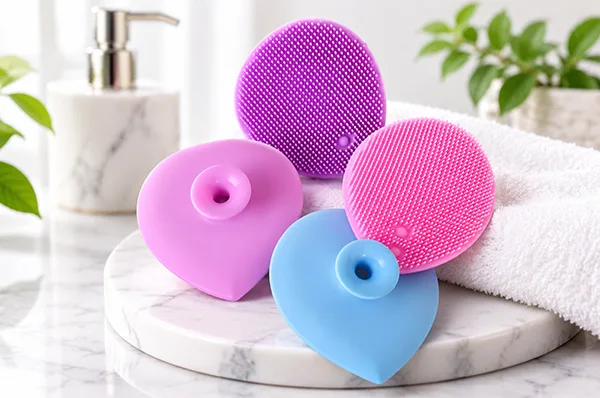
The market of beauty and care products in North America and Europe is rich in opportunities for brands, retailers, wholesalers, and distributors who wish to diversify their assortiment of skincare accessories. Exploring various skincare regimes and beauty products, consumers have started showing interest in certain accessories, such as silicone face scrubbers.
Silicone face scrubbers have numerous advantages from the business point of view. Their compact size, flexible structure, possibility of reuse, and a variety of colors and shapes make silicone face scrubbers appropriate for any retailing concept: as an independent skincare accessory, as a combination with facial cleanser, as a gift set accessory, and as a private label product.
But for B2B customers, entering this market involves not only finding the right product. The purchasing habits of the customers in North America and Europe are diverse, and there are other aspects to take into account when choosing the product and working out the sourcing strategy.
This article discusses the potential markets for silicone-based face scrubs in North America and Europe, including their demand determinants, target customers, distribution channels, design trends, sourcing considerations, and OEM/ODM options.
By taking into account these aspects, cosmetic companies, wholesalers, importers, and online retailers can develop a winning product strategy and find a reliable partner to manufacture these products.
1. An Overview of the Beauty Markets in North America and Europe
North America and Europe are significant beauty markets where personal care products can be delivered.
Both of them have developed skincare markets, well-developed distribution networks, and different customer segments.
According to the Global Wellness Institute 2025 Global Wellness Economy Monitor report, in 2024, the North American personal care and beauty market had reached $440.5 billion and Europe – $398.8 billion. These are general statistics on personal care and beauty industries, but not statistics specifically on silicone facial cleansing tools.
The size of these markets is an opportunity for the companies that can offer their products as additional skincare accessories.
North America comprises the United States and Canada. In Europe, there are diverse national markets like Germany, the United Kingdom, France, Italy, Spain, and many others.
Several reasons why these two regions would be ideal for silicone face scrubber manufacturers include:
- Existent skincare industry
- Existence of diversified retailing and e-commerce outlets
- Need for accessories that complement cosmetic products
- Availability of private label and exclusive products
- Existence of wholesale distributors
- Preference for easy-to-manage cosmetic products
The existence of a large market does not necessarily imply that there will be product demand. This can only be achieved through an analysis of consumer groups, competing products, price, and costs of distribution before venturing into one of these two markets.
For a manufacturer like Beaut-Lohas, these markets would provide good opportunities for supporting the international B2B clients in their businesses.
2. Reasons for Commercial Success of Silicone Face Scrubbers
Despite their relative simplicity, silicone face scrubbers have great commercial potential due to their versatility and possibility of being marketed as products within various categories.
As opposed to electric facial cleansing appliances, silicone face scrubbers do not contain any batteries or chargers, nor any electronics at all. Simplicity of the design might also contribute to better integration within various retail product lines.
A number of product features make silicone face scrubbers commercially attractive:
Product compactness: Small size and light weight allow the placement of such brushes on beauty store shelves, in traveling packs, or as parts of beauty sets.
Flexibility of product customization: Various shapes, colors, textures, sizes and brands are possible for production.
Positioning as complementing products: Facial cleansing brushes can be offered as complements to such products as facial cleansers, masks, headbands, and others.
Product reuse option: Some types of silicone brushes can be washed and reused according to the manufacturer recommendations.
Various sales channels: Silicone face scrubbers can be sold through beauty stores, e-commerce platforms, independent web sites, salons, or wholesale supply chains.
These features are why silicon face scrubbers may be considered by brands that wish to diversify themselves from cosmetic formulas to accessories.
It’s essential to create a product with the defined position on the market instead of just producing one more cleansing brush.
3. Business Opportunities for Silicone Face Scrubbers in North America
North America is a good place for the companies which specialize in production of beauty accessories due to the developed retail environment, well-developed ecommerce industry, and diverse consumer market of skin care products.
The US is especially significant for foreign manufacturers of beauty products, while there is also potential in Canada for those who want to extend their business within North America.
There are some business opportunities for silicone face scrubber suppliers.
The United States
The American market presents a variety of chances to promote products within online commerce, beauty specialty stores, individual skin care lines, and professional beauty services.
The silicone face scrubber could be offered as:
- Facial cleaning products for everyday use
- Accompanying items for skin care regimens
- Items for beauty gift sets
- Portable personal care items for traveling
- Private labels for online stores
The competition level can be rather high, particularly when it comes to e-commerce. Similar-looking products and general product descriptions could be hard to sell.
In this context, US consumers have to take into account product differentiation, good photography, high-quality packing, user feedbacks, and competitive pricing when launching their own product listings.
Canada
In Canada, there are many business opportunities available for companies interested in selling their products to beauty retailers, e-commerce sites, spas, and distributors.
Consider language and labeling issues in regions where the goods may be sold in both English and French.
Also, cost of shipping, delivery methods, and availability of stock locally may influence decision making.
North American market strategy
A realistic strategy will consist of starting with a specific customer segment rather than addressing all beauty consumers.
For instance, one may start with selling a small silicone facial brush that has a coordinated color of the company’s trademark online. Beauty distributor may want to offer a variety of designs and packaging.
The best approach will depend on the buyer’s delivery system, targeted price, expected order size, and advertising possibilities.
4. Market Opportunities for Silicone Face Scrubbers in Europe
Europe represents another market for silicone beauty tools, but it cannot be viewed as a homogeneous consumer market.
Each country has its own retail system, language, pricing considerations, and buying patterns. While a product strategy successful in Germany might need some tweaking prior to introduction in other European countries such as France, Italy, Spain, or UK.
A few European markets are worth considering:
Germany
Germany presents opportunities for personal care items marketed via retail stores, e-commerce, or specialized beauty products outlets.
Buyers in Germany can appreciate clear product specifications, functionality, packaging details, and reliable documentation of the manufacturer.
For business-to-business suppliers, consistent product quality and complete information about product sourcing can play an important role in purchasing decisions.
France
France represents a developed market for beauty and skincare products, presenting opportunities for accessory products.
Products aimed at this market may consider stylistic product design, packaging, and inclusion of the product line into a skincare range.
United Kingdom
Opportunities available in the UK include online beauty retailers, private labels, specialty stores, and professional beauty retailers.
Retailers may want to look at private labels and accessories offered.
Italy and Spain
Opportunities exist in these markets for beauty retailers, distributors, salons, and even online businesses.
Retailers should be cognizant of pricing, language on the packaging, distribution cost, and positioning of competing products.
Strategy for European market
Rather than launch in many countries, businesses could focus on just one or two target markets initially.
This allows retailers to gauge how well products are received, gather feedback from consumers, and work out pricing before distributing in other countries.
This would give manufacturers an opportunity to help buyers with different colors and packaging in different markets.
5. Differences between North American and European Buyers
While there are business prospects for both regions, there may be factors that will be considered more important by B2B buyers from these areas.
Learning about such distinctions can allow manufacturers to develop more fitting offers.
| Purchasing Factor | North America | Europe |
|---|---|---|
| Main sales channels | E-commerce, beauty retailers, distributors | E-commerce, specialty retail, distributors |
| Product positioning | Broad price ranges and brand differentiation | Varies by country and retail segment |
| Packaging | Strong focus on online presentation and retail appeal | Language, traceability, and market requirements |
| Customization | Logo, color, packaging, product differentiation | Design, branding, documentation, packaging |
| Supplier evaluation | Price, quality, delivery, responsiveness | Quality, documentation, safety, reliability |
| Market entry | Often channel-specific | Often country-specific |
| Key commercial concern | Competition and customer acquisition | Market differences and compliance requirements |
This is a list of general purchasing criteria, not an inherent trait of all buyers.
While a wholesaler from the United States is likely to value documentations and consistency of products, a European e-commerce buyer may put high emphasis on the design and pricing of products.
Manufacturers who manage to customize their offers for each buyer are the most successful ones.
6. Main Target Customer Segments for Silicone Face Scrubbers
The audience that can use the proposed product is not limited only to consumers. Several customer segments can be found among B2B organizations.
Skin care brands
There are opportunities to introduce silicone facial cleansing devices as additional products for the current lines of cleansers and facial care products for those brands already established in the market.
Coordinated colors and packaging will contribute to maintaining a coherent brand image.
Beauty retailers
It will be possible for retail stores to offer silicone face scrubbers among the accessories for facial care.
The needs of retailers can include an attractive presentation of the product, good description of it, stable supply, and competitive prices for the wholesale market.
Wholesalers and distributors
Distributors will be buying larger amounts of products for several retailers.
Their priorities often include stable production capacity, consistent quality, competitive pricing, and flexible product selection.
Amazon and Shopify sellers
Online retailers can look for items that can be distinguished by design, branding, photography, and packaging.
These customers will require flexibility in ordering and repeat business from the suppliers.
Salons and spas
Professional cosmetic companies can evaluate silicone brushes to be used as part of some treatment routines or even sold in the retail store.
When considering products meant for professional purposes, care must be taken when choosing products and assessing their cleaning and handling needs.
Beauty boxes and gift companies
Small silicone brushes could fit well into their gift sets or special seasons of gifts and beauty collections.
This group might be concerned with size, packaging, color coordination, and scheduling of the orders.
Understanding target audience is critical to manufacturers in offering suitable recommendations.
7. Product Design Trends and Unique Selling Points
Appearance and utility of the beauty accessory product can play an important role in its perception by potential clients in the competition environment.
A generic silicone face scrubber may seem hard to distinguish from other accessories. Various approaches to designing such products can be considered in order to produce something that will be easily identifiable.
Ergonomic shapes
Such shapes as rounded, oval, pebble-like and teardrop are some options that can be used.
Dual-sided product
Such type of product will have different sides with different textures providing distinctive sensory experience for users.
Usage of each side will need to be clear and proven by sampling.
Finger loop design
This type of design may offer an additional grip and create unique shape of the product.
Compact travel-oriented design
Such types of products can be good for travel kits and gifts for beauticians.
Product minimalist styling
Simple shapes, coordinated colors, and conservative packaging will work well in favor of companies wanting to project themselves in a modern way.
Individualized color blends
The retailers can choose those colors that correspond to their corporate identity or even create their own color sets for various product ranges.
The products must not be evaluated only by the way they look; attention must also be paid to comfort, handling, uniformity of the material, washing, and the quality of the product.
With OEM/ODM development, Beaut-Lohas clients can try out these solutions depending on their needs.
8. Private Label and OEM/ODM Manufacturing Role
Private label and OEM/ODM manufacturing services may assist North American and European companies to create branded silicone face scrubbers without setting up production.
The proper approach is to be chosen based on the level of customization needed.
Private Label: Buyer chooses an existing product and sells it under his brand. Customization options might be represented by a logo, color, and packaging, among others.
ODM: Buyer starts with an existing manufacturer’s design and asks for some particular changes or rebranding.
OEM: Manufacturer creates the product by buyer’s specification or customized product idea. In case of more complex projects, development of a new mold may be included.
Such models can actually intersect, so a buyer should define the scope of a particular project rather than rely solely on terminology.
For instance, an American skincare company may start from an existing product and apply custom logo and packaging.
A European cosmetics company may require some different shape and color, in addition to a unique tip arrangement, and this will require more complicated development project.
Prior to selecting a model, buyers need to take into account:
- Target market and customer demands
- Product differentiation criteria
- Start-up costs
- MOQ and production costs
- Mold requirements
- Time required for sample and modifications
- Packaging and branding considerations
- Future sales outlook
Using an existing design may simplify product development, whereas using a custom OEM project will give buyers additional options regarding product appearance and specifications.
9. Pricing, MOQ, and Profit Analysis
Pricing is an essential element for companies who want to penetrate the North American and European markets.
The price level of the silicone face scrubber will depend on various factors, including its design, brand, packaging, channel of distribution, etc.
However, when calculating profits, customers should not base their figures only on the factory price per unit.
A comprehensive calculation of costs would include:
- Cost of production of the product
- Cost of branding (logo printing)
- Special color preparation
- Cost of mold/tooling
- Cost of sample production
- Cost of retail packaging and printing
- Cost of quality inspection/testing
- International shipping
- Customs duty and costs related to the importing of the goods
- Storage and local distribution costs
MOQ should also be carefully considered.
The minimum volume of the existing product could be different from the volume required for custom colors, custom logos, and custom packaging.
For instance, the minimum volume for the testing of a new product line by a retailer would involve a generic model with personalized branding. The minimum volume for a skincare company might involve the creation of an exclusive item using their own mold and packaging design.
Quotations should be obtained where the development fees are separated from the production costs.
The buyer should estimate the landed cost of the product and compare it to the realistic wholesale and retail prices.
A low unit price does not necessarily mean profitability if it involves expensive marketing efforts and high return rates or additional stock.
10. E-commerce Opportunities for Retail Distribution
Increased demand for online beauty retail offers other possibilities for silicone face scrubber vendors and private labels.
Businesses in North America and Europe have a range of options for distribution.
Amazon
Products listed on Amazon can be introduced either as an accessory or included in the larger skincare kit.
However, product differentiation is key as similar-looking products might compete with it.
In this regard, good imagery, dimensions, detailed instructions, high-quality packaging, and customer feedback could make the shopping process better.
Shopify and other websites
Independently owned websites offer greater flexibility for product presentation and story telling.
Therefore, retailers can promote their own designs and product features on their websites.
Beauty specialty stores
Retailers specializing in beauty products may prefer items that have appealing packaging, availability for resupply, and definite positioning within the store environment.
Wholesale channel
Wholesalers can provide multiple design and color variations to their business customers such as retailers, salons, and so on.
Professional beauty channel
Spas, salons, and wellness centers may acquire facial cleaning devices for use in selected applications or for resale based on product fit and appropriate sanitization process.
In summary, for manufacturers serving multiple sales channels, providing a product quotation alone is not sufficient. Instead, additional requirements include packaging details, product photographs, customization capabilities, and regular ordering arrangements.
11. Product Quality and Compliance Requirements in North America and Europe
Product safety and documentation will be key considerations when exporting silicone face scrubbers internationally.
Buyers need to establish what the compliance requirements will be for the particular product, its purpose, the sales medium, and the destination country.
A silicone facial cleansing brush is basically a physical product of personal care use rather than a cosmetic preparation. As such, regulations which are specific to cosmetics cannot be automatically applied to the accessory.
North American issues
Buyers need to distinguish between the regulations for cosmetic products and the physical accessories in the case of the US.
The US FDA regulates cosmetics as well as other products but it would not necessarily mean that a manually operated silicone facial cleaning tool can be automatically classified as a cosmetic product simply because it will be used as an accessory to skincare products.
For Canada, buyers need to determine the relevant regulations for consumer products in Canada as well.
Considerations from Europe
Regulation (EU) 2023/988, General Product Safety Regulation (GPSR), of the European Union took effect on December 13, 2024.
General product safety obligations for consumer products sold both online and offline have been established, including obligations that apply to the identification, traceability, and duties of economic operators.
Buyers and importers should check what obligations apply to their situation and make sure product and business data is available.
Quality Documentation
Depending on the particular project and market, the buyer might request:
- Specifications of material used
- Reports on testing of materials used
- Product inspection report
- Chemical compliance documents if applicable
- Information on product identification and traceability
- Packaging and label specifications
- Quality control documentation
Certificates will never automatically cover all products and all destination markets. Buyers need to check the scope and relevance of the document.
For manufacturers, giving precise specifications and documentation can help international buyers assess products better.
12. Steps To Pick a Reliable Silicone Facial Scrubber Supplier
The selection of the right manufacturer is one of the top priorities for companies planning to enter international cosmetic markets.
Some of the characteristics to consider when selecting the supplier include manufacturing experience, OEM/ODM capabilities, product quality management, customization options, and communication skills.
Manufacturing experience
It is vital that the manufacturer has a track record in silicone cosmetic and personal care products.
OEM/ODM capabilities
Verify whether the manufacturer can support your design, modify a product, produce custom molds, imprint logo, and pack the product.
Product quality management
Inquire how does the factory control materials, product consistency, flaws, dimensions, and final product inspection.
Sample production
Clarify the process of sample production and approval as well as usage of the sample as a guideline for mass production.
Customization options
Make sure that the supplier is able to provide the needed colors, branding techniques, packaging, and specifications.
Production capacity
Consider if the factory can handle not only the first purchase but also additional future purchases as the business expands.
Communication and delivery
A trustworthy supplier will offer proper quotations, reasonable delivery time, fair MOQ conditions, and up-to-date information.
Commercial terms
Discuss such questions as tooling costs, payment terms, design ownership, packaging fees, transportation, and dealing with quality issues.
The buyers need to judge the suppliers not by the lowest quotation but by the whole project proposal.
13. Ways to Assist North America and Europe B2B Buyers
Beaut-Lohas provides silicone face scrubs and personal care products to B2B clients in international markets, including skincare brands, wholesalers, distributors, retailers, and online stores.
For B2B buyers investigating the silicone face scrubber market in North America and Europe, Beaut-Lohas will be able to assist with product selection, customization discussion, and manufacturing coordination.
Existing product selection
B2B buyers can look at existing silicone face scrubbers and choose those that meet their target customers’ needs and product price range.
An existing design could make it easier for companies to start developing their products.
OEM/ODM customization
To provide more product differentiation, B2B buyers can discuss customization options, such as:
- Shape and dimension of the product
- Silicone color matching
- Cleansing tip configuration
- Logo placement and imprinting
- Structure changes
- Custom mold creation, if needed
Feasibility, MOQ, and development cost depend on a specific design.
Logo and packaging customizing
Possible ways of branding include silk screening, laser engraving, embossed or debossed logos, and customized packaging options depending on the compatibility of the products.
Coordinating manufacturing and quality
Well-established criteria, sample approval, inspection conditions, and manufacturing planning assist in defining the expectations prior to bulk manufacturing.
Beaut-Lohas has more than 15 years of experience in silicone ODM and assists B2B clients in developing silicone products as OEM or ODM.
First and foremost for buyers exploring new markets is to clarify the customer, target price, quantity of orders, design and customization of products.
Contact Beaut-Lohas to discuss wholesale silicone face scrubbers, private label projects, and custom OEM/ODM manufacturing for your target market.
14. Practical Strategies for Entering the North American and European Markets
To enter the new market successfully, it is necessary to develop a strategy concerning the choice of product, pricing, distribution, marketing, and suppliers.
The strategies listed below will help B2B purchasers minimize avoidable risks.
Begin from selecting a targeted customer segment
Rather than trying to reach all consumers of beauty products, target a certain customer group like independent skincare companies, beauty stores, and Amazon resellers.
It will make product choice and creation of marketing materials simpler.
Analyze the competing products
Analyze their designs, prices, packaging, descriptions, and customers’ reviews.
Think about ways to make the product more user-friendly and attractive.
Choose the correct product format
Determine if a compact, ergonomic, double-sided, or another design suits your target customers better.
Do not implement superfluous features increasing the price without giving any added value to customers.
Test the samples before ordering
Check dimensions, texture of the material, tip uniformity, quality of the logo, color, packaging, and cleaning instructions.
Make alterations when the sample does not comply with the required standards.
Tailor the product description to your destination market
Make adjustments to your product descriptions, packaging, language and compliance details to suit the destination.
Test demand with a small order first
Wherever possible, place a reasonable initial order and see how the product sells.
Create a repeat-order system
After proving that the product works, work together with the supplier to make the necessary improvements and estimate future quantities and consistency in quality.
This structured approach helps businesses move from product sourcing to a more sustainable market-entry strategy.
15. Frequently Asked Questions About Silicone Face Scrubber Markets
Is North America a suitable market for silicone face scrubbers?
North America is one of the developed markets for beauty and personal care products. The availability of online and offline distribution networks makes silicone face scrubbers suitable for skincare brands, retailers, wholesalers, and e-commerce vendors, among others.
Which European countries can I consider?
Germany, France, the UK, Italy, and Spain are among those that can be considered. Customers must assess the local competitors, sales channels, language requirements, product positioning, and importation cost among other factors when determining the target country.
Whom can I sell my silicone face scrubbers to?
Possible B2B customers include skincare brands, beauty retailers, wholesalers, distributors, Amazon and Shopify vendors, salons and spas, and gift set firms.
Can silicone face scrubs be customized for North American and European brands?
Certainly. Depending on the product design and production process, some customization options include shape, color, logo, surface finish, size, and packaging.
What is the difference between private label and OEM silicone face scrubbers?
Private label means the sale of the product under the customer’s brand. OEM is an abbreviation for manufacturing according to the customer’s specifications. A private label product could be made through the OEM or ODM approach.
What is the MOQ for wholesale silicone face scrubbers?
MOQ depends on the product design, volume of orders, logo method, customization in color, packaging and tools needed. Buyers should obtain a quotation according to the specifics of the project.
What should European buyers think about while buying silicone face scrubbers?
European buyers should look into product safety and traceability standards that may apply depending on their product (EU GPSR in particular). The buyers should check documentation for the product, labeling, obligations of the importer, as well as the requirements of their sales channels.
Does the US buyer have to get FDA approval for silicone face scrubbers?
A manual silicone accessory for cleaning the face is not always classified as a cosmetic preparation. The FDA rules vary from one product to another and are based on its classification.
What are ways for retailers to differentiate themselves with silicone face scrubs?
They may consider unique forms, ergonomics, personalized colors, tip configuration, logo placement, packaging, and positioning of the product.
How can Beaut-Lohas assist with silicone face scrubber sourcing?
Beaut-Lohas provides B2B clients with assistance with selecting silicone products, OEM/ODM customization, personalization of the logo and colors, packaging, and manufacturing discussions. They can send in their specifications to see which products work for them and their estimated costs.
Conclusion: Exploiting the Business Potential of Silicone Face Scrubbers
The business potential of North American and European regions can be exploited by businesses because of the established skincare industries, variety of retail outlets, and complementary beauty products that they provide.
However, there is much more that is needed to ensure success in this region. Businesses need to learn about regional peculiarities, target appropriate segments of customers, create innovative designs, find good suppliers, and deal with product quality issues.
In order to create silicone face scrubbers without investing in their production, businesses should look into private label and OEM/ODM options.
Using an existing design could possibly simplify the process of initial development, but custom product development may be another way of creating distinction in cases where the business case is strong enough to warrant it.
Beaut-Lohas specializes in helping B2B international buyers develop silicone beauty products on wholesale and OEM/ODM basis.
Regardless of whether you represent a skincare company looking for a new product, a distributor diversifying its product line, or an online retailer creating its own private label range of products, choosing the right product and manufacturer is one of the critical steps to take.
Contact Beaut-Lohas to explore wholesale silicone face scrubbers, request product information, and discuss custom manufacturing solutions for North American and European markets.