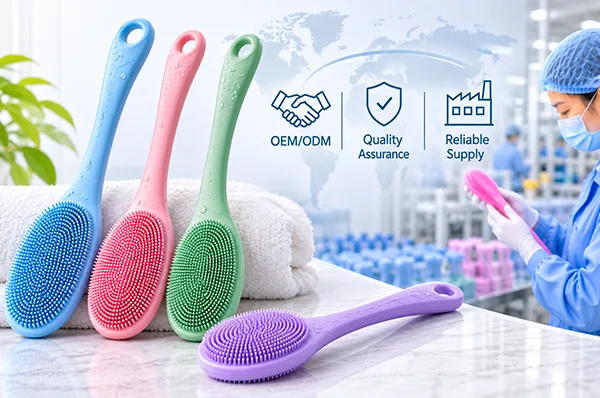
Introduction: How Chinese Manufacturers Help Global Brands
The beauty and personal care industry around the world still offers a lot of possibilities for the creation of novel bath and body products. In particular, silicone body scrubbers, cleansing brushes, massage tools, and other types of reusable personal care instruments have become increasingly significant categories for brands, wholesalers, distributors, and e-commerce companies. To meet growing market demand, many buyers are working with Chinese silicone body scrubber manufacturers to develop customized products, expand their product ranges, and build competitive private-label collections.
But for a successful product launch, a good supplier is not just about having an attractive price quote. International buyers require reliable partners that will be able to understand the product specifics, design the product, control the quality and delivery schedule of the order, and help operate in the international business environment.
And that is why many global brands collaborate with Chinese silicone body scrubber manufacturers.
The Chinese manufacturing industry has everything required for the production of silicone products – raw material supply, mold design, molding technologies, finishing of the product, packaging, and international logistics.
Chinese silicone body scrubber manufacturers support global brands by turning product concepts into manufacturable products, providing OEM/ODM customization, managing production quality, and helping businesses build competitive private-label product lines.
However, all suppliers do not have similar capabilities. While some are specialized in offering standard products, others offer comprehensive services such as product design, prototypes, custom molds, quality control, and packaging.
For cosmetics companies, wholesalers, distributors, and private label producers, the process of choosing the correct manufacturer is a significant step in developing their international supply chain.
This article describes how Chinese silicone body scrubbers manufacturers assist international brands and what international buyers need to consider when setting up a business relationship with them.
1. Why International Brands Prefer Chinese Silicone Body Scrubber Manufacturers
China is increasingly becoming an important source for silicone personal care products due to the availability of a manufacturing supply chain and customization options.
There are many other benefits of using Chinese manufacturers for international brands, apart from factory prices.
Manufacturing capabilities
The Chinese silicone manufacturers will have experience with molding, material choices, customization tools, production, and finishing. This will enable the brands to manufacture products of various designs, textures, structures, and functionality.
Customization abilities
It is rare to find international brands that require all their products to be similar to those of their competitors. Unique color, logo placement, bristle design, package design, and product design are some of the customization services required by these brands.
Expert manufacturers will help them convert their requirements into manufacturing requirements.
Product development resources
The experienced manufacturer will be able to offer feedback on the feasibility of designs, materials, molds, and production issues. This will prevent development changes that may not be necessary.
Scalable manufacturing
Initially, products can be launched on a small scale with growing order volumes as sales rise. The help of a manufacturer with appropriate production capabilities may contribute here.
Effective supplier communication
Communication with a manufacturer directly may facilitate information exchange regarding samples, specs, production, and quality.
For consumers, the true benefit lies not in purchasing a cheaper product but rather in finding a manufacturing partner for the product development throughout its entire life cycle.
2. OEM and ODM Services Assist Brands in Creating Distinguishing Products
OEM and ODM are two manufacturing models commonly used by international clients.
The knowledge of how these models differ from each other will help choose the right cooperation model.
What is the OEM manufacturing?
OEM, which stands for Original Equipment Manufacturing, usually means the manufacturing of products based on the buyer’s requirements.
For instance, a beauty brand already has the design of its silicone body scrubber, its technical drawing, size, and other requireme
nts. It is up to the manufacturer to check the manufacturability of the product and create it based on the required criteria.
The OEM model is preferable for brands that have a relatively clear vision of their product.
What is ODM manufacturing?
ODM refers to Original Design Manufacturing and means higher support by the manufacturer regarding the development of the product.
The buyer could suggest some initial idea or reference product or application, but the manufacturer would participate in the creation of the product structure, material choice, product design, and manufacturing process.
ODM manufacturing could be good for companies which require launching differentiated products but don’t have own product engineering and mold development teams.
Which model should global brands choose?
| Requirement | OEM | ODM |
|---|---|---|
| Product concept | Usually provided by buyer | May be developed jointly |
| Product design | Buyer-led | Manufacturer-supported |
| Mold development | Based on buyer specifications | May include manufacturer design input |
| Customization | Based on agreed requirements | Can include broader development support |
| Best suited for | Established product designs | New product ideas and development projects |
Both types of manufacturing could work for private label business. It depends on what resources the buyer has and at what stage of development he/she needs help.
For new brand joining the market of silicone bath accessories, ODM manufacturing could be helpful. For existing brands with already approved designs, OEM manufacturing could be better.
3. Product Design and Development Assistance
Product development is arguably the most crucial way for a manufacturer to contribute to the success of a globally recognized brand.
Although an attractive-looking product in the concept drawing is not always possible for mass manufacturing, such parameters as material performance, mold design, bristles’ size, thickness of the product and manufacturing restrictions have to be taken into consideration.
The assistance from an experienced manufacturer could be beneficial in evaluating those aspects prior to tooling and production.
In case of silicone body scrubbers, product development might encompass several different aspects of design.
Product shape: The general shape should be comfortable in holding, practical in using and distinctive in appearance.
Bristle placement: The bristles’ length, thickness, distance between them and density affect the overall flexibility of the product.
Material: The grade of the silicone used should correspond to the purpose of the product and its flexibility.
Ergonomic design: The form of grip and handle.
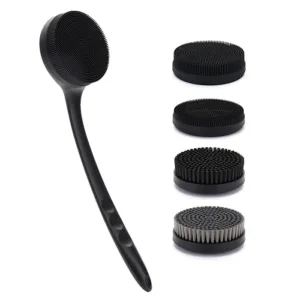
Multifunctional designs: Designs may be multifunctional with multiple surface textures or interchangeable heads.
Manufacturability: The design must be analyzed to understand moldability, material usage, production repeatability, and cost.
For instance, if a brand is working on the development of an expensive body scrubber using silicone material, they would prefer the dual-texture design where one side would have soft bristles while the other side would have another surface texture. It is important to consider whether the design is moldable and what difference does each surface provide in terms of functionality.
This technical partnership will help brands save money and effort on product features that are difficult to manufacture and not valuable enough for the customers.
4. Custom Molds and Development of Private Label Products
Customized molds will help brands go beyond the ordinary catalog products and make their product structures more unique.
Silicone body scrubbers can be produced in molds that incorporate:
- Unique product shape and silhouette.
- Different patterns of bristles.
- Specialized surface texture.
- Incorporated hanging holes and handles.
- Two-sided products.
- Specialized dimensions and thicknesses.
- Product structure features that are specific to the brand.
A custom mold will be needed when the brand needs its unique product design that other competing manufacturers cannot replicate easily.
The development of custom tools is always connected to the need for some development time and extra costs. Potential buyers need to evaluate the volume of orders, positioning of the product, and future demand.
When a company tests a new product category, it can use existing molds along with customized colors, logos, and packaging.
Tooling aspects that matter
Prior to approving the manufacturing of customized molds, foreign customers need to define:
- Ownership of the mold after payments have been made
- What services are covered in the mold quote
- Are there any changes to the samples
- How is the mold stored and maintained
- Can the mold be utilized in other production orders in the future?
- What limitations exist regarding the manufacturer’s utilization of the customized design
- What happens when modifications are needed
All of these terms should be written down for protection of both parties.
An experienced silicone body scrubber manufacturer can discuss tooling and set real expectations regarding costs and timelines.
5. Material Selection and Manufacturing Expertise
The selection of materials has an impact on the functionality, appearance, flexibility, and manufacturing of the products.
For global manufacturers, the process of material selection goes far beyond determining whether a certain product is made of silicone.
It is important to take into account the intended use of the product, its material properties, dimensions, and applicable market specifications.
Key material factors are:
Hardness: Shore A value defines the indentation resistance of soft silicone. It will depend on the design and touch characteristics of the product.
Flexibility: This parameter should be taken into account in view of the intended product structure.
Tear resistance: Thin bristles and narrow connecting areas may require special attention during material and structure assessment.
Surface finish: The finished product must comply with the established appearance standards.
Color consistency: Silicone pigment and process control must be in place to provide uniformity of coloration.
Smell & Cleanliness: Sourcing and manufacturing process control must deal with smell, contamination, and residues.
Material Documentation: Buyers may ask for documentation on materials and tests results based on the application and market.
It is necessary to realize also that the hardness of the silicone is not the only factor which affects the feel of a scrubber. The length, thickness, distance and base construction of the bristles have an effect also.
For international brands, the producer should help prepare the material specifications of the product.
6. Quality Control from Raw Materials to Finished Products
Consistency of quality is crucial for global brands. The product that works well during sample approval must meet the same standards during its production.
Professional manufacturers should introduce quality control processes, which would apply to several production steps.
Material inspection
The raw materials must be inspected according to the purchase standards and any other supplier documentation. The process of identification and tracing of materials could help avoid wrong material selection.
Mold and production preparation
The molds and production equipment should be inspected prior to production. The manufacturer should ensure that the process settings and mold are suitable for the product being produced.
In-process inspection
During the process of production, the following aspects could be inspected:
- Product dimensions and weight.
- Shape and consistency of bristles.
- Surface finish.
- Molding imperfections.
- Color consistency.
- Structure integrity.
Inspection of finished products
Finished products need to be inspected against approved samples and specified criteria prior to dispatching.
Depending upon the product, the following inspections may be carried out:
- Visual inspection.
- Inspection for dimensions.
- Inspection for hardness.
- Inspection of bristles/structure.
- Logo/label printing inspection.
- Inspection of packaging/labels.
- Inspection based on functional or longevity criteria.
Inspection criteria and AQL
International buyers may insist upon conducting AQL sampling inspection as part of their order requirement.
Sampling inspection through AQL provides both buyers and suppliers a method to determine production quality through an inspection arrangement, and not that each individual item is guaranteed to be free from defects.
Inspection level, acceptance criteria, defect classification, and corrective actions need to be finalized prior to production.
For global brands, consistency is the most crucial criterion between the approved sample, production specifications, and dispatched goods.
7. Compliance & Testing for International Markets
When marketing silicone body scrubbers in international markets, compliance, testing and other considerations must be taken into account.
Requirements could vary based on the destination country, product design, intended use and marketing claims.
For instance, products marketed in the USA and Europe will have different applicable requirements such as consumer product regulations, chemical content regulations, labeling regulations and packaging regulations.
The buyer should not presume that all silicone materials comply with all regulations of any destination market.
So what should international buyers consider?
Material Documentation: Obtain documentation related to the silicone material and its intended use.
Chemical Testing: Consider if restricted substance testing or other chemical testing is required in relation to the product and destination market.
Product Safety: Identify foreseeable hazards of design, construction and intended use.
Environmental claims: Make sure that any claims for “recyclable,” “biodegradable,” or “antibacterial” are appropriately supported.
Testing records: Secure relevant testing documents for the particular product under consideration.
Beaut-Lohas can assist buyers in determining appropriate testing requirements and documentations on a project-by-project basis. Tests and compliance obligations would need to be determined in consultation with the buyer and, where necessary, with appropriate testing or regulatory authorities.
A reputable manufacturer would have no problems disclosing relevant documentation and should not promise compliance in all cases without proper documentation.
8. Customization in Branding, Colors, and Packaging
Private labeling is probably one of the most crucial aspects of differentiation of global brands’ silicone body scrubbers from generic goods.
There can be great quality and great functionality of a product, but without proper branding, it would be hard to develop its distinctiveness.
Chinese silicone factories are able to perform many kinds of customization according to product design and technical possibilities of manufacturing.
Customized colors
Color preferences can be made by brand to fit its visual identity, product collection, and the target audience.
The pantone codes can be used for color specification. But, the color preference should be confirmed using a sample product within certain tolerances.
Branding customizations
The right kind of branding for the product can include the following:
- Screen printing.
- Lasering where applicable.
- Embossing of logos.
- Other ways of applying logos that are suitable.
The selected method should be evaluated for material compatibility, visibility, durability, and production feasibility.
Packaging Development
Packaging has a significant role in retail display and perception of consumers.
The manufacturers can help in:
- Custom Printed Boxes
- Retail Display Packaging
- Product Cards & Labels
- Polybags & Protective Packaging
- Packaging for gift set
- Wholesale Carton Labelling
Packaging has to convey the message of the brand while ensuring safety during shipping and handling.
In case of ecommerce brands, the dimension of packaging and logistics also need to be taken into consideration.
9. MOQ Flexibility and Scale of Production
The minimum order quantity is a primary issue for brands that wish to enter new markets.
A high MOQ may cause inventory risks, especially for products which haven’t proven themselves on the market yet.
Global brands tend to start with smaller orders, conduct market research, and then order more as their sales grow.
The optimal manufacturing partner will describe the MOQ structure and list all the aspects affecting the scale of production.
This includes:
- Availability of molds.
- Molds made according to customer needs.
- Purchase of silicone materials.
- Need to colorize.
- Printing of logos.
- Packaging options.
- Schedule of production.
- Efficiency of production process.
For instance, an existing silicone body scrubber mold will be more flexible in terms of starting MOQ than a custom mold made from scratch. Yet, customization of colors and packaging will have its own minimum order quantity.
The buyer will receive a detailed quotation listing the cost of each part of the product and additional expenses.
A scalable production strategy can help brands control inventory risk while preserving the ability to expand their product range.
10. Supply Chain Management and International Shipping
Efficient manufacturing process alone is not enough for building a successful international partnership. Goods must be packaged, stored, prepared for export, and delivered to destination countries.
A manufacturer working on global brands should be clear regarding scheduling of the manufacturing process and the logistics.
The key points for the supply chain management are the following:
Production planning: Check the estimated period of time needed for manufacturing and stages that will be passed during the process.
Packaging coordination: Make sure that the package design and its specification have been reviewed prior to the scheduled production stage.
Order tracking: Stay in touch in regard to manufacturing progress and possible delays.
Export document preparation: Check what kind of documents will be needed for the shipment and who should prepare them.
Shipping conditions: Clarify whether it is EXW, FOB, CIF, DAP or other agreed Incoterm that has been used in your quotation.
Delivery schedule: Schedule the delivery process depending on the sales and inventory plan of your buyer.
For brands delivered via distributors, retail stores, or online fulfillment services, shipping delays may have an impact on the availability and sales performance.
Clear communication and realistic production planning help reduce avoidable supply chain problems.
11. How Chinese Makers Assist Brands in Controlling Costs
Costs of manufacturing are one of the key considerations for developing a competitive range of body care products.
Nonetheless, the lowest cost per unit does not always yield the most profitable outcome.
A poorly-made item might bring extra expenses associated with inspections, returns, replacement, and customer services. Likewise, design complications could drive up manufacturing costs without adding any value to the end consumer.
Professional manufacturers can assist buyers in considering costs throughout product development.
Material Optimization
The size, dimensions, structure of the item will affect the use of silicone. The manufacturer can determine if the design makes a good use of materials in line with the required product specification.
Mold Selection
Utilizing an existing mold may save on tooling costs and shorten the process of development if the product fits the brand specifications.
Manufacturing Design
Reducing unnecessary structural elements could be an aid to manufacturing and lower complexity in the process.
Packaging Optimization
Proper packaging size could result in less consumption of materials and transportation.
Planning for Order Quantity
Combining the production plans for the products or colors might be beneficial for procurement efficiency on the buyer side, provided the MOQ of the manufacturer and production plans.
Preventing Quality Problems
Specifying requirements prior to production could prevent unnecessary costs and disagreements.
The aim here should be the optimization of the landed cost.
12. How to Evaluate a Chinese Silicone Body Scrubber Manufacturer
Every supplier who claims to produce silicone products does not necessarily have the capacity to manufacture for an international brand.
There are some steps that one should undertake before choosing a manufacturing partner.
| Evaluation area | What buyers should check |
|---|---|
| Manufacturing experience | Experience with silicone personal care products |
| R&D capability | Ability to discuss product structure and manufacturing feasibility |
| Mold development | Existing molds and custom tooling support |
| Material management | Material specifications and supplier documentation |
| Quality control | Inspection procedures and production records |
| Customization | Logo, color, shape, and packaging options |
| Production capacity | Ability to support expected order quantities |
| Compliance support | Relevant testing and documentation coordination |
| Communication | Response speed, technical understanding, and transparency |
| Commercial terms | MOQ, tooling ownership, payment terms, and lead time |
Questions to be asked before cooperation
- Do you produce silicone body scrubbers by yourself?
- Are there any existing product catalogs and samples from you?
- What OEM and ODM customizations do you offer?
- Is it possible to create a custom mold?
- What types of silicone material and hardness levels can you use?
- How do you test your products during mass production?
- What is the MOQ and lead time for custom orders?
- Is it possible to perform some testing and documentation?
- To whom does the custom tooling belong?
- Does your company have any references or proof of manufacturing?
Buyers have to verify information about the suppliers via factory documents, video-conferencing, samples, audit when needed, and purchase order specification.
A reliable partnership should be based on verifiable capabilities rather than marketing claims alone.
13. How Beaut-Lohas Supports Global Brands
Beaut-Lohas is a B2B manufacturer and supplier of silicone personal care products, supporting international buyers seeking product development, OEM/ODM customization, and wholesale manufacturing.
With 15 years of silicone ODM experience, Beaut-Lohas combines product development resources, manufacturing capabilities, and quality-management support to serve global brands.
Manufacturing and development capabilities
- 15 years of silicone ODM experience: Experience supporting silicone product development and manufacturing projects.
- 50+ R&D staff: Resources for product development and design-related support.
- 3,000 m² factory: Manufacturing facilities for silicone personal care products.
- 1,000+ existing molds: Existing product options that can help buyers explore development and sourcing opportunities.
- 50+ QC staff: Dedicated quality-control personnel supporting product quality management.
- 50+ sales staff: Sales and communication resources for international customer cooperation.
- 50 million annual production capacity: Company-stated annual production capacity across its product operations.
These resources provide a foundation for supporting different project sizes and customization requirements. Actual production feasibility and lead time depend on the specific product and order.
OEM/ODM services
Beaut-Lohas can support different stages of product development, including:
- Product concept discussion.
- Product design and structural development.
- Prototype and sample coordination.
- Existing mold selection.
- Custom mold development.
- Silicone material and hardness discussions.
- Custom color matching.
- Logo printing and application.
- Packaging and marketing design.
- Quality-control coordination.
- Relevant testing support.
International business experience
Beaut-Lohas has participated in exhibitions in Italy, Korea, the United States, Japan, and Dubai, supporting communication with buyers in different international markets.
For brands, distributors, wholesalers, and ecommerce sellers, the objective is to establish a manufacturing relationship that supports both initial product development and future repeat orders.
Visit https://www.beaut-lohas.com/ to explore silicone personal care products and discuss your OEM/ODM project.
14. Steps that Global Brands Should Take to Initiate the OEM/ODM Program
A well-defined procedure makes the process of going from concept to manufacturing easier for overseas buyers.
Below is the suggested process that buyers may start with.
Step 1: Specify the product requirements
It is necessary to identify the target audience, customers, application, dimensions of the product, design idea, and expected product positioning.
Step 2: Pick a product or send the idea
Buyers can select the desired product or send the images, drawings, and product specs of the product.
Step 3: Assess material and design feasibility
The manufacturer analyzes the design concept, materials required, bristle design, possible customizations, and production process.
Step 4: Approve the quotation
Examine the product price, mold price, sample cost, packaging, MOQ, production lead time, and shipping conditions.
Step 5: Develop and approve the sample
Inspect the product sample in terms of looks, dimensions, material touch, usability, and branding.
Step 6: Verify specifications and manufacturing requirements
Record details of the sample, material specifications, color chart, tolerance range, packaging, and inspection criteria.
Step 7: Start manufacturing in bulk
The supplier plans and executes the production using the negotiated quality control methods.
Step 8: Perform inspection and prepare for shipping
Perform inspection according to the negotiated terms, verify packaging and shipping documents, and facilitate delivery.
Step 9: Assess performance and plan future orders
Gather feedback from the client, evaluate product performance, and look for areas to improve or develop new products.
Conclusion: Establish a Long-Term Partnership with the Suitable Chinese Manufacturer
The capabilities of Chinese silicone body scrubber manufacturers can go beyond providing ready-made products to help global brands in a variety of ways such as product design, material selection, mold design, OEM/ODM customization, quality assurance, packaging, and production planning.
International buyers can use the right manufacturing partner to turn their product idea into a commercially successful product by keeping the same specifications and facilitating further business expansion.
It is crucial not to rely solely on pricing when choosing a manufacturer but consider experience in manufacturing, product development, quality management, customization, communication, and logistics.
For brands producing silicone body scrubbers and personal care accessories, there is a company called Beaut-Lohas that provides OEM/ODM services thanks to its 15 years of silicone ODM experience, R&D and QC teams, a professional factory, and molds.
If your business is looking for a Chinese silicone body scrubber manufacturer, contact Beaut-Lohas to discuss product development, private labeling, custom molds, and wholesale manufacturing solutions.
Frequently Asked Questions
1. Why do global companies choose to manufacture silicone body scrubbers in China?
Chinese factories already have silicone manufacturing supply chains in place, meaning that manufacturers can offer product development, mold production, materials procurement, customization, and scalable production. Nevertheless, buyers still need to assess the capabilities of each manufacturer individually.
2. How does OEM differ from ODM silicone body scrubber manufacturing?
In general, OEM manufacturing follows the buyer’s product design and specifications. Meanwhile, ODM requires more involvement of the manufacturer in product development. Both business models can accommodate private label brands.
3. Is it possible to create a custom silicone body scrubber mold in China?
Yes. Chinese factories capable of providing proper tooling services can develop unique molds for various designs, bristle arrangements, textures, and functionality of a product. The costs of tooling, its ownership, development period, and future use should be clarified before cooperation.
4. What is the MOQ for custom silicone body scrubbers?
The minimum order quantity depends on the product design, mold requirements, material, coloring, logo printing, and packaging. It is recommended that buyers obtain project-specific quotes rather than using a single MOQ for all products.
5. How can manufacturers ensure quality of silicone body scrubbers?
Quality control could include incoming materials inspection, process control, dimensions inspection, appearance inspection, hardness check, and agreed functional/durability test. It is important for buyers to verify the actual inspection procedure and acceptance criteria before production.
6. Are manufacturers able to meet requirements for US/European markets?
Manufacturers could offer material information and coordinate corresponding testing and documentation. Requirements would be depending on the product type, purpose of use, destination, and marketing claims. Buyers need to verify compliance with the help of qualified professionals.
7. Is it possible for Beaut-Lohas to offer silicone body scrubbers under private label?
Yes, Beaut-Lohas specializes in B2B OEM/ODM projects related to product selection, product development, color matching, logo printing, mold development, and packaging coordination, depending on project requirements.
8. How can overseas buyers begin collaboration with Beaut-Lohas?
Buyers can provide product concept, reference images, target market, requirements of customization, estimated quantity of order, and target price. Based on that, Beaut-Lohas can discuss possible product options, feasibility of development, and quotation details.
Are you looking for a reliable silicone body scrubber OEM/ODM partner in China? If yes, pls feel free to Contact Beaut-Lohas to discuss your custom product requirements and wholesale manufacturing project.