Introduction
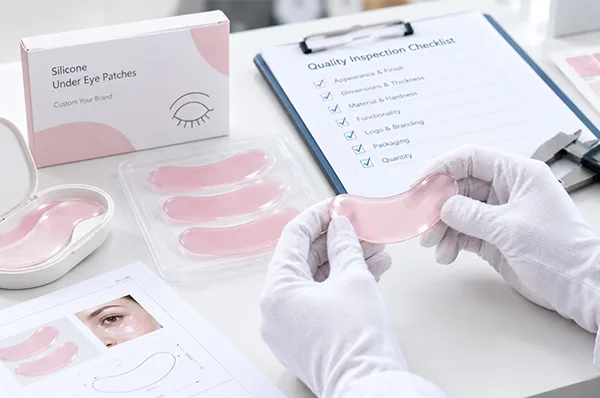
Customized silicone eye patches can be designed to create unique products that match your market needs. Customization can include customization of the product shape and color, customization of the private labels and packaging, among others. However, customization poses some purchase risks since the final appearance and feel of the product will be different from the drawings and sketches provided during purchase negotiations. This is why the custom silicone eye patches sample approval is important for you during the OEM or ODM sourcing process.
A pre-approved sample can reduce any misinterpretations, enhance communication, ensure consistency in quality and assist in avoiding unnecessary reworks. In addition, it offers a tangible guideline for future inspections and repeat orders.
For businesses ordering customized silicone eye patches from the foreign manufacturer, approval of samples must not be considered as an insignificant procedure. It must be a formal procedure based on product specifications, appearance, functionality, branding and packaging.
In case of company’s need for customized silicone beauty patches as B2B clients, at Beaut-Lohas, one can find out information concerning OEM and ODM services of silicone beauty products.
In this article, we describe how the sample approval process works, what types of risks it allows minimizing, what buyer needs to inspect and how to create the approval process.
1. Sample Approval in the Production of Custom Silicone Eye Patches
The process of sample approval entails the assessment by the buyer of a product sample to determine its compliance with the established criteria concerning such aspects as design, materials used, appearance, performance, and other.
Concerning the production of custom silicone eye patches, sample approval is performed after the discussion of product specifications and prior to initiating mass production.
A product sample may be made either by means of provisional manufacturing process, prototype molding, or by use of future production equipment, depending on the development phase.
The sample is reviewed by the buyer, who provides recommendations regarding possible changes and approves the sample.
What is an approved sample?
An approved sample provides a physical benchmark of the agreed-upon product attributes. In some cases, this sample could help the parties involved to determine how the final product should appear.
The following are among those that could be included in an approval package of a sample, depending on the nature of the project.
- Approved product form and size
- Material specifications
- Colors and surface finishes
- Product thickness and flexibility
- Logo art and placement
- Functional aspects
- Packaging design and configuration
- Approved product drawings and specifications
It is essential that an approved sample comes along with documentation. Some attributes of the sample are not verifiable through visual inspection only, including materials used and tolerance requirements.
Sample approval vs. Prototype approval
Prototype can be utilized to test the early stage design, structure, or functionality.
The prototype may not indicate the actual manufacturing process or materials to be used.
The production sample will be created based on the manufacturing process to be used.
For customized silicone eye patches, it is necessary for clients to know what kind of sample is approved and what has been tested.
The visual approval of the prototype does not automatically mean that it is ready for production.
2. Why is Sample Approval Necessary for Custom Orders?
Standard products generally have predetermined specifications and manufacturing details. Custom orders involve even more factors in that there may be new shapes, particular colors, logo printing, exclusive texture, and custom packaging.
Every factor means yet another chance for misunderstandings or mistakes in the production process.
Sample approval allows both sides to discuss all of these factors and avoid future complications.
It specifies expectations.
For example, a written specification like “soft, high-quality silicone eye patches with smooth surface” may mean something else for one person than for another.
While a sample, along with specifications, provides a clearer understanding.
It helps to identify any design issues early on
The buyer will find out whether the patch is too big, whether the curve will work with the eye area, or whether the thickness is as expected.
Changes to be made at the development stage tend to be easier to implement than adjustments to the ready-made stock.
It helps to communicate
The buyer will be able to give precise comments based on pictures, measurements, drawings, and samples.
Less guessing and explanation will be required.
It helps to maintain consistency in production
Once the sample is approved, it will become possible to use it as a reference point for production, quality control, and future orders.
Approval won’t prevent inconsistencies in production but will set up a clearer guideline.
3. How Sample Approval Minimizes the Risks of Design and Fit
Design risk is one of the initial risks in custom silicone eye patch production.
A product can seem aesthetically pleasing when it is presented in CAD drawings or renderings but can have some differences when manufactured of flexible silicone material.
Verify the shape and size
The buyer should confirm that the overall length, width, thickness, curvature, and edge of the product are correct according to the design approval.
The shape of eye patches is critical since the product is supposed to fit the intended area under or around eyes.
An aesthetic design can be larger, narrower, or wrong-curried when it is evaluated physically.
Evaluate the contact area
The contact area should correspond to the intended design and application.
The buyer should consider how the patch will rest on the intended area, how the edges will be positioned, and if the product’s shape is convenient for handling depending on the product.
Fit assessment should involve a specific methodology. It is not enough to conduct just a try-on to approve the product design for all buyers.
Flexibility & Handling
Flexibility of silicone affects its bending, conformation and handling properties.
The sample gives the buyer an opportunity to evaluate if the combination of the material and geometry suits their needs.
In case if the sample turns out to be too stiff, too flexible or not easy to apply, the buyer will have an opportunity to make necessary changes to the material or geometry before giving their approval for production.
Confirm design modifications in writing
In case if the buyer asks for a smaller tip, a bigger center area, a thinner edge and/or different curvature, it is recommended to modify the corresponding drawings.
The updated sample will have to be evaluated according to these new conditions.
This way, a previous sample or outdated drawing will not be used as a base for manufacturing.
4. How Sample Approval Controls Material and Quality Risks
The choice of material has a direct impact on the features of the silicone eye patches: their flexibility, texture, look, and strength.
Two similar-looking products might feature different behavior due to the differences in materials or process conditions used to manufacture them.
Confirm the intended material
During the approval process, the buyer needs to verify the material requirements with the manufacturer.
This may involve the type of silicone material, related documents, hardness requirements, etc.
The physical sample can provide useful information about the feel and look of the material, but not about the material composition and all safety properties.
In some cases, buyers need to ask for relevant documentation or tests.
Check hardness and flexibility
If there is a required hardness range in the project, then the manufacturer should provide the information about the testing method and acceptance criteria.
Select adequate measurements to suit the material and product geometry. We cannot always equate the hardness reading from a standardized test specimen to that of the thin patch.
The sample assessment will include evaluating the flexibility of the patch.
Surface finish check
The surface finish may affect the appearance, touch, and experience of the product.
Examine the sample for any unnecessary roughness, irregularity, damage, contamination, or deviation from the specifications in general.
In case of transparent or translucent patch, examine the sample under even lighting so that the defects and variations become apparent.
Establish objective quality criteria
Do not base your assessment solely on the phrase “it looks good.”
List the qualities you must keep consistent throughout production, including dimensions, thickness, surface finish, color and other attributes.
It provides better criteria for control during the manufacturing process and at the point of quality inspection.
5. Why Sample Approval Helps in Avoiding Logo and Branding Mistakes
In private label products, the logo and brand are an important part of the commercial value of the product itself.
A product may satisfy its functional needs and yet not be appropriate for sale due to the mistake in the logo and branding.
Check logo positioning
Evaluate the logo’s positioning, orientation, dimensions, and alignment on the sample.
The logo that appears centered in the design may not be so on a curved or bendable product.
Confirm artwork is accurate
Verify spelling, proportions, quality of lines, and necessary colors.
In case of debossing or molding logos, verify definition and depth of the logo according to the approved design.
And in case of printing the logo, verify its clarity and quality.
In case of print quality requirement, specify the way for checking print durability; do not suppose that the successful first result proves good durability.
Verify brand representation
Assess the way the product will look like in product photos, retail packaging, and the buyer’s chosen channels of selling the product.
Sometimes just a little change in logo size or placement can make the product look much better.
Approve final version of the branding
If the buyer makes some modifications to a logo or artwork file, the manufacturer should recognize the changed version and approve it.
It is very important if there are different versions of products with various colors, forms, or packaging developed simultaneously.
6. How Does Sample Approval Minimize Risks in Packaging and Labeling?
Problems with packaging may lead to delayed product release and incur unnecessary costs, especially when selling brands via retail, Amazon, Shopify, or distribution agents.
Sample approval makes it possible to check the entire design prior to mass ordering of packaging materials.
Check the packaging design
Depending on the product, packaging may consist of storage cases, protective trays, cardboard boxes, inserts, instructional cards, etc.
Ensure that the product fits well and that packaging protects it in case of regular handling and transportation.
Check artwork and print
Go through the approved artwork, looking at the spelling, logo placement, colors, and other elements required in the package.
It’s also necessary for the buyer to ensure that the right artwork version is being utilized.
Check labels and barcodes
In case where the product needs to have a barcode, SKU, batch coding, or any other kind of label data, check the pertinent details before approval.
Packaging requirements will depend on the market for which the product is destined, its type, claims, and intended uses. The buyer must verify these requirements separately from the packaging sample.
Approve the packaging along with the order
If the packaging is part of the end product, this should be clearly specified in the approval process.
A product sample approved without the complete packaging cannot guarantee compliance with all packaging requirements.
7. How Approval of Samples Aids in Avoiding Production Delays and Additional Expenses
Production delays arise when key requirements are left unfulfilled even after production has begun.
For instance, there can be a requirement to change the logo after the materials have already been ordered for printing or an observation that the thickness of the product is different than expected after having manufactured thousands of pieces.
Approval of samples will allow identifying such problems ahead of time.
Avoid unnecessary reworking
By approving the design, materials, and branding prior to mass production, the manufacturer will have a better chance of creating the right production process.
Thereby, avoiding unnecessary reworking of the mold, artwork, packaging, or stock.
Avoid waste of materials
Inappropriate changes during production can lead to discarding of the products or packaging.
Pre-checking the design before mass production will help avoid producing goods that may not satisfy the requirements of the buyer.
Scheduling improvement
The sample approval marks an important milestone in the production schedule.
The manufacturer can schedule future work according to the approved requirements, while the buyer can coordinate the packaging, promotion, and inventory.
Avoid unnecessary delays in shipment
In case there is a significant problem found only during the last inspection, the order can be sorted, redone, or manufactured anew.
While the best approval system can’t prevent defects from happening, it can minimize chances of last minute issues due to open questions in design or specifications.
Know the price of late change
The cost of the change depends on the product, tools, quantity, and the manufacturing stage.
The buyers should not think that all changes would cause the same price but ask manufacturers which decisions should be made before tooling, materials, printing, and production.
8. Sample Approval Process for Custom Silicone Eye Patches
A clear flow process facilitates sample approval management, avoiding any misunderstanding among the buyers, designers, and the manufacturers.
This is the procedure that can be modified depending on the project of any other OEM and ODM manufacturer.
Step 1: Define the product specifications
Give a detailed description of your product design, its targeted market, size, materials, colors, logos, packaging, and the quantity of the future order.
It is always helpful to provide a more detailed set of initial specifications, as it will be much easier to determine the manufacturing limitations.
Step 2: Check out the design and manufacturing feasibility
In this step, the manufacturer determines if the designed product features (size, texture, shape, logo, etc.) are feasible for the planned production method.
If the manufacturer requires design change, both sides should discuss the alternative designs.
Step 3: Manufacture the first sample
Manufacturer manufactures a prototype/sample according to the current stage of development.
The buyer should confirm what the sample represents and which characteristics have not yet been validated.
Step 4: Evaluate the sample
Examine the appearance, size, texture, fit, logo, packaging, and any other criteria pertaining to the item.
Write out particular problems rather than giving generic feedback.
Step 5: Ask for revisions, if necessary
In case the sample does not satisfy the requirements, give feedback along with images, dimensions, detailed drawings, or any other proof you have.
The supplier must acknowledge the suggested changes and produce a new sample, if necessary.
Step 6: Approve the final sample
After the sample complies with all agreed upon requirements, give your approval in writing on the approved sample.
Mention the respective sample date, product number, drawing revision, logo artwork revision, and packaging revision, if necessary.
Step 7: Approve mass production
The manufacturer should ensure that mass production will be according to the approved specification and list any modifications that need to be re-approved.
The mass production should not start on the presumption that the sample was already approved until the buyer’s approval has also been granted.
Step 8: Inspect mass production
Appropriate inspections, both during the process and at the end of production, should be carried out to ensure that the finished products conform to the approved specifications.
Sample approval is the standard reference; the production inspection ensures whether the order conforms to it.
9. What Should Buyers Check Before Approving a Sample?
A checklist for sample approval can help buyers avoid overlooking key aspects of the product.
The checklist should consider the design, function, and business aspect of the product.
| Inspection Item | What to Verify | Approval Reference |
|---|---|---|
| Product shape | Overall outline and intended contour | Approved drawing |
| Dimensions | Length, width, and other specified measurements | Technical specification |
| Thickness | Consistency at defined measurement points | Agreed tolerance |
| Material | Required material identity and documentation | Material specification |
| Flexibility | Handling and bending behavior | Approved reference and test criteria |
| Surface finish | Texture, smoothness, appearance, and visible defects | Golden sample |
| Color | Color and transparency consistency | Approved color reference |
| Edges | Trimming, profile, and absence of unacceptable defects | Product specification |
| Logo | Artwork, placement, size, and orientation | Approved logo file |
| Packaging | Structure, fit, materials, and artwork | Packaging specification |
| Labeling | Required text, product identification, and barcode details | Approved artwork and applicable requirements |
| Function | Fit, retention, cleaning, or other relevant performance | Defined test procedure |
| Documentation | Drawing and version information | Approval package |
Use an unequivocal approval status
Each item must have one of the following statuses:
- Approved – Satisfies the pre-approved requirements.
- Revised – Requires changes prior to approval.
- Pending verification – Needs further measurement or testing.
A checklist cannot state that an unverified attribute is approved solely on the basis of an acceptable sample.
10. How to Properly Document Sample Approval
It is convenient to get verbal approval, but it could cause confusion later on in case of any queries during manufacturing.
Documentation will make it easier to keep track of the samples that have been approved and which version of the product must be produced.
Keep track of versions
Every sample and/or specifications update should have a clear version.
For instance, there may be a first sample, a second one with a different thickness, and a third one where the logo position is changed.
This should be documented clearly so as not to misguide the factory into using outdated information.
Ensure supporting documents are complete
The following documents may form part of the approval package:
- Approved sample photographs
- Technical Drawings
- Product Specifications
- Materials
- Colors
- Logos
- Packaging artwork
- Relevant test data
- Written confirmation of the approval
The documents listed vary depending on the nature of the project.
List conditions for approval
Should approval be based on an outstanding test or document, the condition should be clearly stated.
Treat conditional approval differently from unconditional approval in cases where the latter is used to approve mass production unless the parties agree otherwise.
Put in place change control process
After the approval process, any change to material, shape, thickness, surface, logo, or packaging should be subject to the agreed upon change control process.
Some of the changes will need the provision of new samples or testing.
This prevents unauthorized modifications from undermining the original approval.
11. Approving Samples in Business-to-Business Deals: Common Mistakes to Avoid
Even seasoned buyers may run into trouble when there is a problem with how fast and accurately samples are approved.
Relying on photographs
Photographs may aid in evaluating visual aspects, but they will not guarantee the correct evaluation of all dimensions, materials qualities, tactile properties, or performance capabilities.
If the custom-made product is important, then the physical evaluation of the sample along with its proper verification would be the preferred choice.
Concerning appearance only
It is possible that the sample looks fine even though it does not meet the thickness, flexibility, fitting, and durability requirements.
It is important to take into account the features which are relevant for the intended use.
Vague feedback
Such comments like “make it better” or “material feels wrong” may not be informative enough for the producer.
When it is possible, one needs to provide detailed information about the problem together with measurements, comparisons, or photographs.
Putting off packaging until the last minute
The packaging art and material might have different manufacturing lead times.
Delaying the packaging approval process will impact the timeline even if the silicone item is already finished.
Failing to note the approval of the final version
If the purchaser and supplier cannot determine what the approved sample is, problems could develop on the type of design that will be manufactured.
This problem will not occur if there is written evidence and proper control of the versions.
Thinking that approved samples automatically guarantee flawless mass production
An approved sample serves as a guide, but not all production samples would be exactly alike.
Manufacturers need to employ efficient process controls and inspection as well as corrections if any.
Making changes to the specification after approval without going through the review process
A seemingly minor modification might have an effect on tooling, material performance, time of manufacture, or packaging.
Any material change should be evaluated and documented before implementation.
12. How Sample Approval Establishes Long-Term Cooperation Between Buyers and Suppliers
Sample approval is not only a technical procedure but also a means of establishing a more formal relationship between buyers and manufacturers.
Develop a standard for quality
Both sides can use the same approved sample and related documents when negotiating product requirements.
It makes it possible to have better discussions without misunderstandings.
Define responsibilities
An approved sample shows clearly what requirements have been agreed and what sample was approved for production.
If there is any deviation from the requirements, both sides can evaluate the completed product according to the established standard.
Simplify order placement for future purchases
If the buyer places an order again, the approved sample and specification can be used as a base for comparison.
Buyers need to verify whether some conditions such as materials, manufacturing process, design, or tools are different now.
If relevant conditions change, further verification may be necessary.
Help develop products
Feedback from sampling evaluation can assist in improving product usability, visuals, packaging, and manufacturing considerations.
It provides an opportunity to further develop the product prior to larger volume commitment.
Assess supplier communication
The way the supplier responds to feedback on the sampling can give insight into its ability to manage revisions, convey manufacturing constraints, and justify decisions made.
The buyer needs to find clear answers, realistic deadlines, and a problem-solving approach.
13. Selecting a Custom Silicone Eye Patch Supplier
The best sample approval process will be one where the supplier is both technically and operationally capable of turning the approved sample into production.
For B2B purchases, appearance is just one criteria of many.
Evaluation of Customization Capability
Can they provide for customization in terms of the necessary shapes, colors, textures, logos, and packagings?
If the product requires custom tooling or designs, it is important that you determine their feasibility, costs, and time frames before making any commitments.
Quality control processes
A good supplier should be able to give details on how it controls its material, mold process, trimming, dimensions, surface finishing, packing, and final testing.
Inquiry on how approved samples and specifications are used during production.
Verify change control
Understand how the manufacturer manages changes to material batches, moldings, production specifications, logo design and package.
It is important for the buyer to know which changes need to be reported, reapproved, or tested again.
Evaluate production communication
The manufacturer needs to clearly communicate information related to sample creation, changes required, approval status and readiness for production.
Poorly communicated information can cause unnecessary delays, particularly when several customized products are being manufactured simultaneously.
Review repeat order capability
For repeat orders, it is necessary that the manufacturer is capable of maintaining proper records and using them to process repeat orders.
The records will include drawings approved, material specifications, samples, inspection reports, and corrective action history.
For Beaut-Lohas, having discussions about these criteria in advance will benefit customization of the product.
14. Frequently Asked Questions
Why is sample approval necessary in custom silicone eye patch products?
The buyer gets an opportunity to check out some important features before mass production starts. This will help you to identify possible errors related to design, material, branding, packing, etc., and establish a reference for manufacturing.
When should I approve a sample before mass production?
Approve a sample when all necessary aspects of the design, material, size, appearance, branding, etc., have been checked out. If some documents and testing are left undone, specify the criteria under which production will be approved.
Is an approved sample enough for mass production?
No, it isn’t. An approved sample just creates a reference point, but you still need some control and testing during mass production.
How many revisions to samples do I need to have?
It will depend on the complexity of the design, materials needed, customization, and how detailed the brief itself was. Structured feedback and a clear brief can help eliminate unneeded rounds of revisions, but no fixed number of revisions will work in all projects.
What other documents must be part of my sample approval?
Depending on your project, the approval pack can include the technical drawing, product specification, material specification, color chart, logo file, packaging artwork, test results, and the approval note itself.
Do I need to get my packaging approved separately from the product?
Yes, you may need to approve the packaging separately from the product in case of custom printed boxes or labels, or even custom-made storage cases.
Can a approved sample be used to make repeat purchases?
Yes, in terms of a reference, as long as the design, materials, and appropriate production parameters stay the same. Buyers need to find out whether any changes have been made and need to be approved.
How can sample certification lower sourcing expenses?
The benefits would depend on the project and the potential problems that would otherwise be avoided.
Conclusion: Approve the Sample Before Committing to Mass Production
In B2B purchases of custom silicone eye patches, sample approval is an efficient way of reducing uncertainties in a manufacturing process before mass production begins.
An efficient approval process would include checking on issues like design, fit, properties of the material used, finish, branding, packaging, among others according to the set standards. This will act as the standard for production inspection as well as future orders.
The best way of doing so would be by getting a physical sample with specifications, acceptance criteria, versioning, and documented approval. Post-approval, there should be proper production controls and checking whether the order produced is at par with the specified standard.
For brands, wholesalers, distributors, and private labeling businesses in the skincare market, such a process will minimize unnecessary risks, communication, and ensure quality consistency.
Beaut-Lohas is an experienced partner in developing silicone beauty products under B2B services through OEM and ODM customization. In this regard, buyers can discuss their product ideas, customizations, and quality expectations before sample development and mass production.
Planning a custom silicone eye patch project? Contact Beaut-Lohas to discuss your design, private label requirements, sample development, and production specifications.