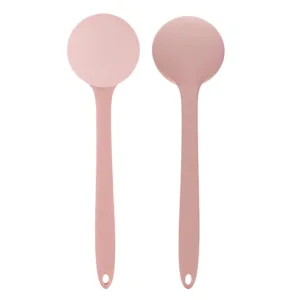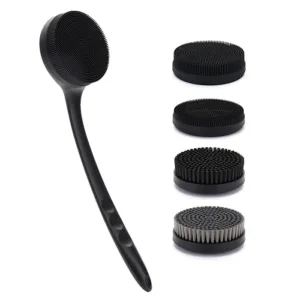
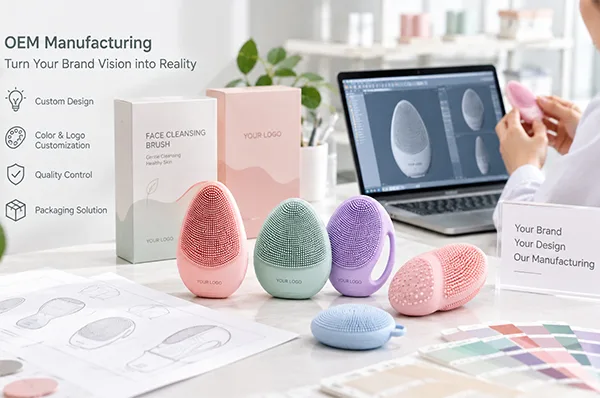
In the highly competitive beauty industry, retailers require more than just regular products in order to create a distinguishable brand and increase customer loyalty. OEM silicone facial brushes, featuring unique product design, high quality, unique packaging, and steady supply, could help retailers distinguish their product line from other beauty shops and online stores.
The use of silicone facial brushes is a great idea for retailers interested in enriching their line of skin care accessories. These manual cleansing products can be used alongside facial cleansers, masks, and other skin care products, providing retailers with great customization possibilities.
But in order to launch an exclusive product, retailers will need to think not only about choosing the right product from a supplier and placing a company’s logo on it.
And this is where the OEM manufacturer comes into play.
Working together with an OEM silicone facial brush manufacturer allows retailers to create a product out of the idea and make it a real commercializable product designed specifically for their target audience. It covers product engineering and mold design to brand positioning and mass production and makes OEM manufacturing the most structured method of creating your own exclusive beauty accessories without having to create your own manufacturing facility.
And for retailers, distributors, skin care brands, and e-commerce stores, it is crucial to understand the process.
Here we will tell about the role of the OEM manufacturer in creating exclusive silicone facial brushes for retailers, what retailers need to know before ordering, and how Beaut-Lohas helps in the process.
1. OEM Manufacturing of Silicone Facial Brushes
What is OEM? OEM means Original Equipment Manufacturer. In the world of beauty accessories, OEM manufacturing usually means manufacturing of products based on the needs or designs of a client.
For the silicone facial brushes, some examples of OEM projects include designing a new product shape, changing the structure of cleansing tips, using a certain type of silicone material, making a new color, printing the company logo, and even designing retail packaging.
The scope is defined by the agreement between the client and the manufacturer.
For instance, a skin care company may require a small-sized facial brush with a rounded body, flexible cleansing tips, a non-slip handle, and a custom color. The OEM manufacturer reviews the idea, proposes workable specifications, designs the samples, and manufactures the required design.
The finished product can be sold as their own branded goods, based on the agreements about the intellectual property rights, the branding process, and the manufacturing process.
OEM manufacturing is different from the mere purchase of generic wholesale products. The standard wholesale product purchasing involves choosing an already manufactured good while OEM manufacturing allows for customization and product development.
The other thing retailers have to distinguish is OEM and ODM. ODM manufacturing usually involves modification of a manufacturer’s existing design by the buyer while OEM manufacturing involves customization and product development according to the buyer’s requirements. In fact, in practice, these two schemes are very close.
The choice depends on the budget, exclusivity, time frame of the product development, and quantity of products.
2. The Reasons for Retailers to Offer Exclusive Silicone Facial Brushes
Retailers typically compete with other sellers who provide products that resemble each other and have similar prices. As products become very similar visually, price becomes a natural benchmark for comparison, which may affect margins and hinder the development of unique branding.
Exclusive silicone facial brushes can allow retailers to create a more recognizable product range.
Increased brand recognition: Unique shape, color, logo, and package design may make the product visually consistent with other products from the retailer’s skincare range.
Product differentiation: Designing unique gripping area, tip pattern, or compact shape may allow distinguishing from usual products available on the market.
More flexible positioning: The retailer can create entry-level, every day, premium-looking, travel, or gift products depending on the design and packaging.
Better product line integration: A unique facial brush can be sold together with facial cleansers, skincare gift packages, or beauty accessories.
Greater control over the customer experience: Retailers will be able to define their products’ specifications, instructions, packaging, and presentation, instead of just being left with an off-the-shelf item by a supplier.
But exclusivity needs to be understood clearly. A color change and logo do not immediately translate into making a design exclusive. For better protection, retailers need to understand the extent of molds, design files, tooling, and usage rights of the product from the manufacturer’s side.
An exclusive product that is commercially successful needs to have elements of both distinction and functionality.
3. How OEM Manufacturers Convert Retailer Concepts into Products
While retailers know their customers well, they do not always have the means to convert their concept of a product into a viable product. The role of an OEM manufacturer is to help in converting a retail concept into a commercially viable product.
The manufacturing process is generally initiated by a brief of the product.
The brief will contain information about who the customer is, market positioning, preferred look, size and dimensions, function, cost, sales channel, and volume of the order.
An example of such a product would be an electric facial brush for a skincare company selling online. It would require a small design, flexible silicone bristles, comfortable handle, unique color, and proper packaging.
The manufacturer will then evaluate if this concept can be manufactured from an existing design or mold or a new one has to be developed.
At this point in the development process, the company might ask for changes in terms of thickness, tip formation, body shape, and/or logo placement to enhance functionality and ease of manufacture.
An ideal OEM partner is one that does not just agree to any design changes that it is asked to make without considering the ramifications first.
Working with such an OEM partner can save retailers from the mistake of designing a part that looks great on paper but is impossible to manufacture.
4. Custom Product Design: Developing a Unique Facial Brush
Product design happens to be one of the most critical spheres in which OEM manufacturers can help retailers.
The purpose is not to develop an extraordinary shape for the sake of being different.
Design should correlate with the target audience, demonstrate the desired positioning, and be feasible to produce and operate.
There could be several possible design options.
Ergonomical rounded shapes: Rounding the shape of the brush body will help develop a modern-looking design and will be appropriate for a wide range of personal care products.
Teardrop shaped brushes: The form allows you to vary the cleansing tips’ configuration and the whole design concept.
Nature-related organic forms: These can become an interesting addition to botanical skincare ranges or nature-related branding.
Finger-looped design: It is possible to incorporate a finger loop into the design; it can become convenient in terms of handling and storing, depending on its size and flexibility.
Two-sided facial brushes: Two-sided texture can become a unique feature of the product.
Mini-brushes: Small-sized design can become an option for travel sets, introduction packs, etc.
Dimensions, body thickness, tip height, tip spacing, edge treatment, flexibility, and grip should also be considered during product development.
Retailers should not only depend on renderings but ask for samples, as a product that looks good in a rendering can turn out to be too small, too flexible, or uncomfortable to use.
The design of the product should be based on sample testing, requirements of the consumer, manufacturing feasibility, and price.
5. Material Choice and Silicon Product Performance
Material selection and construction determine tactile performance, flexibility, robustness, and quality control of the silicone facial brush.
The retailers are supposed to request the OEM manufacturers to clarify material specifications along with providing documentation relevant to the particular application.
Some important factors are listed below:
Material compatibility: Ensure that the silicone material selected is appropriate for the intended cosmetics or personal care application.
Hardness and flexibility: Determine if the body and cleansing tips provide proper hardness, flexibility, and handling.
Tip shape: Height, spacing, design, and thickness of tips affect the performance of the product during use.
Surface finish: Check if the sample has any inconsistencies in surface texture, excessive flash, or other issues with regard to the approved design.
Shape maintenance: Check if the product maintains its intended shape during regular use and cleaning.
Consistency in colors: Come to a decision on the color reference and compare the completed piece in a controlled light environment.
Cleaning and maintenance: Check if the product is capable of being cleaned and maintained according to the designated purpose.
Documentation on the materials used should be appropriate. Retailers should not assume that all products made of silicone are suitable for every client.
The manufacturer and the buyer should come to an agreement on the specifications before the large-scale production in order to control other pieces in relation to the sample.
6. Mold Design and Manufacturing Feasibility
Where an exclusive facial brush is in need of a new shape or structure, mold design could be one of the crucial parts of the OEM process.
The mold influences a lot about the product’s geometry, such as body form, tip layout, surface finish, and certain elements of logos.
Before beginning the development of a special mold, the manufacturer needs to consider the feasibility of manufacture of the design.
Issues to consider include:
- Is the designed shape capable of being molded reliably?
- Are the cleansing tips compatible with the intended molding process?
- Does the design create hard-to-mold areas?
- Is the thickness of the product acceptable?
- Are the product’s flexibility correct?
- Can the logo be integrated into the design without violating the design concept?
- Can the design be manufactured at the intended unit cost?
A custom mold will assist in producing a unique product, but there is still a cost implication in terms of tooling, development time, and validation.
When retailers are trying a new category, it would be easier to begin by modifying the existing product in terms of the color, logo, and package.
When there is a defined concept and sufficient demand, then it may be worth the extra cost to produce a customized mold.
Before proceeding with tooling, buyers should be aware of the ownership of the mold, the responsibility for maintenance, the way it is stored, and who has access to the mold.
This should be included in writing.
7. Custom Colors, Logos, and Packaging
Customization makes a factory-produced item become an integral part of the retail business.
Several customizations could be arranged by OEMs depending on the product design and manufacturing.
Custom colors
A retailer could select a color corresponding to the current brand palette or come up with a color for a unique line of products.
Pantone color codes, physical samples, and acceptable manufacturing tolerances facilitate understanding of requirements. The appearance of a color needs to be tested on the actual silicone.
Logo placement
Silk screening, where applicable, laser engraving, embossing, debossing, and mold branding are among the methods.
It is difficult to give preference to one method as each is dependent on the logo design, available surface, product shape, durability, and quantity.
Custom packaging
Packaging could be used to make the product noticeable on store shelves and maintain consistency of the customer experience.
These specifications must include dimensions, design artwork, choice of materials, placement of barcodes, languages, and shipping.
Coordinated product collections
In creating more than one accessory in the line of beauty products, the retailer may utilize colors and design aspects that will provide a cohesive collection.
Consistency must be the goal but not at the expense of the needs of the specific product.
Approval by the buyer of the logo artwork, color chart, packaging samples, and final sample prior to mass production is essential.
8. OEM vs. ODM vs. Wholesale: Which Is Better?
The type of sourcing strategy will depend on the extent to which the retailer needs the products to be differentiated and on its ability to fund the development process.
| Factor | Standard Wholesale | ODM | OEM |
|---|---|---|---|
| Starting point | Existing product | Manufacturer’s existing design | Buyer-defined specifications or design |
| Product changes | Usually limited | Moderate, depending on the project | Potentially extensive |
| Logo and packaging | Depends on supplier | Commonly customizable | Customizable |
| Tooling investment | Usually unnecessary | Depends on modifications | May be required |
| Development complexity | Low | Low to moderate | Moderate to high |
| Product differentiation | Usually limited | Moderate | Potentially high |
| Best suited for | Fast product selection | Faster branded launches | More customized product development |
This is a general comparison, not a rule. The manufacturer could provide plenty of customization for the ODM, whereas even a fairly basic OEM could require minimal development effort.
The retailer should judge the entire proposition and not choose based on the label alone.
In case the main objective is quick launching with controlled costs, the existing design would make a good choice.
In case the product requires specific shape, structure, or specification, then the OEM development could be a better choice.
Another option could be combining the two: launching the existing design first and investing in the custom design once the demand is clear.
9. Quality Control During Sample Approval and Mass Production
It is only by maintaining good production quality that an exclusive design can be commercially profitable.
OEM vendors must assist retailers in setting quality standards prior to the initial bulk production.
Sample inspection
Check the sample in terms of its size, flexibility, look of material, uniformity of cleansing tips, location of logo, color, and packaging.
When possible, conduct testing under ordinary handling, rinsing, and cleaning conditions.
Production inspection
It is necessary to determine which of the features are crucial to the functioning, look and presentation of the item.
According to the project, this can include dimensional checks, visual inspection, checking the accuracy of logos, colors, packaging and manufacturing defects.
Acceptance criteria
It is better for buyers to set quantitative criteria instead of using descriptions like “high quality.”
For instance, the specifications may include dimensions, color references, logos and visible defects.
Consistency of batches
Ensure that the reference sample accepted and all relevant specifications are kept so that future orders can be compared to the same standards.
Remedy for defective products
Define clearly the procedure that the supplier follows in dealing with products that do not meet the required standard.
Retailers can also come up with an appropriate AQL sampling inspection plan, where necessary, before commencement of production.
Quality control should be seen as a continuous activity and not just the final visual inspection carried out after the completion of the order.
10. MOQ, Cost Planning, and Inventory Risk
The main problem in an OEM project is to balance the product differentiation with investment and inventory risks.
A bespoke product can involve costs beyond just the manufacturing cost – these include tooling, samples, coloring, printing, bespoke packaging, inspection, and freight.
It is necessary that retailers ask for a quote which shows the one-off costs and manufacturing costs separately.
Let’s take two hypothetical cases for sourcing.
- In the first case, we use an existing silicone brush for a facial with a customized logo and bespoke packaging. In this case, the upfront cost will be relatively low since the retailer doesn’t have to create a new mold.
- In the second case, we create a product of the new shape and tooling. In this case, the upfront cost will be relatively high, but this design will ensure differentiation once the product gains popularity.
None of them will be more profitable automatically; it all depends on sales volume, retail prices, and other parameters.
For the assessment of MOQ, you should establish the individual MOQs for the item, color selection, logo printing, and packaging.
At the same time, you need to think about overstocking danger. The large initial order will allow you to save on the cost of units but lock your funds in unsold stocks.
To avoid such problems, retailers should analyze the market, develop products, discuss order amounts, and rely on client feedback for replenishment orders.
11. The Role of OEM Production for Reducing Time to Market for Retailers
To launch a product, one needs to do more than manufacture it. Retailers have to arrange design decisions, sample testing, packaging, photograph the product, make listings, manage inventory, and prepare for sale via chosen channels.
The right OEM manufacturer will assist retailers to structure these activities into a logical process.
It would usually look something like this:
- Product brief: Describe target audience, application, design ideas, desired cost, and estimated quantity.
- Design evaluation: Evaluate manufacturing viability and check if there is an existing design or need for tooling.
- Quote: Agree on the costs for development, MOQ, production, and timeframes.
- Sample creation: Create the sample of the suggested product.
- Finalization and approval: Set all product parameters, branding, and packaging.
- Mass production: Start manufacturing the approved design according to required quality standards.
- Inspection and packaging: Inspect the product and packaging prior to shipping.
- Delivery coordination: Confirm shipment arrangements and required documentation.
Lead time depends on tooling, sample adjustments, production capability, size of order, packaging, and other specific project parameters.
Retailers should ask for realistic timelines, which include checkpoints at which approval is required, rather than making assumptions about quick delivery.
It is especially important to communicate early on when the item is planned to be part of some kind of seasonal campaign or new product launch.
12. How Retailers Can Select the Proper OEM Manufacturer
The selection of the proper manufacturer is a business decision that impacts on the quality of the product, its timing, cost control and scalability.
The proper approach to the analysis of a potential supplier includes several aspects.
Experience: Check if the manufacturer has any experience of production of silicone personal care items and similar product designs.
Product development capabilities: Check if the company is capable of providing design reviews, samples, existing molds, tooling, etc.
Customization capabilities: Check which methods of logo application, color matching, packaging, and other product modifications are provided.
Quality system: Learn more about the company’s approaches to material specifications, incoming inspection, in-process inspection, final inspection and corrective action.
Communication: Check if the supplier provides proper quotes, timelines, specifications and response time.
Capacity and scalability: How would the factory deal with repeat orders or increased order volume, if the product sells well.
Documents: Which documentation, test reports and other materials does the company provide in relation to the particular product.
Commercial transparency: Specify the terms of payment, tooling costs, MOQ, lead time, ownership of design for custom items, and procedures for dispute resolution regarding quality problems.
Potential buyers need to request samples and check the manufacturing evidence and company background information where feasible.
The competent supplier is not the one with the lowest prices but the one whose abilities, communication, quality standards, and commercial terms suit the project needs.
13. Common Mistakes Retailers Need to Avoid
Even a good idea for a product can run into issues if some critical decisions are taken late.
Deciding solely based on unit price
A cheaper quote may not include tooling, packing, inspection, or freight costs. Evaluate the total project cost.
Rushing to approve samples
The sample needs to be evaluated in terms of usability, aesthetics, branding, size, and packing. Any issues that come to light only after large scale production can prove costly.
Failing to specify requirements clearly
Requirements like “soft silicone,” “high-quality finish,” or “custom color” are subjective. Make sure to list down measurable criteria and approve physical references if necessary.
Confusing custom logos with exclusive designs
A logo can enhance brand identity even without altering the core product. The exclusivity needs to be defined clearly.
Disregarding packaging specifications
Wrong dimensions, artwork, barcode location, or language could hold back the launch or cause issues with retail and distribution partners.
Placing orders without validation of demand
A big order will bring down the quoted unit price but increase risk. Be conservative with demand projections when deciding on the first quantity.
Basing product claims on nothing
Be sure to not make any unsubstantiated claims about your product being antibacterial, medicinal, or perfect for any type of sensitive skin.
All of these mistakes can be avoided through a proper sourcing process.
14. OEM Silicone Facial Brush Development Support by Beaut-Lohas
Beaut-Lohas is there for the B2B customers requiring silicone-based personal care and beauty items such as retailers, skin care brands, wholesalers, distributors, and online sellers.
For those who want to introduce their own exclusive silicone facial brushes, Beaut-Lohas can provide consultations concerning product selection and customizations depending on the target audience and scale of project.
Product selection and design development
The retailer can consider existing designs first. If more differentiations are necessary, then they can discuss desired shape, sizes, cleansing tips placement, and other design issues.
OEM and ODM production
It all depends on the nature of project whether existing designs will be considered, changes made to existing designs, or complete custom development. It is all about the level of exclusiveness, tooling required, investment, and order size.
Branding and coloring
The possible ways of branding can include silk screening, laser marking, embossing, debossing, and color matching provided that the product allows it and the design has been chosen.
Packaging development
The retailer can discuss packaging options suitable for their brand and retailing needs.
Quality and Production Planning
It is important to have clear specifications, approval samples, and inspection criteria as well as proper production planning to set expectations prior to mass production.
Beaut-Lohas provides OEM/ODM service to international B2B customers. Availability of the product, minimum order quantity, tooling needs, sample issues, lead time, and customization should be verified for each particular project.
For additional sourcing guidance, buyers can explore Beaut-Lohas’s silicone face scrubber product range and manufacturing solution services.
Planning to launch an exclusive facial brush? Tell Beaut-Lohas about your idea, your target audience, the number of items you would like to order, your color preferences, and your logo and packaging needs.
15. FAQs on OEM Silicone Facial Brushes
What is an OEM manufacturer of silicone facial brushes doing?
The OEM manufacturer will produce the silicone facial brushes based on the set buyer requirements or specifications. Depending on the contract terms, they will either develop the design, molds, choose the materials, manufacture samples and branded and packaged products in bulk.
Are retailers able to design their own unique silicone facial brushes?
Yes, based on the technical ability of the manufacturing and an agreed contract of development. Retailers have the opportunity to explore unique designs in the form of the shape, dimensions, cleansing tips, color, logo, packaging and many more.
What is the difference between OEM and private label facial brushes?
OEM is the name of a contract for manufacturing a product based on the buyer’s requirements or specifications. Private labeling is the process of selling a certain product under your own brand.
Does the retailer require a new mold for an exclusive product?
Not necessarily. You can customize the existing product with a certain color, logo, or packaging without using new tooling.
What is the MOQ for custom silicone facial brushes?
The MOQ depends on the product, level of customization, color requirements, logo technique, packaging, and tooling arrangement. Retailers should ask for a quotation of the product and verify the MOQ.
What is the development time for OEM?
This time depends on the complexity of design, sample changes, mold creation, packaging approval, order volume, and production schedule. Ask for a milestone-based timeline from the manufacturer.
How to ensure consistent product quality?
Approve the reference sample, document the important specifications, establish acceptable quality parameters, and develop the inspection process before production. In case of subsequent orders, compare the completed products with the approved reference and established requirements.
Does Beaut-Lohas offer customization for facial brushes in terms of color, logo, and packaging?
Yes, Beaut-Lohas offers OEM/ODM customization for silicone products.
Is OEM production feasible for small-scale retailers?
It can be, but everything will depend on the MOQ of the manufacturer and level of customization. For budget retailers, first, it can be an existing design with customized brand elements without mold creation.
What information should a retailer include in a quotation request for OEM production?
A retailer should include in the request for quotation the concept of the product, its use, target market, materials, dimensions, logo, colors, packaging, and quantity.
Conclusion: Create a More Competitive Line of Beauty Products Using OEM Manufacturing
With OEM manufacturing, the retailer has a real option to make silicone facial brushes more in line with their brand, customer, and business strategy.
By means of product design, material research, mold making, branding, quality assurance, and production scheduling, it is possible to go from the general idea of the product to a clearly defined product that is ready for testing.
It is advisable to start with a clear target audience and reasonable budget at hand. The retailer will need to analyze various available designs against the custom development, examine samples, set quality standards, and calculate landed cost.
A good manufacturer will be able to highlight any technical difficulties, coordinate the customization of the product, and create a manufacturing process.
Beaut-Lohas provides the possibilities of OEM/ODM manufacturing for retailers, distributors, skincare companies, and online sellers who want to manufacture unique silicone facial brushes.
Contact Beaut-Lohas to discuss your silicone facial brush, review customization options, and develop a sourcing plan that fits your brand!