Introduction
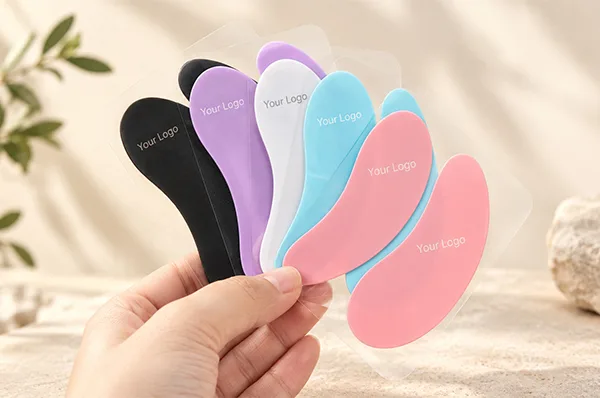
The expectation from beauty brands, skincare products, wholesalers and other buyers of bulk silicone under eye patches is to receive units that meet the same standards of quality. It may happen that a sample patch is perfect in all terms, including performance, but challenges start arising when a company starts mass production of silicone under eye patches.
Consistency of the products is an important issue for businesses since it impacts customer satisfaction, product reviews, supplier relationships and other issues related to sales of beauty products.
Let us assume that you received 10,000 units of a reusable silicone under eye patches for your private label skincare products. The first few items that you examined had a perfect texture, they were soft and uniform in color (nude-pink). However, some units were hard, others had uneven edges, while some of them even varied in thickness or color. Even if the majority of units met your requirements, the inconsistency of the product can bring additional costs and risks.
This is why experienced buyers take into account the capability of the manufacturer to provide the approved item with consistent quality.
For businesses that purchase bulk silicone under eye patches, the concept of consistency is multi-faceted and includes the following aspects: physical properties, product shape, thickness, surface texture, color, weight, quality of logos, packaging and functional consistency.
B2B buyers who wish to explore OEM and ODM development opportunities for silicone products from Beaut-Lohas can learn about how manufacturers ensure consistency in their products. This information will help buyers be better prepared when it comes to writing specifications and making wholesale purchases.
This article provides insight into why product consistency is important, what causes inconsistencies in manufacturing process and how manufacturers can control quality.
1. What Do We Understand by Consistency of the Product?
Product consistency refers to the fact that the product produced in the same batch, or in different batches, stays within the set specification and operates as designed.
Consistency does not mean that each individual product will be mathematically equal to the other. In the course of manufacturing, variations are inevitable. It is about setting up tolerances and ensuring that the results of manufacturing are within the acceptable range.
In the case of reusable silicone under eye patches, the following aspects of consistency are usually involved.
Material consistency
The silicone should have consistent quality according to the set material specification, which will include hardness, flexibility, color, and other parameters.
If the formula or curing procedure changes unexpectedly, the products will feel different, although they will have the same dimensions.
Dimensional consistency
Dimensions such as length, width, thickness, curve, and edge geometry should stay within the tolerances allowed.
Dimensional inconsistencies can have an effect on the way the patches fit below the eyes and the way the customer handles them.
Appearance consistency
The final products should maintain consistency with regards to color, surface finish, transparency/opacity, and overall appearance.
Functional consistency
Products should yield similar performance with regards to flexibility, skin contact, positioning, removal, and cleaning based on the product instruction.
Branding consistency
Custom logos, molding, and printed graphics should remain legible, positioned properly, and maintain consistency.
Package consistency
Individual packages, package boxes, instruction cards, labels, and cartons should conform to the approved package specification.
In the case of B2B purchases, these features should be defined prior to mass production. Absence of a defined package specification will cause both the buyer and the manufacturer to have different perceptions of acceptable quality levels.
2. Reasons for Maintaining Product Consistency when Processing Bulk Order
Small manufacturing variances become amplified in bulk production.
Whereas one minor defect in one product may go unnoticed, the same defect in hundreds or thousands of products becomes an important business problem.
Ensuring good brand image
Products belonging to one brand should be uniform.
Whereas one product may feel soft and flexible, but the other product of the same type will feel stiffer, consumers will have doubts regarding quality of all products belonging to this brand.
It is especially critical for beauty brands which emphasize reusable under eye patches as a high-end skincare accessory.
Avoiding customer complains and returns
Any inconsistencies in dimensions, rough edges, unwanted stickiness, or color variations can lead to negative comments from customers.
Whereas for retailers and online stores complains may result into products’ return or increased customer service work, it also affects the product rating.
Facilitating wholesale sales
Wholesalers and distributors typically provide several retailers with the same products.
Whereas quality of products shipped in different batches will differ significantly, distributors will have to do more quality checks themselves or deal with complains from their own clients.
Better production planning
Standardized items are simpler to check, pack, label, store, and ship.
Good manufacturing can also help customers in their planning and ordering of the items.
Ensuring healthy margins
Pricing is not the sole element that contributes to the total cost of purchasing.
Some other costs could be incurred through the processes of checking again, sorting out, sending replacement, labeling, repacking, and delayed release in the market.
In such a case, a supplier with a little higher pricing might be more economical because of its process.
In this regard, large volume purchasers need to look at total sourcing cost rather than unit price alone.
3. The Key Quality Variables for Bulk Silicone Eye Patches
Not all quality variables have the same significance in terms of commercial success. Buyers need to recognize the key variables that will affect performance and consumer perceptions.
| Quality Variable | Potential Problem | Business Impact |
|---|---|---|
| Silicone hardness | Different flexibility or tactile feel | Inconsistent user experience |
| Thickness | Uneven fit or handling | Product complaints |
| Shape and curvature | Poor alignment under the eyes | Reduced comfort |
| Color | Differences between units or batches | Brand presentation issues |
| Surface finish | Uneven gloss, texture, or tackiness | Appearance and performance concerns |
| Edge quality | Flash, roughness, or uneven trimming | Comfort and quality complaints |
| Logo placement | Misaligned or unclear branding | Reduced perceived quality |
| Packaging | Incorrect labels or damaged cases | Fulfillment and retail issues |
The significance of these variables will depend upon the product design.
As an example, transparent silicone patches might require special attention during visual inspections since any defects can easily be observed under bright lights. Colored silicone patches may require controls to ensure color uniformity from different manufacturing batches.
Manufacturers and buyers need to establish critical to quality variables prior to placing the order.
4. Impact of Silicone Material Differences on Product Consistency
Selection of the right material is one of the fundamentals of silicone under-eye patch manufacturing that ensures product consistency.
Various silicone formulations may vary by hardness, elasticity, tear resistance, curing behavior, and surface properties.
While two materials might be described using similar general names, their performance can be very different.
Control material specification
The buyers should ask for a well-defined material specification instead of depending on descriptions like “soft silicone” or “premium silicone”.
Depending on the product, it may include:
- Material type and approved formulation
- Desired hardness and its measurement method
- Color or translucency requirements
- Relevant mechanical properties
- Chemical or regulatory requirements
- Supplier and batch information
Material requirements specific to the product should take into account the intended use and the markets where the product will be sold.
Control material traceability
Manufacturers should be able to link material batches to production batches where the materials have been used.
It allows investigating quality problems and determining whether the issue is related to the material, processing conditions, mold, or any other factor of production.
Storage of materials
Storage conditions, shelf-life, material handling, and preparation shall be carried out in accordance with the material manufacturer’s specifications.
Improper handling will make it harder to achieve consistent manufacturing results.
The importance of material traceability for bulk customers becomes crucial when purchasing the same material on a repeated basis.
5. Importance of Mold Accuracy in Maintaining Dimensional Consistency
The mold is an essential part of the tool which determines the shape and dimensions of silicone under eye patches.
A good mold design assists the manufacturer in achieving the right product geometry. Even then, a good mold must be maintained and controlled along with proper inspection.
Sources of variations can be as follows:
- Wear/damage to the mold
- Variations in mold temperature
- Uneven distribution of material
- Inadequate venting
- Formation of flash
- Damage during demolding
- Varying conditions of molding
- Difference in mold cavities
Establish tolerances for dimensions
Buyers need to determine important dimensions from the approved technical drawing.
Important dimensions can be total length, width, thickness at particular points, curvature, edges, and logo dimensions.
All dimensions do not require similar tolerance. A dimension that affects the functionality of the product can require tighter tolerance as compared to a decorative one.
The right tolerance can be determined based on the geometry of the product, material properties, manufacturing capability and product performance.
Measure at multiple points
Length and width alone may not help identify any variations in thickness or curvature.
Manufacturers must define measuring points and employ proper measuring techniques.
Mold maintenance
Inspection and maintenance of molds contribute to preventing any progressive deterioration in the appearance and size of products.
If large-volume orders will be supplied repeatedly, then mold maintenance must become an integral part of the production control process at the supplier’s side.
6. Influence of Surface Finish and Color on Consistency
This criterion is especially significant when we speak about cosmetic accessories since the customer makes conclusions about quality of products based on the product picture, packing and other aspects of its appearance.
Consistent product means that both parties agreed surface finish and color should be retained throughout the entire order.
Surface finish
The surface that touches the skin and outer one might have different requirements.
It can require smooth finish, and the outside can feature another type of texture or logo.
The manufacturer should look for:
- Scratches and other visible marks
- Difference in gloss
- Texture variations
- Flashing
- Edge problems
- Bubbles and contamination
- Different surface tackiness
Golden sample should determine the appearance of approved products.
Color Matching
Custom colors can be chosen by using a Pantone color chart, a color reference, or another color standard.
But only having a color reference does not ensure an exact color match every time. Silicone formulation, colorants, processing, lighting, and the method of color evaluation can influence color perception.
This is why both buyer and seller must establish the color reference, allowable difference, and color evaluation conditions.
Transparency/Optical Density
Translucent, transparent, and opaque silicone goods should be examined under uniform lighting and examination conditions.
Color differences that may look insignificant in one environment can appear noticeable when photographed for use in product images in online sales channels.
In this way, transparency and opacity controls play a role in the consistent representation of the brand product line.
7. The Importance of Process Control in Mass Manufacturing
Not only raw materials and precision molds but also process control is needed.
Silicone molding is a multi-factor process that includes such parameters as material conditioning, mold temperature, curing conditions, molding pressure (when used), cycle time, and demolding.
The precise process control depends on the composition of silicone used and the manufacturing process itself.
Standards operating procedure
There should be a documented standards operating procedure indicating the way the product is manufactured and specifying the parameters to be controlled.
The standards operating procedure should indicate approved process ranges and specify actions to take when any parameter goes out of range.
First piece approval
Before continuing production in full scale, the manufacturer should examine the initial pieces and make sure that they comply with the approved process.
This is especially true after changes in mold, maintenance works, material, and process changes.
In-process inspections
Inspections carried out periodically during the manufacturing process will detect deviations before the entire batch is affected.
For instance, if there are surface defects in the output after changing a process parameter, in-process inspections can reduce the affected amount.
Process documentation
Documentation during the manufacturing process will make it easy to track the source of the problem as a particular shift, equipment, mold, material batch, or process condition.
For repeat business from B2B customers, this kind of process discipline could be an essential measure of reliability of the supplier.
8. How Quality Control Minimizes Risk of Bulk Orders
The manufacturing process itself should incorporate quality control instead of just carrying out the final inspection.
An appropriate plan for controlling quality for silicone under eye patches can consist of incoming material inspection, first-piece inspection, in-process inspection, final inspection, and packaging inspection.
Incoming material inspection
The factory inspects the incoming material according to the approved specification and supporting documentation.
This could involve the identification of the material, batch number, color, and other necessary characteristics.
In-process inspection
Production employees inspect products at certain intervals to discover any discrepancies in size, appearance, or process.
Final inspection
The finished products are inspected according to the established product specification and inspection criteria.
It could involve dimensions, appearance, surface condition, functional testing, and the quantity of the products.
Packaging inspection
The last stage ensures that the right products, labels, inserts, boxes, and cartons are applied.
Mistakes in packaging could cause serious trouble even in the case of the perfectly compliant patches.
Define the acceptance criteria
The buyer and supplier must define defects, inspection procedures, sample plans, and acceptance criteria prior to production.
While AQL sampling can work for certain orders, AQL does not mean that all units are free from defects. AQL is one element of an accepted acceptance sampling plan.
Safety or regulatory requirements must not be substituted with a generic inspection process or just an AQL number.
9. How to Compare Samples With Products Mass Produced
One of the most frequent errors in sourcing is that of approving a sample without determining how it will serve as a production sample.
A sample proves what the supplier can do within certain conditions. The mere sample does not assure that the supplier is capable of replicating such quality on mass scale.
Approve production sample
In any case, it is recommended to examine samples produced using actual material, actual mold, actual production and finishing processes.
An artisan sample could be good for shape evaluation, but not for production.
Golden sample creation
Approved golden sample must be kept by all parties involved or handled by another method with an approved procedure in place.
It should be linked to corresponding drawing, material specification, color reference, logo and packaging specification.
Systematically compare samples
Comparison check list could be made up of:
- General shape and size
- Thickness at certain points
- Hardness and feel
- Color and transparency
- Surface finish
- Edge finish
- Position and visibility of logo
- Functionality
- Packaging information
Reapproval of major changes
Any changes in material, formula, mold, texture, color or processing can impact the end product.
Suppliers must inform buyers about any material change that impacts the agreed upon specifications of the product and get approval when necessary from the purchasing agreement.
This will eliminate the chance of getting the product which is technically similar to the sample but looks or feels quite different.
10. Ensuring Consistency Over Repeated Orders
Consistency is critical for a product when customers keep ordering the same silicone under eye patches over an extended period.
There may be many batches of the same product made using various materials and processes.
Without sufficient documentation, minor variations could accumulate over time.
Use consistent product specifications
Each repeated order should refer to the same approved product specification and version.
Such a specification should outline the relevant dimensions, material specifications, surface finish, color, logo, packaging, and inspection requirements.
Manage versions
In case the customer requires a different color, changed shape, modified logo, or different packaging, make sure that these changes are accounted for in documentation.
It ensures that old versions of the specification are not used by mistake.
Manage batch information
Batch production and material information will help trace any patterns if there are defects.
For instance, if a few orders reveal the same surface problems, one could investigate if there is a common batch of materials, mold, or process.
Evaluation of supplier performance
Buyers can assess for repeat orders:
- Defect rates and rejection rates
- Delivery punctuality
- Consequences of retesting
- Number of complaints
- Efficacy of corrective action
- Uniformity of deliveries
These criteria will show whether the supplier can assist the company’s further development or only perform one good order.
11. The Most Common Reasons for Variations in Bulk Orders
Knowing what the most common reasons for variations are, helps buyers ask more specific questions prior to manufacturing the product.
| Common Cause | Possible Result | Recommended Control |
|---|---|---|
| Material substitution | Different feel or mechanical properties | Approved material specification and change control |
| Mold wear | Dimensional or appearance differences | Preventive mold maintenance |
| Unstable curing conditions | Variation in finished-product properties | Process monitoring and documented settings |
| Poor color control | Differences between batches | Approved color standard and controlled inspection |
| Inconsistent trimming | Uneven edges or visible flash | Standardized finishing and edge inspection |
| Unclear sample approval | Disputes over acceptable quality | Golden sample and signed specifications |
| Weak in-process checks | Large quantities of defective products | Defined inspection frequency |
| Inadequate packaging checks | Wrong labels or damaged products | Packaging verification before shipment |
Such problems are not exclusive to silicone under-eye patches. This problem is common to any molded consumer goods, when there are no sufficient specifications, process controls, or communication from the supplier.
The best way to deal with the issue is to have a prevention-oriented quality system.
12. How a B2B Buyer Can Evaluate a Silicone Under Eye Patch Manufacturer
In the comparison of suppliers, the manufacturing capabilities should be considered, along with pricing, communication, and logistics.
When evaluating a supplier, the following issues should be considered.
Manufacturing capabilities
Questions about the supplier’s experience in silicone molding, molds making, colors customization, finishing options, and repeat orders should be asked.
Experience in producing similar products is typically more valuable than the experience related to the size of the factory.
Quality management
Questions should be asked about managing material traceability, first-piece approval, inspection process during the manufacturing process, final inspection, management of nonconformities, and corrective actions.
Documents should be requested when necessary.
Customization capability
For projects with private labeling, confirmation that the manufacturer is able to customize shapes, logo, colors, packaging and other customizations should be obtained from the supplier.
The supplier should explain how design changes are being evaluated and approved.
Communication and change control
The supplier should inform the buyer about problems that could affect specifications, delivery, or quality of the product.
Procedures for changes approval should be clarified by the buyer.
Repeat order ability
Inquire about how the supplier is able to align future batches with the first one that was approved by you.
This should include the process of specifications, material control, mold management, production, and inspection procedures rather than just an assurance that they will keep up the quality.
At Beaut-Lohas, foreign clients have the opportunity to consult on OEM/ODM development of silicone beauty products, as well as the product design and its packaging. Consistency standards should be communicated to the buyer early on.
13. Checklist for a Bulk Silicone Under Eye Patches Order
When a bulk silicone under eye patch order is placed, the buyer may employ this checklist as follows.
Product Specifications
- Product Drawing and Dimensions Approved
- Requirements Regarding Silicone Material and Hardness Established
- Product Surface Finish and Color Confirmed
- Product Logo Design and Location Approved
- Packaging and Labeling Specified
Sample Approval
- Production Sample Tested
- Golden Sample Approved
- Product Performance Checked
- Tolerances Defined
- Significant Changes Approved
Production & Quality Control
- Material Traceability Confirmed
- Process for Mold Maintenance Reviewed
- First Piece Approval Required
- In Process Inspections Defined
- Criteria for Final Inspection Agreed on
- Defect Classification & Sampling Plan Defined
Shipping
- Correct Product and Quantity Verified
- Packaging Inspected
- Product Batch Identification Recorded If Applicable
- Inspection Documentation Reviewed
- Documentation for Shipping Inspected
This checklist is easily adaptable based on order quantity, complexity of the product, and quality requirements of the buyer.
14. Frequently Asked Questions
Why is consistency an essential requirement for bulk silicone under eye patches?
Product consistency ensures a consistent customer experience, avoids reputational risks to the brand, minimizes unnecessary re-inspection and returns, and facilitates ordering. Consistency becomes especially important for brands when products are marketed under one brand name through several sales channels.
How do I ensure that the bulk items will be similar to the approved sample?
Approve a representative production sample, create a gold sample, determine material and dimensional specifications, and define surface, color, functional, and package requirements. In-process and final inspections can help you confirm the compliance.
What quality requirements should I ask a silicone under eye patch manufacturer to meet?
It depends on the specific product and its destination. Consumers need to set up acceptance criteria for each item and ask the supplier to provide necessary materials documentation. One standard does not prove everything.
Does AQL check suffice for a bulk order?
No. AQL checks may help make acceptance decisions based on a predetermined sampling scheme; however, they cannot ensure defect-free products. It is necessary to use specification criteria, proper controls and testing.
Can custom colors affect consistency?
Yes. Selection of dyes, materials, manufacturing processes, lighting used in inspections are all factors that can affect color perception. It is recommended to use an authorized color reference.
How can I minimize defects in repeated orders?
It is necessary to have controlled specifications, maintain authorized reference samples, obtain approval for any change, keep a batch tracking system and evaluate supplier performance after each order. One needs to investigate recurring defects, rather than just sorting or exchanging defective units.
What questions should I ask before placing a wholesale order?
How does the supplier control batch material, sizes, surface quality, color, molds, in-process inspection, final acceptance, packing and changes of authorized specifications?
Conclusion: Consistency Is a Sourcing Strength in the Long Run
For beauty brands, wholesalers, and distributors, product consistency is one of the most important factors when purchasing bulk silicone under eye patches.
It is crucial to have a good quote and sample at the initial stage, but it does not mean that the producer will be able to ensure consistent mass production. One should choose the company which can control the material characteristics, mold precision, surface finish, color, size, branding, packaging, and inspection results.
The best way would be to set requirements prior to manufacturing, agree on a sample, set a golden sample, track the manufacturing process, and keep the traceability during repeat orders.
For those who create their own private label products, such measures can help to avoid unnecessary quality issues.
The development of silicone products for beauty is done using OEM/ODM solutions at Beaut-Lohas, which include product design, branding, and packaging. Discussing the quality demands early in the developmental stages will help to create a much more dependable basis for bulk purchase and cooperation.
If you need to buy silicone under eye patches for your beauty company, wholesale business, or distribution scheme, ensure that product consistency becomes a requirement.