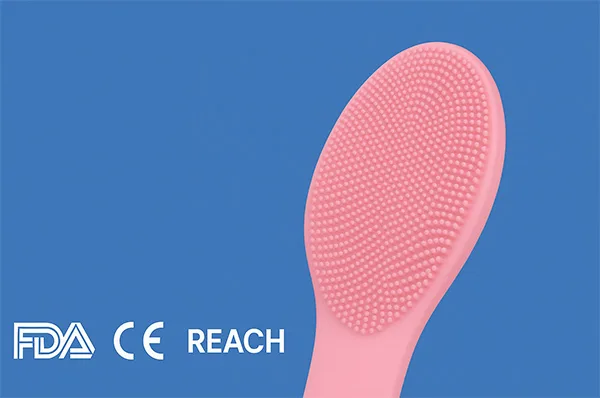
Silicone Face Scrubbers
The silicone face scrubbers have not only become an accessory of the day but the most popular beauty tool in the personal care market, particularly among users who look for deep cleansing of the face, exfoliation, and hygienic options to conventional nylon brushes. For the brands and private-label buyers, who intend to import and sell silicone face scrubbers in the USA and Europe, knowing the regulatory requirements is a must. Certification is a legal requirement, but also it plays a role in the retailer acceptance, customer trust, advertising compliance, and safeguarding against product recalls or legal disputes.
Thus, this article describes the main certifications, testing procedures, and compliance standards that silicone face scrubbers need in the U.S. and European markets, thus assisting B2B buyers, brand owners, distributors, and Amazon sellers to maneuver through the regulatory maze with assurance.
1. Why Certification Matters for Silicone Face Scrubbers
If we divide the silicone face scrubbers into two categories that are skincare devices and cosmetic tools, their classification will be determined according to the market and hand in the case of the specific design. Although they are not subjected to the same rigorous regulations medical devices have, still they are required to comply with chemical safety laws, labeling standards and -if electrical or motorized- additional electronic safety rules.
Certification ensures:
Legal eligibility for entry into the market
Compliance with material safety requirements
Retail or marketplace approval (e.g., Amazon, Sephora, Target)
Reduced risk of product complaints or liability claims
Consumer trust and competitiveness in a crowded market
2. Required U.S. Certifications
The regulations that apply in the U.S. depend on whether the silicone face scrubber contains electronics. Below is a breakdown of both non-electronic and motorized product compliance requirements.
2.1 FDA Regulations (Food & Drug Administration)
A basic silicone face scrubber without vibration or medical claims (e.g., “cleans pores” or “exfoliates”) is not typically classified as a medical device and therefore does not require FDA approval.
However, FDA oversight may apply if the brand:
Markets the scrubber as treating medical conditions such as acne, dermatitis, or rosacea
Adds microcurrents or advanced functions that cross into “therapeutic” use
Sells the product as a medical-grade instrument
While FDA registration is not mandatory for most silicone scrubbers, compliance with the U.S. FDA Food-Grade Silicone Requirements (21 CFR 177.2600) is widely recommended, especially for products that contact human skin.
2.2 CPSIA (Consumer Product Safety Improvement Act)
If the product is marketed to children (e.g., bath scrubbers suitable for youth), CPSIA applies. Required testing includes:
Lead content
Phthalates
Material safety
Tracking labels
Products intended for adults typically do not require CPSIA testing, but many retailers still expect voluntary test reports.
2.3 ASTM Testing (Recommended for Safety)
ASTM testing is not legally mandatory for cosmetic tools but may apply for consumer safety, durability, or packaging claims. Common test standards include:
ASTM D2240 – Silicone hardness (Shore A)
ASTM D412 – Tensile strength and tear resistance
ASTM D1149 – Anti-aging resistance
Retail buyers, especially chain stores, may request ASTM data during supplier qualification.
2.4 FCC Certification (Motorized Scrubbers Only)
If the face scrubber includes a motor, battery, or electrical components, FCC testing is mandatory before selling in the U.S. This ensures the device does not cause electromagnetic interference.
FCC applies to:
Sonic scrubbers
Electric vibration cleansing brushes
USB rechargeable devices
Both FCC ID and FCC Supplier’s Declaration of Conformity (SDoC) may be needed.
3. Required Certifications for Europe
Europe has a more centralized regulatory system than the U.S. Most silicone face scrubbers require compliance with material safety laws and proper labeling before being sold.
3.1 REACH (Mandatory for Chemical Safety)
REACH (Registration, Evaluation, Authorization, and Restriction of Chemicals) is the most important regulation for selling silicone face scrubbers in Europe. It ensures the product does not contain harmful chemicals such as:
SVHCs (Substances of Very High Concern)
Carcinogens
Reproductive toxins
Heavy metals
Harmful plasticizers
Every face scrubber imported into Europe must pass REACH testing or have a valid declaration of compliance.
3.2 RoHS (For Electronic Silicone Scrubbers Only)
RoHS applies if the silicone face scrubber contains electronic parts. It restricts hazardous substances such as:
Lead
Cadmium
Mercury
Hexavalent chromium
Brominated flame retardants (PBB, PBDE)
RoHS is mandatory for:
Motorized cleansing brushes
USB rechargeable units
LED skincare tools
RoHS certification is often paired with EMC and LVD under CE marking.
3.3 CE Marking (Motorized Products Only)
Non-electronic silicone scrubbers do not require CE marking, but devices with electronics must meet:
EMC (Electromagnetic Compatibility Directive)
LVD (Low Voltage Directive)
RoHS
After passing these, the product must:
Carry the CE logo
Include a Declaration of Conformity
Maintain a technical file for inspection
Failing CE compliance can lead to customs seizure or sales bans in EU states.
3.4 Cosmetics and Skin Contact Compliance
Although silicone face scrubbers are not cosmetics, they require compliance with surface safety and labeling standards such as:
General Product Safety Directive (GPSD)
Skin sensitivity testing
Usage and warning labeling
Retailers like DM, Boots, and Douglas may request biocompatibility testing such as:
ISO 10993-5 (cytotoxicity)
ISO 10993-10 (skin irritation)
This is increasingly common as European consumers demand hypoallergenic products.
4. Voluntary Certifications That Improve Market Acceptance
Although not mandatory, the following certifications make the product more attractive to premium retailers and eco-focused brands:
BPA-free declaration
Vegan + cruelty-free logos
ISO 9001 or GMP factory certification
SGS / Intertek / TÜV test reports
Biodegradable or sustainability documentation
These certifications help achieve stronger product positioning and better consumer perception.
5. Documentation Required for Import and Retail
To avoid customs delays or marketplace rejection, silicone face scrubbers should be supported with the following documents:
For the U.S.
FDA material compliance declarations
CPSIA documents (if applicable)
FCC certificates for motorized products
Material safety data sheets (MSDS)
For Europe
REACH test report (mandatory)
RoHS / CE documents (if electronic)
Technical file and labeling compliance
Safety data sheets
Meeting document requirements is often as important as the testing itself.
6. What Happens If the Product Is Not Certified?
Failure to comply may result in:
Customs seizure or rejection
Marketplace delisting (Amazon, Walmart, etc.)
Retailer refusal
Legal penalties or fines
Mandatory recalls or destruction
For this reason, most large buyers require compliance before shipment—not after.
Conclusion
Selling silicone face scrubbers in the U.S. and Europe necessitated an exhaustive knowledge of regulatory requirements. Non-electronic scrubbers primarily needed compliance with FDA materials, REACH testing, and correct labeling, whereas motorized products had to satisfy FCC in the U.S. and CE-related directives in Europe as well. Getting the relevant certifications not only opens the door to the legal market but also enhances the brand’s credibility, access to retailers, and consumer trust. Collaborating with manufacturers with extensive experience in international compliance, companies can reduce their risks, speed up the launching of their products, and expand in worldwide markets with assurance.