- Have any questions?
- +86 19574832024
- admin@beaut-lohas.com

Body Scrubber Distributors
In the personal care and hygiene industry, competition is intense. Distributors face an ongoing challenge: finding products that are not only in demand but also strong enough to compete in the local market. One category that has seen a steady rise in popularity in recent years is the silicone body scrubber. Compared with traditional loofahs or sponges, silicone scrubbers are promoted as more hygienic, longer-lasting, and eco-friendly.
However, not every silicone body scrubber will perform equally well in every local market. For distributors, the key is to evaluate the competitiveness of the product before committing to large orders. This ensures that investment in inventory and marketing yields maximum returns.
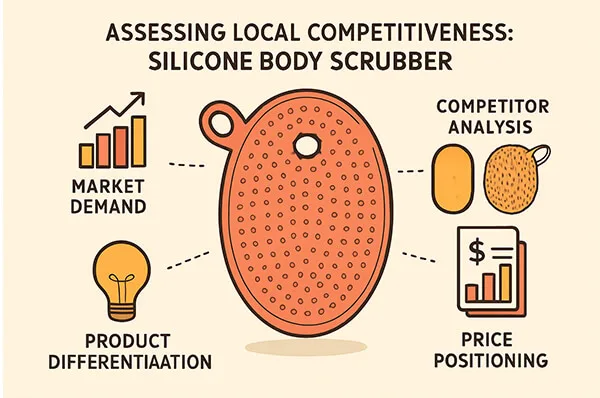
Below, we will explore a systematic approach to judging a product’s competitiveness, with silicone body scrubbers as our working example.
1. Understanding the Local Market Context
Before looking at the product itself, distributors must first map the local market landscape. This involves answering a few fundamental questions:
-
Who are the consumers? Identify whether your target demographic is mainly urban or rural, younger or older, budget-focused or premium-oriented.
-
What are the current bathing or skincare habits? In some regions, exfoliation tools are an everyday necessity; in others, they may be considered a luxury or even unnecessary.
-
What’s the purchasing channel? Determine whether your customers prefer to buy personal care items in physical stores, supermarkets, beauty salons, or online platforms.
Example: In a city with a younger, health-conscious population that is highly active on e-commerce platforms, a silicone body scrubber might have higher adoption rates, especially if promoted with eco-friendly and hygienic benefits.
2. Competitor Analysis: Who Else Is Selling It?
A core part of determining competitiveness is mapping out direct and indirect competition.
-
Direct competitors: Other silicone body scrubber brands selling similar designs, price ranges, and functions.
-
Indirect competitors: Products that serve the same need (exfoliation, cleansing), such as natural loofahs, nylon brushes, or even electronic exfoliation devices.
Steps to analyze competition:
-
Visit local retail stores and see which body scrubbers are stocked.
-
Check online marketplaces (Amazon, Lazada, Shopee, local equivalents) for top-selling and top-rated products in the category.
-
Note price ranges and promotional tactics used by competitors.
Example: If most silicone scrubbers in your area are sold at $6–$8 with basic packaging, introducing a premium model priced at $15 may require strong differentiation (e.g., a patented design, ergonomic handle, built-in liquid dispenser).
3. Product Differentiation: Is It Truly Unique?
One of the most decisive factors in competitiveness is differentiation. If your silicone body scrubber looks, feels, and functions exactly like the five other brands on the shelf, it becomes a price war — and distributors often lose profit margins in such situations.
Key aspects to evaluate:
-
Design innovation: Ergonomic handle, double-sided texture, built-in soap dispenser, or adjustable strap.
-
Material quality: Food-grade silicone, higher density bristles, heat resistance, or antibacterial properties.
-
Brand story: Eco-friendliness, sustainable sourcing, or charity-linked campaigns.
Example: Two silicone scrubbers may cost the same, but one with a dual-texture surface (soft side for sensitive skin, firm side for exfoliation) could stand out in marketing.
4. Price Positioning and Value Perception
Price is not just about affordability — it is about value perception. Even if your product costs slightly more, customers will often pay extra if they believe they are getting more value.
When determining price competitiveness, consider:
-
Cost-to-value ratio: How much better is the product than cheaper options?
-
Psychological pricing: Does pricing at $9.99 feel more accessible than $10?
-
Bundling opportunities: Offering two scrubbers in a set can increase perceived value.
Example: If local markets have low-cost, generic silicone scrubbers at $5, you could position yours at $8 but highlight features like “premium food-grade silicone” and “lasts 3x longer than loofahs.”
5. Distribution Channel Strength
Even the best product can fail if it is not present in the right channels. Distributors should assess how easily and effectively the product can reach target consumers.
-
Offline: Is it suitable for supermarkets, pharmacies, beauty supply stores, or spas?
-
Online: Can it be promoted effectively through e-commerce platforms, social media, and influencer marketing?
-
Hybrid: Combination of both, supported by seasonal promotions and events.
Example: In regions where online shopping is booming, offering your silicone scrubber through popular e-commerce platforms with free shipping could outcompete brands that rely only on in-store presence.
6. Marketing Potential and Storytelling
Competitiveness is often shaped by how well you can market the product. For silicone body scrubbers, storytelling is powerful:
-
Hygiene factor: Unlike loofahs that harbor bacteria, silicone dries faster and stays clean longer.
-
Eco-conscious appeal: Long-lasting, reducing waste compared to disposable sponges.
-
Wellness positioning: Promotes healthy, smooth skin without harsh chemicals.
Example: A social media campaign showing a side-by-side “30-day comparison” of a used loofah and a used silicone scrubber could visually drive home the hygiene benefits.
7. Regulatory Compliance and Safety Standards
In many markets, personal care products — even non-electric tools — must meet material safety standards.
-
Check for certifications: BPA-free, FDA-approved silicone, or local consumer safety approvals.
-
Labeling requirements: Clear instructions, material description, and care tips in the local language.
Example: A distributor who imports silicone body scrubbers with verified certifications can use “Certified Safe Material” as a marketing advantage over uncertified products.
8. Long-Term Market Potential
Some products experience short-lived trends, while others enjoy consistent demand. Assess whether silicone body scrubbers are a sustainable category in your local market:
-
Is personal hygiene a growing focus in your region?
-
Are consumers becoming more aware of skincare routines?
-
Are eco-friendly and reusable products gaining popularity?
If yes, the silicone body scrubber has a strong chance of remaining competitive over time.
Conclusion: A Holistic Competitiveness Check
To judge the competitiveness of a silicone body scrubber — or any body scrubber — in your local market, distributors must look beyond the product’s basic features. A holistic evaluation covers:
-
Market demand and consumer habits
-
Competitor presence and positioning
-
Product uniqueness and differentiation
-
Price-to-value balance
-
Distribution network suitability
-
Marketing and branding potential
-
Regulatory compliance
-
Long-term trend sustainability
When these factors align in your favor, the product is far more likely to succeed. In the case of silicone body scrubbers, the combination of hygiene, durability, and eco-friendliness offers a strong foundation — but only if it is matched with smart pricing, effective storytelling, and local market alignment.
For distributors, the process may require extra research and effort, but the payoff is clear: a competitive product that wins shelf space, attracts customers, and delivers lasting profitability.