- Have any questions?
- +86 19574832024
- admin@beaut-lohas.com

Silicone Body Scrubbers
Silicone body scrubbers have gone from being a niche novelty to a mainstream bath accessory in Western markets. Concerns about hygiene and the multifunctional self-care rituals drove the trend to a certain extent, along with the growth of e-commerce. The end result was that silicone scrubbers were regarded as a viable alternative to traditional loofahs and sponges. Market reports and consumer studies consider the constant development of the category as well as changing buyer expectations to be the main reasons for this trend that B2B buyers should know about so that they can make appropriate product, packaging and go-to-market decisions.
1. Market snapshot – steady growth, widening distribution
The most recent market analyses indicate that the wider bath-tools category plus the silicone niche are growing at a mid-single-digit CAGR because of consumers’ preference for exfoliation and hygienic materials. Market intelligence companies foresee the silicone body scrubber segment growing rapidly along with digital sales channels and private-label demand. Greater part of North American demand is attributed to the high personal-care spending per-capita and the established penetration of e-commerce. Europe is not far behind, especially in the cases of Northern and Western Europe, where the concepts of fashionable cleanliness and negligible-waste have a powerful attraction.
B2B takeaway: Look for SKUs that can be increased in scale and guarantee the supply chain’s flexibility — buyers who secure reliable OEM capacity early can take advantage of seasonal increases and private-label opportunities.
2. Hygiene, durability and “cleanability” are the major reasons for the purchase
Hygiene is at the forefront of the people’s reasoning behind the switch to silicone, as indicated by the product reviews and editorial coverage: non-porous silicone dries faster, is resistant to mold, and can be easily cleaned.Top-selling items and product stories that are mostly talked about in the biggest retail markets state that durability and little care involved are the main reasons for purchase. Customers, on the other hand, are more likely to mention ‘no smell / easy to clean’ and long-lasting compared to sponge alternatives as the main reasons.
B2B implication: make sure the material specifications are validated (LFGB/FDA/REACH where necessary) and provide detailed care instructions on the product pages — this practice leads to lower returns and higher trust.
3. Multifunctionality and wellness positioning are the major reasons for premiumization
Consumers are more willing to pay for products that serve more than one purpose: double-sided scrubbers (fleecy side for delicate areas, harder side for peeling), built-in scalp massagers, and body scrubbers that also allow dry-brushing practices are becoming very popular. Euromonitor and other consumer research reports indicate that the whole wellness concept is gaining popularity — consumers are buying tools that guarantee healthiness, relaxation, and good skin qualities. Those who express their effectiveness (i.e., better blood circulation, smoother skin) and the corresponding lifestyle advantages can get a price that is significantly higher than their cost.
B2B implication: allocate SKUs differentiating by function (two textures, ergonomic handles, combos with oils or scrubs) and experiment with premium packages for DTC and retail channels.
4. Sustainability narratives — nuanced but important
Consumer perception places “Silicone” between the two categories of plastics and naturals. Even though the material can’t be decomposed like the latter, on the other hand, its durability and less frequent replacement can be highlighted as an eco-friendly feature, that is, less waste over time due to fewer exchanges. Clean beauty, on the other hand, and transparency in the areas of materials, manufacturing and end-of-life, remain the key drivers in both Europe and North America. The companies that offer a combination of recyclable packaging, low chemical hazard (no phthalates) and durable product claims take the eco-conscious shoppers, allowing them to enjoy the market. The surveys among clean-beauty customers prove that environmental claims should be specific and verifiable.
B2B implication: provide lifecycle messaging such as “replace every X months vs. loofah every Y weeks”, use recyclable boxes, and ensure that any sustainability claims are data-based.
5. Design & tactile preferences — color, texture, and ergonomics matter
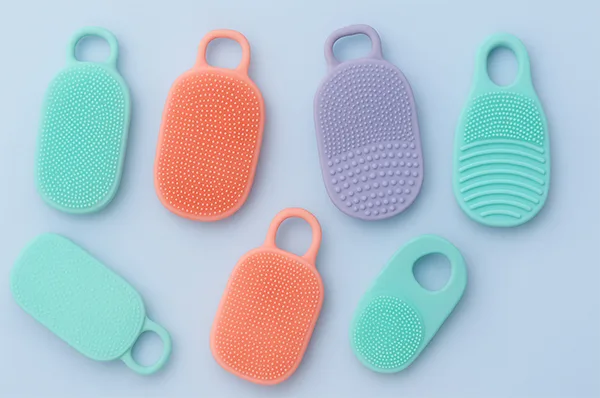
The Western markets do not see aesthetics as a secondary factor. Online selling of pastel palettes, Instagram-friendly and ergonomic shapes is very successful. Textures are engineered taking care of their length, density, and duality of surfaces. Different segments of the market are offered soft bristles for sensitive skin and denser patterns for the vigorous exfoliation. Besides, customers pay great attention to usability features—grip loops that are comfortable, hanging options, and compact sizes that are travel-friendly. In online marketplaces, products that combine “cute” design with clear performance claims tend to be rated higher and get repeat purchases.
B2B implication: when creating private-label lines, don’t just limit to one texture; offer two or three at a time and different colorways; A/B testing of hero SKUs for conversion signs before scaling.
6. Channel dynamics – e-commerce leads, but retail still significant
E-commerce (DTC, Amazon, and specialty retailers) is the main driver for silicone scrubbers. Their discoverability and mass feel are fully backed up by paid acquisition, a high number of reviews, and prompt delivery. But, retail and spa/retail partnerships are effective in establishing brand authority and generating premium sales for “wellness” and spa-grade variants. Thus, wholesale buyers should strategically plan their SKU splits for various channels – packs with a lower price for mass retail, and premium gift sets for spas and boutiques.
B2B implication:CBM suppliers to prepare for different channel-specific packaging and pricing; ensure flexibility in MOQs for retail distribution and DTC testing.
7. Price setting expectations and margin mechanics
Silicone scrubbers are offered in a range from low-priced commodity SKUs to high margin premium items. Material grade, mold complexity, dual-function features and custom packaging are the main price drivers. Consumer education is important and most buyers are willing to pay a slight price premium if performance and hygiene claims are well substantiated. Retailers and brands can still count on bundling (scrubber + body oil or scrub) as an effective method to boost average order value.
B2B implication: negotiate with the producers for tiered pricing and batch sampling to confirm the positioning before large sales.
Actionable checklist for Beaut-Lohas clients
-
Verify material certificates (LFGB/FDA/REACH) and ask for third-party lab tests.
-
Prototype 2–3 textures (soft, medium, firm) and test with target consumers.
-
Design channel-specific packaging: retail gift boxes vs. bulk e-commerce polybags.
-
Build hygiene messaging: include cleaning instructions, sanitization methods, expected lifespan.
-
Plan MOQ strategy: start with small test orders, scale to optimized MOQ for profitability.
Conclusion
In North America and Europe, silicone body scrubbers are gaining popularity from major trends — hygiene consciousness, the adoption of multiple wellness practices, and the beauty-focused online shopping. For the B2B customers, the product engineering (texture, material quality, ergonomics) supported by reliable compliance paperwork and customer-specific SKU design will determine the success. The brands that merge substantiated effectiveness, sustainability story-telling and appealing design will be the ones to take Western market demand next.
Beaut-Lohas — with experienced R&D, existing molds, and OEM/ODM capabilities — is well positioned to help brands turn these trends into market-winning product lines.