- Have any questions?
- +86 19574832024
- admin@beaut-lohas.com

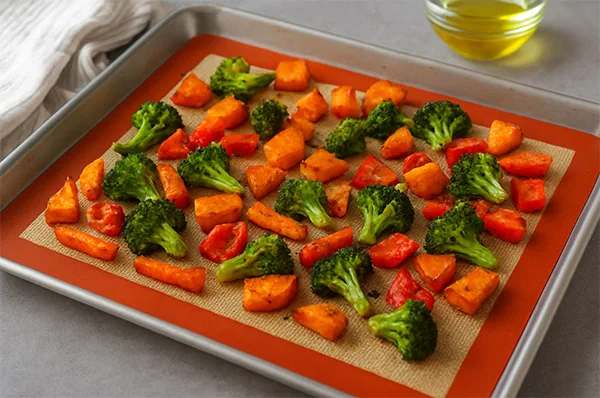
Silicone Baking Mats
If you relish roasted veggies — the crunchy and golden-brown pieces that make healthful food hard to resist — you must have been pondering whether silicone baking mats can substitute parchment paper or aluminum foil. They are, after all, the three reusable, non-stick, and eco-friendly materials. But the question still remains, are they really good for roasting veggies at high temperatures?
To put it simply, the answer is yes, silicone baking mats are suitable for roasting vegetables but only if they’re used properly. We will, in the following, delve into the performance of silicone mats under the high heat, their advantages and disadvantages, and also give you the best tips on how to bake your vegetables evenly and deliciously every single time.
1. Understanding Silicone Baking Mats
Silicone baking mats consist of food-grade silicone that is reinforced with a fiberglass mesh. The combination of these two materials gives the mat its flexibility, durability, and its ability to distribute heat uniformly. Most mats are safe for oven use at temperatures up to 480°F (250°C); thus, they can be used for a wide range of activities such as baking cookies, roasting vegetables, or even kneading dough.
The main advantage is that the surface is non-stick — veggies can be roasted with minimal or no oil at all, and cleaning up is very simple. Just like that, the mats not only help you save on the cost of buying disposable parchment paper and foil but also make you a little more environmentally friendly if you are a home cook or even a professional chef.
2. Benefits of Using Silicone Baking Mats for Roasting Vegetables
Let’s break down why so many cooks are switching to silicone mats when roasting veggies.
✅ 1. Non-Stick Performance
Silicone mats are naturally non-stick, so your vegetables won’t cling or burn onto the surface. This is especially useful for sticky or caramelized vegetables like sweet potatoes, carrots, or bell peppers. You can use less oil while still achieving great results.
✅ 2. Even Heat Distribution
The fiberglass layer within the mat helps distribute heat evenly across your baking sheet. This ensures that all your vegetables — whether on the edges or in the center — cook at the same rate, minimizing hot spots.
✅ 3. Easy Cleanup
No more scrubbing or soaking metal pans. With silicone mats, roasted residue simply wipes off with a soft sponge and warm water. The mat can be reused thousands of times, saving both money and waste.
✅ 4. Eco-Friendly and Cost-Effective
Silicone mats can last for years if properly cared for. By replacing parchment paper and aluminum foil, you reduce waste and your long-term kitchen expenses.
✅ 5. Versatility
In addition to roasting, silicone mats can handle cookies, pastries, and even freezing tasks — making them a multipurpose addition to your kitchen.
3. How to Roast Vegetables on a Silicone Baking Mat
Using silicone baking mats for roasting is simple, but technique matters if you want to achieve perfect texture and browning. Follow these steps for the best results:
🥕 Step 1: Preheat the Oven
Always preheat your oven before adding vegetables. For most veggies, the ideal roasting temperature is between 400°F (200°C) and 425°F (220°C).
🫑 Step 2: Prepare the Vegetables
Cut vegetables into evenly sized pieces so they roast uniformly. Pat them dry — excess moisture can cause steaming rather than roasting.
🫒 Step 3: Add a Light Coat of Oil
Even though silicone mats are non-stick, a small amount of oil enhances browning and flavor. Toss your vegetables with olive oil and seasoning before spreading them on the mat.
🧂 Step 4: Spread Evenly
Arrange the vegetables in a single layer. Crowding leads to steaming, which prevents crispiness. For best airflow, ensure a bit of space between each piece.
🔥 Step 5: Roast Until Golden
Roast according to your recipe — typically 20–35 minutes depending on the vegetables. Stir or flip halfway through for even browning.
🍽️ Step 6: Cool and Clean
Once done, remove the mat from the baking tray and let it cool before washing. Use mild soap and a soft cloth — avoid abrasive scrubbers to preserve the surface.
4. Will Vegetables Get Crispy on Silicone Mats?
This is one of the most common questions. The truth is that silicone mats produce slightly less crisp results than parchment paper or direct contact with metal trays.
Why? Because silicone is a heat insulator, not a conductor. While it ensures even cooking and prevents burning, it slightly reduces surface browning since it doesn’t transfer heat as aggressively as metal.
However, this doesn’t mean you can’t achieve crisp results. Try these pro tips:
🌽 Tips for Crispier Roasted Vegetables
-
Use a higher temperature — 425°F (220°C) is ideal for golden edges.
-
Preheat the baking sheet before placing the mat and vegetables on it.
-
Avoid overcrowding — airflow is key to roasting, not steaming.
-
Pat veggies dry to remove moisture.
-
Use a little oil — it helps with caramelization.
With these adjustments, your vegetables will come out tender inside and beautifully roasted outside, even on silicone mats.
5. Comparing Silicone Mats with Other Roasting Surfaces
| Feature | Silicone Baking Mat | Parchment Paper | Aluminum Foil | Bare Metal Pan |
|---|---|---|---|---|
| Reusable | ✅ Yes (Thousands of uses) | ❌ Single-use | ⚠️ Sometimes | ✅ Yes |
| Non-stick | ✅ Excellent | ✅ Good | ⚠️ Depends on oil | ❌ Often sticky |
| Browning/Crisping | ⚠️ Moderate | ✅ Good | ✅ Very good | ✅ Excellent |
| Cleanup | ✅ Easiest | ✅ Easy | ⚠️ Messy sometimes | ❌ Requires scrubbing |
| Eco-Friendly | ✅ Yes | ❌ No | ❌ No | ✅ Yes |
| Max Temperature | ~480°F / 250°C | ~420°F / 215°C | ~500°F / 260°C | No limit |
From this comparison, it’s clear that silicone mats offer superior convenience and sustainability, though parchment or bare pans may edge out in crispness.
6. Precautions When Using Silicone Mats for Roasting
While silicone baking mats are durable, proper handling ensures longevity and safety:
-
Avoid cutting or slicing on the mat. Sharp tools can damage the silicone surface.
-
Don’t broil with a silicone mat. Broilers can exceed 500°F (260°C) and may cause the silicone to degrade.
-
Don’t expose to direct flames. Keep mats away from stovetops and grills.
-
Avoid strong oils and spices staining. Turmeric, paprika, or high-heat oils may discolor the mat over time — though this won’t affect performance.
7. Cleaning and Maintenance Tips
After roasting, allow the mat to cool completely before washing. Use warm soapy water and a soft sponge. For stubborn oil residue, soak the mat in hot water with lemon juice or vinegar for 10 minutes, then rinse.
Avoid using harsh detergents or dishwasher cycles over 60°C (140°F), as they can wear down the silicone over time. Always store the mat flat or rolled, never folded, to avoid creases.
✅ Conclusion: A Smart Choice for Everyday Roasting
Are silicone baking mats suitable for vegetables roasting? Entirely! They are a safe and mess-free option that guarantees the vegetables being roasted evenly along with the convenience of being eco-friendly. Besides, they may not create the ultra-crunchy texture of metal pans, but still, the pros — easy to clean, non-stick surface, and environmentally-friendly—are way more than the cons of this particular aspect.
In the case of silicone baking mats for regular roasting, they are an optimal combination of performance, practicality, and environmental care. As soon as you use them, you will not understand how you roasted without such a mat.
At Beaut-Lohas, quality and innovation are our top priorities. We maintain strict quality control systems throughout the production cycle and continuously invest in R&D and product design to meet the evolving needs of global markets. Our experienced engineers and designers collaborate to develop customized OEM & ODM solutions for international clients seeking unique branding and functionality.